Math · Unit 5 · Weeks 25–30
Unit 5 test: Length, time and data
25–30 min
For the grown-up
Give this test on Week 30 Day 5, after the Unit 5 Show Me game. Before the test: (1) choose a crayon, a spoon and a pencil that differ in length by at least a finger's width, line them up yourself and write their order from shortest to longest on the answer key; (2) choose two things in your home that cannot be moved next to each other, are both shorter than the 3-foot string and differ by at least a hand's width, such as the height of the couch seat and the height of the bathroom sink, and check which is longer yourself; (3) measure the book and the fork with the same paper clips and write your counts on the answer key. Have ready: the crayon, spoon, pencil, book and fork; a string about 3 feet long and child-safe scissors (you help cut); 20 same-size paper clips; and the paper plate clock. Read every item aloud. There is no clock on this test. Split it into two sittings: Parts 1 and 2 (length) one day, and Parts 3 and 4 (time and data) the next, about 12 minutes each. Do not help with the math. If your child is stuck, say only: "What is the first rule for this kind of problem?" A length counts as right if it is within 1 paper clip of your count. Score with the answers and scoring notes, add the points and find the level. Level E, or Level P with 20 or 21 points (at least 4 of every 5 right, about 80 percent: the pass mark in the test-day lesson): start Unit 6 in Week 31. Level P with 17 to 19 points, or Level A: start Week 31 and use the Week 31 warm-ups to redo the part with the most misses (Week 25 for ordering and comparing, Week 26 for measuring, Weeks 27 and 28 for time, Week 29 for data). Level D: spend 2 or 3 days on the Guided Practice from Week 26 Day 1, Week 28 Day 1 and Week 29 Day 4 before Week 31. Paper clips and the paper fastener on the clock are small parts: keep them away from children under 3.
Standards: 1.MD.A.1, 1.MD.A.2, 1.MD.B.3, 1.MD.C.4
Part 1: Compare and Order Lengths
Use the real things. Line up the ends first.
- 1.Put the crayon, the spoon and the pencil in a row from shortest to longest.
- 2.Your grown-up names two things that cannot be moved next to each other. Use the string to find out which one is longer. Then tell how the string helped.
- 3.The leash is longer than the belt. The belt is longer than the shoelace. Which one is the longest? Which one is the shortest?
Part 2: Measure With Paper Clips
Measure with paper clips that are all the same size. Start at the end. No gaps and no overlaps.
- 4.Measure the book with paper clips. Write how many paper clips long it is.
- 5.Measure the fork with paper clips. Write how many paper clips long it is.
- 6.
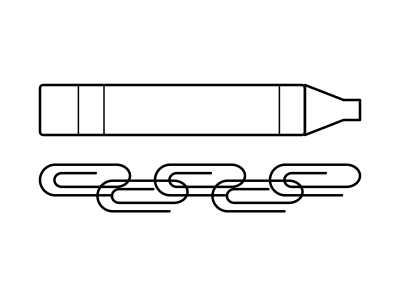 Is this a good way to measure the crayon? Tell what is wrong.
- 7.A comb is 6 paper clips long. A spoon is 4 paper clips long. Which one is longer? How many paper clips longer?
Part 3: Tell Time
Read the clocks. Write the time, circle the clock or draw the hands. Your child may use the paper plate clock.
- 8.
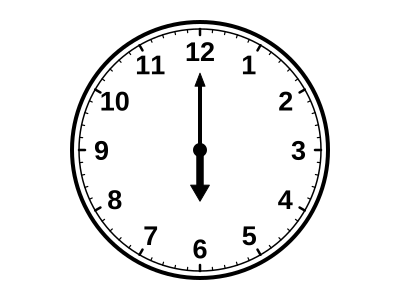 What time is it? Write it the way a digital clock shows it.
- 9.
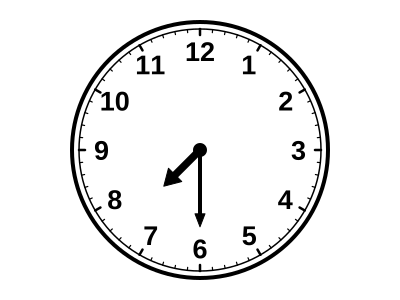 What time is it? Write it the way a digital clock shows it.
- 10.Circle the clock that shows 2:30.
- 11.
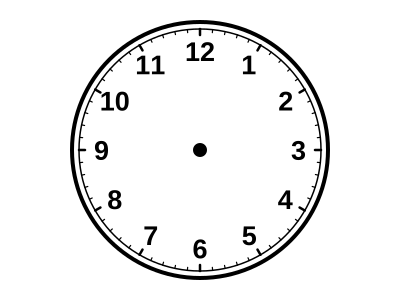 Draw the hands to show 11:00.
- 12. Draw the hands to show half past 4.
- 13.
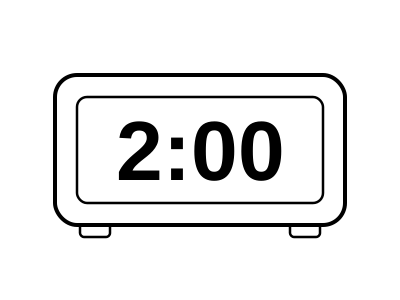 Say this time in words.
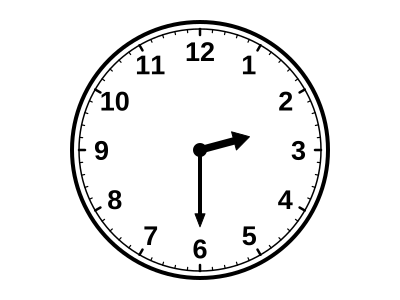
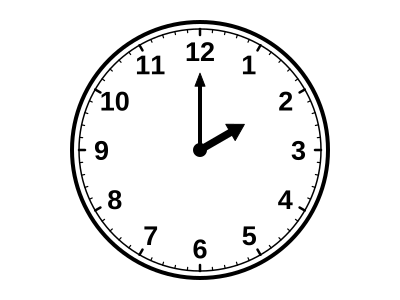
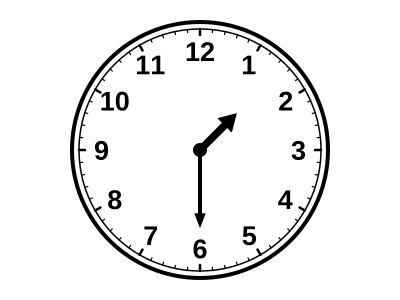
Part 4: Read a Bar Graph
Use the bar graph to answer. 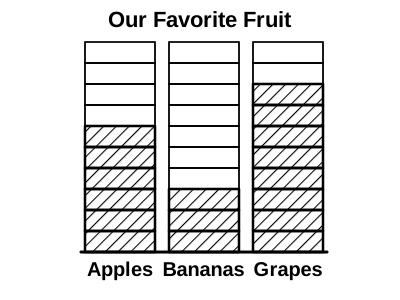
- 14.How many people chose bananas?
- 15.Which fruit got the most votes?
- 16.How many more people chose grapes than apples?
- 17.How many votes are on the graph in all?
Score and next steps
Total: 24 points.
- Exceeding: 22–24 points
- Proficient: 17–21 points
- Approaching: 12–16 points
- Developing: 0–11 points
Write the score in the Assessment & Records pages. The directions above say when to move on and when to reteach first.