Social Studies · Unit 3 · Weeks 13–18
Unit 3 test: Maps and our place in the world
20–25 min (fine to split into two sittings)
For the grown-up
This test checks what your child learned in Weeks 13–18 about maps, globes, landforms, weather and climate, kinds of communities, and how places change. Read every question, every choice and every picture note aloud; this test checks social studies thinking, not reading. Your child answers by circling, pointing, drawing or telling, and you write their words exactly. Nothing is timed. If your child tires, stop after Section 2 and do Sections 3 and 4 later. Section 1 uses the Pine Lake Park map on the test page; your child may look at it as often as they like. Have crayons ready. Items that say "Answers vary" can have more than one good answer; use the "Look for" notes. If your child is stuck, read the item again once, or offer to let them point or draw instead of telling. Do not teach or hint during the test. Add the points and find the level at the end. If your child earns less than half of the points in a section, use that section's reteach note in Week 19.
Standards: D2.Geo.2.K-2, D2.Geo.1.K-2, D2.Geo.3.K-2, D2.Geo.6.K-2, D2.Geo.4.K-2, D2.Geo.8.K-2, D2.Geo.9.K-2, D2.Geo.5.K-2, D2.Geo.7.K-2, D2.Geo.10.K-2, D2.Geo.12.K-2
Section 1: Reading and Making Maps
Look at the map together. Read each question aloud. Your child points, circles or tells.
- 1.
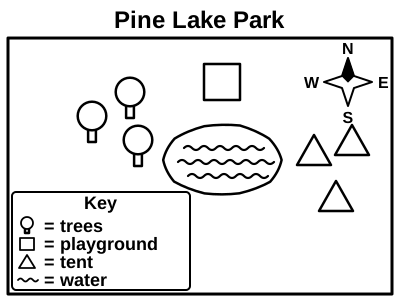 What is the title of this map?
- 2.Look at the key. What does a triangle stand for?
- a tent
- a tree
- a playground
- 3.What is north of the lake?
- 4.Are the tents east or west of the lake? Tell how you know.
- 5.Draw a map of a table with a plate and a cup on it, as a bird would see it from above. Add a key that shows what your symbols mean.
Section 2: Earth, Land and Water
Read each question aloud. Your child points, circles or tells.
- 6.On a globe, what does most of the blue show?
- water (oceans)
- land
- roads
- 7.Put these places in order from smallest to biggest: our country, our town, our state.
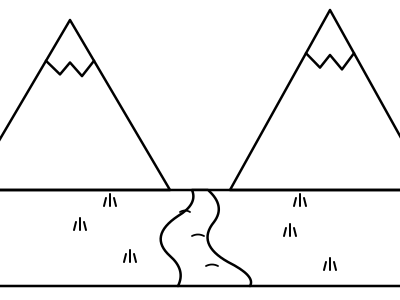
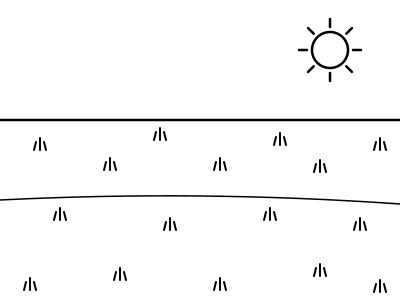
- 8.Name each landform.
Section 3: How Land and Weather Shape How People Live
Read each question aloud. Your child circles or tells.
- 9.A family lives where summers are very hot and dry. Circle what they would most likely need.
- a fan or air conditioner
- a snow shovel
- thick snow boots
- 10.Homes in very cold, snowy places have strong heaters and thick walls. Tell why.
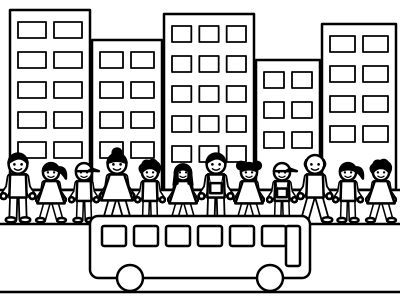
- 11.City, suburb or rural? Tell which one each picture shows.
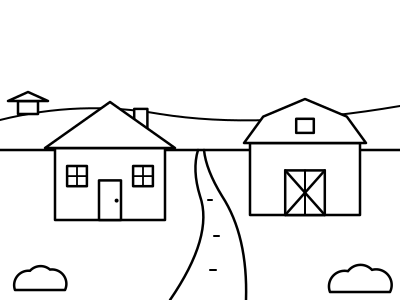
- 12.A place has warm weather and rich soil. What job fits that place? Tell why.
Section 4: Places Change
Read each question aloud. Your child tells, and you write the words.
- 13.A town turns an empty, weedy lot into a playground. Does this change help or harm the place? Tell why.
- 14.Your cousin far away makes up a new song. How could the song get to you?
- 15.Why do families make a plan before an emergency, like a big storm?
- 16.
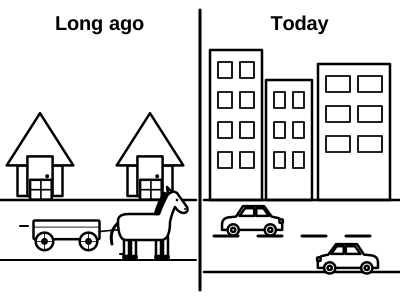 Tell one thing that changed on this street. Tell one thing that stayed the same.
Score and next steps
Total: 23 points.
- Exceeding: 21–23 points
- Proficient: 17–20 points
- Approaching: 12–16 points
- Developing: 0–11 points
Write the score in the Assessment & Records pages. The directions above say when to move on and when to reteach first.