Math
10 more with blocks
I can add one ten and tell the new number.
Standards: 1.NBT.C.5
- Number practice (no timer)
- Ten more and ten less (mental, no counting)
- Builds on
- Weeks 14 and 15 tens and ones (a two-digit number is some tens and some ones). One-minute check: "Build 36 with the kit. How many tens? How many ones?" (3 tens and 6 ones)
New words
- 10 more: the number you get when you add one ten
- digit: one of the symbols 0 to 9 that we use to write numbers; 45 has a tens digit (4) and a ones digit (5)
You need
- Tens and ones kit: 9 tens and 10 ones. Use straw bundles of 10 (a rubber band around each) and loose straws, base-ten rods and unit cubes, or paper ten-strips (strips of 10 squares, cut by an adult) with beans as ones
- 12 number cards made from paper squares: 52, 18, 32, 75, 40, 67, 27, 81, 43, 16, 58, 34
- Notebook and pencil
- Beans and unit cubes are small parts: keep them away from children under 3.
Warm-Up · 5 min
Fluency: ten more, starting small. Ask: "What is 10 more than 3?" (13) "10 more than 8?" (18) "10 more than 20?" (30) Say: "This week you will find 10 more and 10 less in your head, with no counting." Spaced review from Week 13: "Count on from 96 to 103." (97, 98, 99, 100, 101, 102, 103)
Mini-Lesson · 10 min
Say: "Today we add one ten to a number and see what changes." Build 45: 4 bundles and 5 loose ones. Ask: "What number is this?" (45) Write 45 in the notebook. Put one more bundle next to the others. Say: "I added 10. Count the tens with me: 10, 20, 30, 40, 50. And 5 more: 55." Write 55 under 45. Ask: "Look at the two numbers. What changed?" (The tens digit went from 4 to 5.) "What stayed the same?" (The ones. There are still 5.) Say: "10 more than 45 is 55. When we add a ten, only the tens change." Do one more: build 62, add a bundle. Ask your child to say the new number before counting. (72) Say: "6 tens and 1 more ten make 7 tens. 72."
Guided Practice · 10 min
For each number, your child builds it, says it, adds one bundle and says the new number. Then write both numbers in the notebook: 23 and 33. 1) 23 (33) 2) 38 (48) 3) 70 (80) 4) 14 (24) 5) 86 (96) 6) 59 (69) After each one, ask: "Which digit changed?" (The tens digit, up by 1.) If stuck, say: "Point to each bundle and count by tens. Then count on the loose ones."
Play · 10 min
Ten More Flip. Mix the 12 number cards and put them face down. On your turn, flip a card and build the number. Before you add a bundle, say what you think 10 more will be: "10 more than 52 is 62." Then add the bundle and check by counting the tens. If your guess was right, keep the card. If not, put it at the bottom of the pile. Take turns until the pile is gone. The player with more cards wins. Answers: 52 (62), 18 (28), 32 (42), 75 (85), 40 (50), 67 (77), 27 (37), 81 (91), 43 (53), 16 (26), 58 (68), 34 (44).
Exit Ticket · 3-5 min
Put the objects to one side but leave them on the table. Read each question aloud. Your child answers out loud, with objects or with a quick drawing. Check each answer together right away.
Exit ticket
- What is 10 more than 64?
- I have 3 tens and 9 ones. I add 1 more ten. What number do I have now?
- Add 10 to 21. Which digit changes?
Answers
- 74
- 49
- The tens digit (2 becomes 3). 10 more than 21 is 31.
Watch for, and help or stretch
- Watch for
- Adding 1 instead of 10, such as saying 10 more than 45 is 46.
- Try
- Ask: "Did we add one loose straw or one bundle?" (A bundle.) "A bundle is 10, so the tens digit goes up by 1."
- Extra help
- Use numbers under 50. Count the bundles by tens out loud each time before saying the new number.
- Stretch
- Ask: "What is 20 more than 36?" (56) "How did you know?" (Two more tens: 46, 56.)
At home (optional): Your child picks a number between 10 and 89 that they see at home (a page number or a number on a box) and tells a family member 10 more than it.
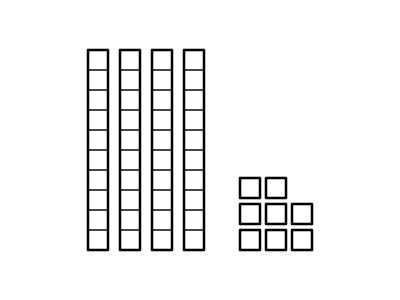 Draw 1 more ten. The new number is ____.
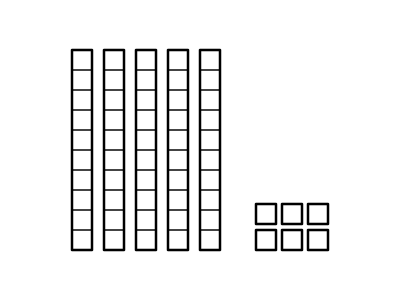 Draw 1 more ten. The new number is ____.