    1First Grade

    10 more, 10 less in my head

    A small moment with senses

    Practice pages

    0 of 180 days complete · Saved on this device

    View all 180 days

    Math

    10 more, 10 less in my head

    I can find 10 more or 10 less without counting and explain how.

    Standards: 1.NBT.C.5

    Number practice (no timer)
    Ten more and ten less (mental, no counting)
    Builds on
    Day 3 hundred chart hops. One-minute check: "On the chart, what is one row up from 52?" (42)

    New words

    • in my head: working out an answer by thinking, without counting objects or fingers
    • explain: tell how you know

    You need

    • 12 "I have, who has" cards made from paper squares. Write on each: "I have 45. Who has 10 more than 62?" / "I have 72. Who has 10 less than 48?" / "I have 38. Who has 10 more than 71?" / "I have 81. Who has 10 less than 36?" / "I have 26. Who has 10 more than 49?" / "I have 59. Who has 10 less than 73?" / "I have 63. Who has 10 more than 17?" / "I have 27. Who has 10 less than 94?" / "I have 84. Who has 10 more than 20?" / "I have 30. Who has 10 less than 64?" / "I have 54. Who has 10 more than 76?" / "I have 86. Who has 10 less than 55?"
    • Hundred chart to 120: printed, or drawn as 12 rows of 10 boxes (1 to 10 in the top row, 111 to 120 in the bottom row) (to check only)
    • Notebook and pencil
    1. Warm-Up · 5 min

      Fluency: ten more and ten less, no counting. "10 more than 33?" (43) "10 less than 33?" (23) "10 more than 70?" (80) Spaced review from Week 11: "Is 6 + 4 = 7 + 3 true or false?" (True. Both are 10.)

    2. Mini-Lesson · 10 min

      Say: "Today you find 10 more and 10 less in your head. No counting, no chart." Say a number: 52. Ask: "What is 10 more?" (62) "How do you know?" (The tens go up one. 5 tens become 6 tens. The 2 ones stay.) "What is 10 less?" (42) "How do you know?" (The tens go down one.) Write a pattern: 14, 24, 34, ___. Ask: "What comes next?" (44) "What is the pattern?" (Each number is 10 more.) Write: 86, 76, 66, ___. (56) "What is this pattern?" (10 less each time.) Say: "Only the tens digit moves. Say the tens, then keep the ones."

    3. Guided Practice · 10 min

      Ten Sandwich. Say a number. Your child says 10 less, the number, and 10 more, like bread, filling, bread. 1) 47 (37, 47, 57) 2) 38 (28, 38, 48) 3) 70 (60, 70, 80) 4) 19 (9, 19, 29) 5) 81 (71, 81, 91) Then finish the patterns in the notebook: 6) 7, 17, 27, ___, ___ (37, 47) 7) 93, 83, 73, ___ (63) 8) 45, 55, ___, 75 (65) 9) 100, 90, 80, ___ (70) After two of them, ask: "How do you know?" Listen for: "The tens go up (or down) by one." If stuck, say: "Cover the ones digit with your finger. Change only the tens digit by 1. Then uncover the ones."

    4. Play · 10 min

      I Have, Who Has. Deal the 12 cards, 6 each. Anyone can start by reading a card: "I have 45. Who has 10 more than 62?" The player with 72 reads: "I have 72. Who has 10 less than 48?" Keep going. The answers in order are 72, 38, 81, 26, 59, 63, 27, 84, 30, 54, 86 and back to 45. The game ends when the chain comes back to the first card. Rule: answer in your head. If you are not sure, check on the hundred chart after you answer. Play twice, dealing new hands.

    5. Exit Ticket · 3-5 min

      Put the objects to one side but leave them on the table. Read each question aloud. Your child answers out loud, with objects or with a quick drawing. Check each answer together right away.

    Exit ticket

    1. What is 10 more than 25? What is 10 less than 25?
    2. Finish the pattern: 58, 68, 78, ___
    3. What is 10 more than 82? How do you know?
    Answers
    1. 35 and 15
    2. 88
    3. 92. Answers vary. Look for: the tens go up by one (8 tens to 9 tens) and the 2 ones stay the same.
    Watch for, and help or stretch
    Watch for
    Counting on by ones on fingers to find 10 more.
    Try
    Say: "No need to count. Which digit do we change?" Point to the tens digit.
    Extra help
    Allow the hundred chart for the first 3 sandwiches, then cover it.
    Stretch
    Use three-digit numbers to 120: "10 more than 104?" (114) "10 less than 117?" (107)

    At home (optional): In the car or at the table, say a number between 10 and 89. Your child says 10 more and 10 less and tells how they know.
    Reading & Writing

    A small moment with senses

    I can write a small moment that uses sense words.

    Standards: W.1.3, RL.1.4, L.1.2.e

    Phonics
    r-controlled er, ir and ur (her, bird, fur, turn)
    Sight words
    will, if, so, make, like
    Reading
    Mother Goose rhymes (public domain); "Rain" by Robert Louis Stevenson (public domain)
    Writing
    Narrative: a small moment told with sense words · Handwriting: copying a poem neatly
    Builds on
    Planning the small moment (Day 2). One-minute check: your child tells the First and Then of their plan.

    New words

    • small moment: one short time, told with details
    • detail: a small fact that helps a listener see or hear what happened

    You need

    • Word wall chart: paper with three columns headed er (her), ir (bird), ur (fur)
    • Sight word cards: will, if, so, make, like (two sets: 10 cards for Memory Match)
    • Printed "Rain on the Porch" and "Rain" (from Day 1)
    • Five senses chart (from Day 1) and the First/Then plan (from Day 2)
    • Story paper with a drawing box and lines; pencil; crayons
    1. Phonics & Word Work · 15 min

      Spelling /er/. I do: say "Three spellings make /er/. When I spell, I think: which one looks right? I check our chart." Write her, bird and fur at the top of the three columns. We do: spell perch together: say the sounds, choose er, and check the chart. You do: your child spells 4 words you say, then checks each against the chart you complete afterward: fern, dirt, burn, chirp. Then read phrases with plurals: six birds, ten shirts, two ferns. Read: "Turn the cups up." "The girls had curls." Dictation: curls, skirts, herd, hurt. If stuck, ask: "Is it the er of her, the ir of bird or the ur of fur?" and let your child look at the chart. Many /er/ words must be learned by sight, so checking is good spelling.

    2. Sight Words · 5 min

      Review: will, if, so, make, like. Memory Match: put the 10 cards face down in rows. Your child turns over two cards and reads them. A match is kept. Take turns until all pairs are found.

    3. Read-Aloud & Shared Reading · 15 min

      Say: "'Rain on the Porch' is a small moment. It tells one short time with details." Your child reads it aloud once. Ask: "What happened first?" (Rain hit the porch, and Kit sat on the step with Burt.) Ask: "What happened then?" (The sun came out, and Kit and Burt ran to the dirt.) Ask: "Which words help you hear or see the moment?" (Answers vary. Look for: drip, Chirp, gray, bright, Splat.) Then reread "Rain" together once, with feeling.

    4. Writing & Handwriting · 15 min

      Your child writes the small moment from the plan. Say: "Start with First. Then tell what happened next with Then. Use two sense words." Model: "First, I got wet in the rain. Then I had a hot bath." Your child writes 2 or 3 sentences, using the five senses chart for sense words. For new words, say the word slowly and write each sound you hear (spell by sounds). An ending sentence is a bonus: "It was fun." Your child draws a picture in the box. Handwriting (3 min): your child checks that each sentence starts with a capital and ends with a period that sits on the line.

    5. Exit Ticket · 5 min

      Oral answers.

    Exit ticket

    1. Tell me one sense word you used in your story.
    2. Read this: The fern got wet. Then the sun came out.
    3. What word can you use to tell what happened next?
    Answers
    1. Answers vary. Look for: a word for seeing, hearing, smelling, tasting or touching.
    2. The fern got wet. Then the sun came out.
    3. Then (also next or after that).
    Watch for, and help or stretch
    Watch for
    Listing things (rain, mud, dog) instead of telling what happened in order.
    Try
    Point to the First box: "What did you do first?" Then point to the Then box: "What happened next?"
    Extra help
    Your child draws both boxes and tells the story; you write it; your child copies one sentence.
    Stretch
    Your child adds a third sentence that starts with Last and tells a feeling.

    At home (optional): Your child reads the small moment to someone at home.

    Social StudiesWeekly check

    Past, present and future

    I can use the words past, present and future and put a day's events in order.

    Standards: D2.His.1.K-2, D2.His.2.K-2

    Builds on
    My life timeline (Day 2). One-minute check: ask "On a timeline, which side does the earliest event go on?" (the left side, the start)

    New words

    • past: the time that has already happened
    • present: the time that is happening now
    • future: the time that has not happened yet

    You need

    • 6 picture cards of a day (draw or write): waking up, eating breakfast, doing school, eating lunch, playing outside, going to bed
    • 3 word cards: Past (yesterday), Present (today), Future (tomorrow)
    • Life timeline from Day 2
    • Week 19 social studies check page (given separately)
    • Pencil
    1. Warm-Up / Wonder · 5 min

      Spaced review: your child reads their life timeline aloud from left to right. Wonder question: "Is yesterday in the past or the future?"

    2. Review Game · 10 min

      Play "Day in Order." Mix the 6 day cards. Your child puts them in order and tells the day using first, next, then and last. Then play "Past, Present, Future." Lay out the 3 word cards. Say a sentence, and your child points to the right card. "Yesterday we went to the library." (past) "Right now we are playing a game." (present) "Tomorrow we will bake bread." (future) "Last week it rained." (past) "Next summer we will swim." (future) "I am sitting on the floor." (present) Then your child makes up one sentence for each card. Point to the life timeline. Ask: "Is your baby picture in the past, present or future?" (past) "The dotted picture?" (future) Then compare then and now: ask "When you were a baby, how did you get around? How do you get around now?" (Answers vary. Look for: carried or crawling then; walking and running now.) Say: "Comparing life then and now is what history detectives do." If stuck, ask: "Did it already happen, is it happening now, or has it not happened yet?"

    3. Check · 10 min

      Give the Week 19 social studies check. The check items are on the Week 19 check page; do not show them ahead of time. Read each part aloud. Your child answers by talking, pointing, showing with the real materials or drawing. You write down their words exactly. It is not timed; stop and finish later if your child is tired. Make a check mark next to each part your child shows on their own. The printed check has 8 items. It covers these goals: (1) I can put events from my life in order on a timeline; (2) I can use the words past, present and future and put a day's events in order. This week the check is an ordering and sorting task. Look for: your child puts 4 events in order and uses the words past, present and future correctly, each with a matching example. If stuck on a part, lay out only 2 events and ask which came first, then add the rest one at a time. Secure: 6 of 8 correct, with at least one right on each goal. If the check is not yet secure, use the reteach step on the check page that matches the items missed.

    4. Exit Ticket · 3–5 min

      Ask the three questions aloud. Your child answers by talking or drawing.

    Exit ticket

    1. Is your last birthday in the past, present or future?
    2. Is your next birthday in the past, present or future?
    3. Tell me one thing that is happening in the present.
    Answers
    1. The past.
    2. The future.
    3. Answers vary. Look for: something happening right now, such as "I am answering questions."
    Watch for, and help or stretch
    Watch for
    Mixing up past and future.
    Try
    Point behind you for past and in front of you for future. Ask: "Did it already happen? Then it is behind us, in the past."
    Extra help
    Order 3 day cards and use only past and future.
    Stretch
    Your child tells one past, one present and one future event about your family.

    At home (optional): At dinner, your child tells one thing that happened in the past today and one thing they will do in the future.

    Practice

    Read each direction aloud. Your child works on the page; answers are in the grown-up view.

    Warm-up

    Remember?

    Math

    1. 56 is 5 tens and 6 ones. It is also 4 tens and how many ones?
    2. How many tens and how many ones are in 26?

    Reading & Writing

    1. sight, fright, shy

    Math · Week 19 Day 4

    I can find 10 more or 10 less without counting and explain how.

    Look: 10 less and 10 more than 64

    1. Say 64: 6 tens and 4 ones.
    2. 10 less is 5 tens and 4 ones: 54. 10 more is 7 tens and 4 ones: 74.
    3. Only the tens digit moves. The ones stay 4.

    Make a ten sandwich: write 10 less on the left and 10 more on the right.

    1. 1.
      ____, 53, ____
    2. 2.
      ____, 26, ____
    3. 3.
      ____, 90, ____
    4. 4.
      ____, 11, ____

    Finish the pattern.

    1. 5.
      12, 22, 32, ____, ____
    2. 6.
      99, 89, 79, ____
    3. 7.
      How do you know that 10 more than 57 is 67? Tell or write.

    Challenge (optional)

    I am 10 more than 30. I am also 10 less than 50. What number am I?

    Reading & Writing · Week 19 Day 4

    I can write a small moment that uses sense words.

    Look: a small moment

    1. First: I got wet in the mud.
    2. Then: I sat in the sun.
    3. Add a sense word: wet, hot, drip, soft.

    The Mud

    First, Bert and Jen ran in the mud. Slap! The mud was wet and thick. Then they sat in the sun. The sun was hot on the dirt.

    Read the story. Circle the right word.

    1. 1.
      What did Bert and Jen do first?
      • ran in the mud
      • sat in the sun
    2. 2.
      What did they do then?
      • ran in the mud
      • sat in the sun
    3. 3.
      Then they sat in the ____.
      • sun
      • mud

    Write about a time you got wet. Use First and Then, then draw it.

    1. 4.
      First, I ____.
    2. 5.
      Then I ____.
    3. 6.
      It was ____.
    4. 7.
      My wet day

    Challenge (optional)

    Then I was ____.

    You need: crayons

    Social Studies · Week 19 check

    Weekly check

    How to give it: Read every question and choice aloud, and point to each picture as you name it. This week the check is an ordering and sorting task. Your child answers by talking, pointing, circling, acting it out or drawing; write their words exactly on the line. It is not timed; stop and finish later if your child is tired. Do not show the page ahead of time. For items 3 to 5, read each choice as "past," "present, now" and "future, not yet," and your child says the word while circling it. If stuck on item 1, lay out only 2 events and ask which came first, then add the rest one at a time. Make a check mark next to each part your child shows on their own.

    Secure when: 6 of 8 correct, with at least one right on each goal

    • I can put events from my life in order on a timeline.
    • I can use the words past, present and future and put a day's events in order.
    1. 1.
      Put these zoo-trip events in order: drive home; get in the car; see the animals; buy tickets at the gate.
    2. 2.
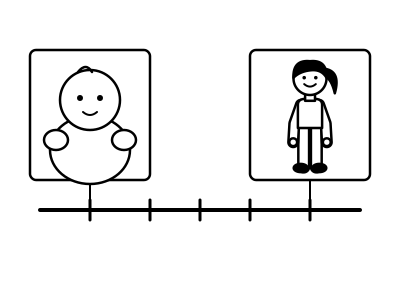
      A timeline with a baby picture at the left end and a picture of a first grader at the right end. Which end shows the earliest event?
    3. 3.
      "Last summer we went to the beach." Your child circles past, present or future.
      • past
      • present (now)
      • future (not yet)
    4. 4.
      "I am drinking water right now."
      • past
      • present (now)
      • future (not yet)
    5. 5.
      "Next week we will plant seeds."
      • past
      • present (now)
      • future (not yet)
    6. 6.
      Tell one thing that will happen in the future.
    7. 7.
      Tell one thing from your own past.
    8. 8.
      When you were a baby, how did you eat? How do you eat now?