This week's lessons
Math and reading every day; science and social studies take turns
- Day 1 · Monday
- MathDoubles to 5 + 5I can tell doubles facts to 5 + 5.
- Reading & WritingMain topic and detailsI can tell the main topic and retell key details of a nonfiction text.
- Social StudiesSkills helpers needI can tell what a helper needs to know and be able to do for their job.
- Day 2 · Tuesday
- MathDoubles to 10 + 10I can tell doubles facts to 10 + 10.
- Reading & WritingHow are they connected?I can tell how two ideas in a text are connected.
- ScienceDoes the moon make light?I can test how a mirror, foil and paper bounce light and tell where the moon's light comes from.
- Day 3 · Wednesday
- MathNear doublesI can use a double to help with a near double.
- Reading & WritingA, an, the, this, thatI can use a, an, the, this and that in sentences.
- Social StudiesGoods and servicesI can tell the difference between goods and services.
- Day 4 · Thursday
- MathDoubles in storiesI can use doubles and near doubles to solve stories.
- Reading & WritingAll About book planI can plan an All About book with a topic and facts for each page.
- Science · CheckLight up the toyI can bounce light with a mirror to make a toy in the dark box easy to see.
- Day 5 · Friday
- Math · CheckLesson + weekly check: doublesI can use doubles to add.
- Reading & Writing · CheckShare and check: r- and s-blendsI can read r-blend and s-blend words and tell the topic of a text.
- Social Studies · CheckWorking to earn moneyI can explain that people earn money by doing work.
This week's checks
Short checks on the last day each subject meets this week
Science · Day 4
- I can test how a mirror, foil and paper bounce light and tell where the moon's light comes from.
- I can bounce light with a mirror to make a toy in the dark box easy to see.
Secure when: 6 of 8 correct, including item 1 (lights the toy with the mirror) and item 6 or 8 (the moon reflects sunlight).
Open the checkMath · Day 5
- I can tell doubles facts to 5 + 5.
- I can tell doubles facts to 10 + 10.
- I can use a double to help with a near double.
- I can use doubles and near doubles to solve stories.
Secure when: 8 of 10 correct, with at least 2 of the 3 near doubles (items 6–8) explained with the right double
Open the checkReading & Writing · Day 5
- I can read words that start with an r-blend or an s-blend.
- I can read the sight words again, once, says, every and other.
- I can tell the main topic of a text and one key detail.
- I can tell how two ideas are connected.
- I can use a, an, this and that.
Secure when: 8 of the 10 words in items 1 and 2, 4 of the 5 sight words, the topic in item 4, and 3 of items 5 to 8.
Open the checkSocial Studies · Day 5
- I can tell what a helper needs to know and be able to do for their job.
- I can tell the difference between goods and services.
- I can explain that people earn money by doing work.
Secure when: 6 of 8 correct, with at least one right on each goal
Open the check
Reading About Our World: Goods and Services
Read it aloud. Your child reads the sentences marked with a star. Builds social studies knowledge.
Goods
Goods are things people make or grow that we can buy, like bread, shoes and toys. Mom can get a hat at the shop.
Services
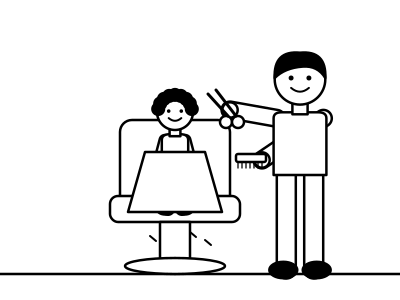
A service is work one person does for another. A barber cuts hair. A vet helps sick pets. A bus driver takes people where they need to go. A teacher helps children learn.
Working to Earn
People who make goods or give services do work. When they work, they earn money. They use the money to buy what their family needs.
Words to know
- goods: things people make or grow
- service: work done to help someone
- earn: get money for doing work
Talk about it
- Name one good from the passage.
- What does a vet do?
- A dentist cleans your teeth. Is that a good or a service? How do you know?
Home Connection
Five-minute ideas for the whole family, with things you already have
Math
Doubles like 6 + 6, and near doubles like 6 + 7, help us add quickly.
Do: Hunt for doubles at home: 5 fingers and 5 fingers make 10, and an egg carton has 6 and 6, which makes 12. Then ask: if 6 + 6 = 12, what is 6 + 7?
Talk: How does knowing a double help you with a near double?
Reading & Writing
The main topic is what a whole text is mostly about.
Do: Read a fact book, a magazine page or a cereal box together and ask what it is mostly about. Write frog, drum, step, swim and trip for your child to read.
Talk: What is this text mostly about?
Science
The moon and mirrors do not make their own light; they bounce light.
Do: In a dim room, shine a flashlight at a piece of foil and find where the bounced light lands on the wall.
Talk: Where does the moon's light come from?
Social Studies
Goods are things people make or grow; services are jobs people do for us. People work to earn money.
Do: Sort things in your life into goods (bread, shoes, a toy) and services (a haircut, a doctor visit, a bus ride).
Talk: Is a haircut a good or a service?
This week's words: again, once, says, every, other
Celebrate a double your child found at home, the main topic of a book and a good and a service your child named.
Math catch-up: Five and Five Doubles
10 minutes, if this week's math check was not secure · 1.OA.C.6
Small doubles come quickly, but children often guess the big ones (7 + 7, 9 + 9). Seeing each big double as 5 + 5 and a small double gives a reason, not a guess.
You need: 2 rows of 10 boxes drawn on paper (one ten frame above another), 20 dry beans or buttons
- Put 7 beans in one row and 7 in the row below it. Ask: "Are both rows the same?" (Yes. It is a double.)
- Cover the first 5 in each row with your hands. Say: "5 and 5 make 10." Uncover the extras: 2 and 2 make 4. 10 and 4 is 14.
- Do 9 + 9 and 6 + 6 the same way: 5 and 5, then the small double, then put them together.
- Your child says one double they know by heart and one they figured out with the five-and-five trick.
Try again
- You have 8 red blocks and 8 blue blocks. How many blocks in all?
- 2 rows of chairs have 10 chairs in each row. How many chairs?
- A domino has 7 dots on one side and 8 dots on the other. Use a double to find how many dots.
Specials This Week
Weeks 7–12 unit • ~90 min/week per subject
Non-Locomotor Skills and Balance
Practicing non-locomotor movements (bending, stretching, twisting, shaking, swaying), developing static and dynamic balance.
Discovering Color and Texture
Primary and secondary colors, warm and cool colors, mixing colors, identifying and creating textures (rough, smooth, bumpy, soft).
Pitch and Melody
High/low sounds, step/skip in melody, identifying melodic contour (up, down, same), singing simple melodies.
For guiding principles and full standards reference, visit How to use this curriculum
As an Amazon Associate, we earn from qualifying purchases. Book and supply links on this page are affiliate links — using them supports this curriculum at no extra cost to you.