This week's lessons
Math and reading every day; science and social studies take turns
- Day 1 · Monday
- MathAdding to: act it outI can act out an adding story and tell how many in all.
- Reading & WritingReaders ask questionsI can ask and answer questions about a story we read together.
- ScienceSounds all aroundI can listen closely and tell about sounds I hear.
- Day 2 · Tuesday
- MathPutting together: part-part-wholeI can put two groups together and find the whole.
- Reading & WritingWho and whereI can tell who is in a story and where it happens.
- Social StudiesAll about me and my nameI can tell something special about me and listen to what is special about someone else.
- Day 3 · Wednesday
- MathNumber bonds to 10I can show two parts that make 10.
- Reading & WritingWhat makes a sentenceI can find the capital letter at the start and the end mark at the end of a sentence.
- ScienceLoud, quiet, high, lowI can sort sounds as loud or quiet and high or low.
- Day 4 · Thursday
- MathWriting addition equationsI can write an equation with + and = to match a story.
- Reading & WritingAll About My NameI can draw myself and label my picture by writing the sounds I hear.
- Social Studies · CheckFamilies are alike and differentI can tell how my family is special and how families can be alike and different.
- Day 5 · Friday
- Math · CheckLesson + weekly check: addition storiesI can show an addition story with objects, a drawing and an equation.
- Reading & Writing · CheckShare and check: short a and iI can read short a and short i words and tell about my name page.
- Science · CheckSound Journal: what makes sound?I can tell what I think makes a sound and draw my idea.
This week's checks
Short checks on the last day each subject meets this week
Social Studies · Day 4
- I can tell something special about me and listen to what is special about someone else.
- I can tell how my family is special and how families can be alike and different.
Secure when: 6 of 7 correct, with at least 2 right on items 3 to 7
Open the checkMath · Day 5
- I can act out an adding story and tell how many in all.
- I can put two groups together and find the whole.
- I can show two parts that make 10.
- I can write an equation with + and = to match a story.
Secure when: 7 of 8 correct, with at least 1 right on each goal
Open the checkReading & Writing · Day 5
- I can read short a and short i words.
- I can blend sounds into a word and write a letter for each sound.
- I can tell who is in a story and where it happens.
- I can find the capital letter at the start and the end mark at the end of a sentence.
Secure when: 8 of the 10 words in items 1 and 2, 2 of the 3 blended words in items 3 to 5, and 4 of the 5 items 6 to 10.
Open the checkScience · Day 5
- I can listen closely and tell about sounds I hear.
- I can sort sounds as loud or quiet and high or low.
- I can tell what I think makes a sound and draw my idea.
Secure when: 5 of 6 correct on items 1 to 6, and your child gives a drawing and a prediction for items 7 and 8 (any idea counts).
Open the check
Reading About Our World: Listen Closely
Read it aloud. Your child reads the sentences marked with a star. Builds science knowledge.
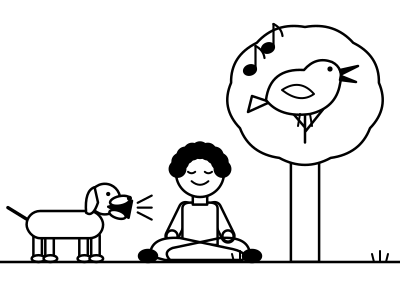
Listen!
Close your eyes and listen. You might hear a dog bark, a car go by or a bird sing. Sounds are all around us. We hear them with our ears.
Loud and Quiet
Some sounds are loud, like a drum or a fire truck. Some sounds are quiet, like a whisper. A soft tap makes a quiet sound. I can tap a tin can.
High and Low
Some sounds are high, like a little bird's tweet. Some sounds are low, like a big dog's growl. Your ears can tell high sounds from low sounds.
Words to know
- sound: something you hear
- loud: a big, strong sound
- quiet: a soft, small sound
Talk about it
- What part of your body do you hear with?
- Name one loud sound from the passage.
- A baby is sleeping. Should you use a loud voice or a quiet voice? Why?
Home Connection
Five-minute ideas for the whole family, with things you already have
Math
Adding means putting groups together; two parts make a whole.
Do: Put 10 spoons or socks on the table. Split them into two piles in different ways, like 7 and 3 or 4 and 6. Your child tells an adding story for each split: "7 socks and 3 socks make 10 socks."
Talk: How many different ways can you split 10 into two piles?
Reading & Writing
Good readers ask questions and tell who is in a story and where it happens.
Do: Read any picture book together. Stop twice to ask "Who is in the story?" and "Where is it?" Then write cat, sit, map and pin on scrap paper for your child to read.
Talk: What is one question you have about the story?
Science
Sounds are all around us; they can be loud or quiet, high or low.
Do: Take a 5-minute listening walk inside or outside. Stop, close your eyes and name every sound you hear. Sort them into loud or quiet, and high or low.
Talk: What was the quietest sound you heard?
Social Studies
Every person and every family is special; families can be alike and different.
Do: Tell your child the story of their name: who chose it, why, or what it means. Look at a family photo together and name everyone in it.
Talk: How are the families you know alike? How are they different?
This week's words: I, see, like, look, can
Celebrate one adding story, one new question about a book and one sound your child noticed.
Math catch-up: Count Them All
10 minutes, if this week's math check was not secure · 1.OA.A.1
Many children count only the group that comes in at the end of the story. Pushing everything onto one plate shows that 'in all' means every object, counted once.
You need: 20 pieces of dry pasta or dry beans, 1 plate, 2 small cups
- Put 4 pasta pieces in one cup and 3 in the other. Say: "4 ducks are in the pond. 3 more ducks swim over."
- Pour both cups onto the plate together. Your child touches each piece and counts from 1: 1, 2, 3, 4, 5, 6, 7. Say: "In all means everybody on the plate."
- Tell 2 more stories with new numbers that make 10 or less. Each time, your child pours both cups onto the plate before counting.
- Write the last story as an equation together, such as 4 + 3 = 7. Your child points to each number while telling the story again.
Try again
- 5 spoons are in the drawer. You put in 3 more. How many spoons are in the drawer now?
- Show 5 pasta pieces and 1 more. How many in all?
- 2 socks are on the bed. 6 more socks are on the floor. Write an equation for all the socks.
Specials This Week
Weeks 1–6 unit • ~90 min/week per subject
Locomotor Skills and Space Awareness
Mastering basic locomotor skills (walking, running, hopping, jumping, galloping, sliding, skipping), understanding personal and general space.
Exploring Line and Shape
Different types of lines (straight, curved, zig-zag, wavy), identifying basic shapes, creating patterns with lines and shapes.
Rhythm and Beat
Identifying and keeping a steady beat, understanding basic rhythms (ta – quarter note, ti-ti – eighth notes), clapping and patting rhythms.
For guiding principles and full standards reference, visit How to use this curriculum
As an Amazon Associate, we earn from qualifying purchases. Book and supply links on this page are affiliate links — using them supports this curriculum at no extra cost to you.