This week's lessons
Math and reading every day; science and social studies take turns
- Day 1 · Monday
- MathTaking from: how many are left?I can act out a taking-away story and tell how many are left.
- Reading & WritingRetelling with detailsI can retell what happened in a story using key details.
- Social StudiesEveryone helps at homeI can name jobs at home and tell why each helper matters.
- Day 2 · Tuesday
- MathTaking apart: two groups in oneI can split a group into two parts and find the missing part.
- Reading & WritingMiddle soundsI can hear and say the middle vowel sound in a word.
- ScienceFeel the buzzI can feel my throat shake when I hum.
- Day 3 · Wednesday
- MathCounting back to subtractI can count back 1 or 2 to subtract.
- Reading & WritingNames get capitalsI can write people's names with a capital letter.
- Social StudiesWhy do we have rules?I can tell why we need rules.
- Day 4 · Thursday
- MathFact families: add and subtract go togetherI can use three numbers to write adding and subtracting facts.
- Reading & WritingMy family story, part 1I can draw and write the first thing that happened in a true story about my family.
- Science · CheckRubber band guitarI can show that a stretched band shakes when it makes a sound.
- Day 5 · Friday
- Math · CheckLesson + weekly check: subtraction storiesI can solve taking-away and taking-apart stories.
- Reading & Writing · CheckShare and check: short vowelsI can read words with all five short vowels and share my story start.
- Social Studies · CheckRules in many placesI can tell rules for home, school and the playground and why each one helps.
This week's checks
Short checks on the last day each subject meets this week
Science · Day 4
- I can feel my throat shake when I hum.
- I can show that a stretched band shakes when it makes a sound.
Secure when: 6 of 8 correct, including at least 2 of items 1, 3 and 5 (plucks and points, knows a still band makes no sound, says "When it shakes, I hear it").
Open the checkMath · Day 5
- I can act out a taking-away story and tell how many are left.
- I can split a group into two parts and find the missing part.
- I can count back 1 or 2 to subtract.
- I can use three numbers to write adding and subtracting facts.
Secure when: 7 of 8 correct, with at least 1 right on each goal
Open the checkReading & Writing · Day 5
- I can read words with all five short vowels.
- I can read the sight words the, of, to, said and was.
- I can hear the middle vowel sound in a word.
- I can retell a story in order.
- I can write a name with a capital letter.
Secure when: 8 of the 10 words in items 1 and 2, 4 of the 5 sight words in item 3, and 4 of the other 6 items.
Open the checkSocial Studies · Day 5
- I can name jobs at home and tell why each helper matters.
- I can tell why we need rules.
- I can tell rules for home, school and the playground and why each one helps.
Secure when: 6 of 8 correct, with at least one right on each goal
Open the check
Reading About Our World: Helping at Home
Read it aloud. Your child reads the sentences marked with a star. Builds social studies knowledge.
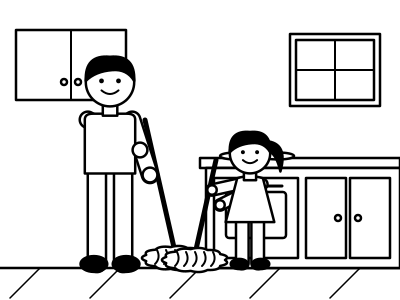
Every Helper Counts
In a home, people help each other. One person cooks. One person feeds the cat. A child can set the table or put away toys. Every helper makes the home run well.
Rules at Home
Homes have rules. A rule tells us what to do. "Put toys away" is a rule. "Hold hands near the street" is a rule too. Dad said to get the mop.
Why Rules Help
Rules keep us safe. Rules help us share and get along. When everyone follows the rules, home is a happy place.
Words to know
- rule: something that tells us what to do
- helper: a person who does a job for others
- safe: not in danger
Talk about it
- Name one job a child can do at home.
- What does a rule tell us?
- Why might a family have the rule "Hold hands near the street"?
Home Connection
Five-minute ideas for the whole family, with things you already have
Math
Subtracting means taking away or finding a missing part.
Do: Put 9 crackers on a plate. Your child eats or hides 2 and tells the story: "9 take away 2 is 7." Then say the whole fact family together: 7 + 2 = 9, 2 + 7 = 9, 9 - 2 = 7, 9 - 7 = 2.
Talk: How are adding and subtracting with the same numbers like a family?
Reading & Writing
Retelling a story in order, with key details, shows we understand it.
Do: Write hot, sun, bed, cup and dog on scraps of paper. Your child reads each word and says a sentence with it. Then your child retells a favorite story: who, where, and what happened first, next and last.
Talk: Who was in the story, and what happened first?
Science
When something makes a sound, it shakes. That shaking is called a vibration.
Do: Hum a song with a hand gently on the front of your throat. Then stretch a rubber band around an open plastic container and pluck it gently. A grown-up helps, and keep the band away from faces.
Talk: What did you feel in your throat when you hummed?
Social Studies
Everyone helps at home, and rules help keep us safe and fair.
Do: Make a list of helper jobs in your home, like feeding a pet or setting the table. Your child picks one job to do every day this week.
Talk: What would happen at home if there were no rules?
This week's words: the, of, to, said, was
Celebrate a fact family your child said, a story your child retold and a home job done every day.
Math catch-up: Who Is Still Here?
10 minutes, if this week's math check was not secure · 1.OA.A.1
In taking-away stories, children often count the objects that left instead of the ones that stayed. Hiding the gone ones under a cup keeps attention on what is left.
You need: 10 crackers or 10 dry beans, 1 plastic cup, a napkin
- Put 8 beans on the napkin. Say: "8 bugs are on a leaf. 3 bugs fly away." Your child slides 3 beans under the cup.
- Ask: "Which bugs are still on the leaf?" Your child points only to the beans on the napkin and counts them: 5.
- Lift the cup and ask: "Are these still on the leaf?" (No.) Say: "The answer is the ones still here."
- Do 2 more stories with numbers to 10. Write the last one together, such as 8 - 3 = 5, and read it as "8 take away 3 leaves 5."
Try again
- 9 grapes are in a bowl. You eat 3. How many grapes are left?
- 6 toy cars are on the rug. 4 cars drive away. How many cars are still on the rug?
- 10 crackers are on a plate. 1 cracker is eaten. How many are left?
Specials This Week
Weeks 1–6 unit • ~90 min/week per subject
Locomotor Skills and Space Awareness
Mastering basic locomotor skills (walking, running, hopping, jumping, galloping, sliding, skipping), understanding personal and general space.
Exploring Line and Shape
Different types of lines (straight, curved, zig-zag, wavy), identifying basic shapes, creating patterns with lines and shapes.
Rhythm and Beat
Identifying and keeping a steady beat, understanding basic rhythms (ta – quarter note, ti-ti – eighth notes), clapping and patting rhythms.
For guiding principles and full standards reference, visit How to use this curriculum
As an Amazon Associate, we earn from qualifying purchases. Book and supply links on this page are affiliate links — using them supports this curriculum at no extra cost to you.