Math
Number bonds to 10
I can show two parts that make 10.
Standards: 1.OA.A.1
- Number practice (no timer)
- Make 5 and make 10 with fingers and ten frames
- Builds on
- Day 2 parts and wholes. One-minute check: put 2 red and 5 yellow counters on the mat. Your child names the parts (2 and 5) and the whole (7).
New words
- number bond: a picture that shows two parts and the whole they make
- partner: the number that goes with another number to make a whole, such as 3 and 7 for 10
You need
- Ten frame drawn on paper
- 20 counters in two colors
- Deck of playing cards with face cards and 10s taken out (ace counts as 1)
- Notebook and pencil
Warm-Up · 5 min
Fluency: make 5 and make 10. Flash fingers and your child shows the partner to make 10 on their own fingers: you show 6, your child shows 4. Do 9 (1), 3 (7), 5 (5) and 2 (8). Spaced review from Day 2: "The parts are 4 and 2. What is the whole?" (6)
Mini-Lesson · 10 min
Say: "Today we find all the ways two parts make 10." Fill the ten frame with 6 red and 4 yellow counters. Ask: "How many red?" (6) "How many yellow?" (4) "How many in all?" (10) Draw a number bond: a circle with 10 at the top and two circles below it with 6 and 4. Say: "This is a number bond. It says 6 and 4 make 10." Now swap 1 yellow for 1 red. Ask: "How many red now?" (7) "Yellow?" (3) Draw the number bond 10, 7 and 3. Say: "Every time I change one counter, I get a new pair of partners for 10." Ask: "What if all 10 are red?" (10 and 0)
Guided Practice · 10 min
Your child fills the ten frame with two colors a new way each time and draws the number bond. Go until you have found all of them together: 9 and 1, 8 and 2, 7 and 3, 6 and 4, 5 and 5, and 10 and 0. Write them as a list in order. Ask: "What do you notice?" (Answers vary. Look for: as one part goes down by 1, the other goes up by 1.) If stuck, say: "Count the empty boxes. That is the partner."
Play · 10 min
Make 10. Lay 12 cards face up in rows. Take turns finding two cards that make 10 (ace and 9, 2 and 8, 3 and 7, 4 and 6, 5 and 5). Say the pair out loud: "3 and 7 make 10." Keep the pair and put two new cards in the empty spots. Play until no pairs are left. Count your pairs at the end, but there is no racing: take as long as you need on each turn.
Exit Ticket · 3-5 min
Put the objects to one side but leave them on the table. Read each question aloud. Your child answers out loud, with objects or with a quick drawing. Check each answer together right away.
Exit ticket
- 7 and what number make 10?
- 4 and what number make 10?
- 10 apples are in a bowl. Some are red and some are green. How many could be red and how many green? Use a different pair than 7 and 3 or 4 and 6.
Answers
- 3
- 6
- Answers vary. Look for any pair that makes 10, such as 8 and 2, 9 and 1, 5 and 5 or 10 and 0.
Watch for, and help or stretch
- Watch for
- Counting the filled boxes again instead of the empty ones when finding the partner.
- Try
- Cover the filled boxes with your hand. Ask: "How many boxes can you still see?"
- Extra help
- Use the ten frame for every question and let your child count the empty boxes. Start with partners of 5 (4 and 1, 3 and 2).
- Stretch
- Ask for partners of 9 and 8 (for 9: 8 and 1, 7 and 2, 6 and 3, 5 and 4). Ask how partners of 9 are like partners of 10.
At home (optional): Play Make 10 with an adult using the cards. Name each pair out loud.
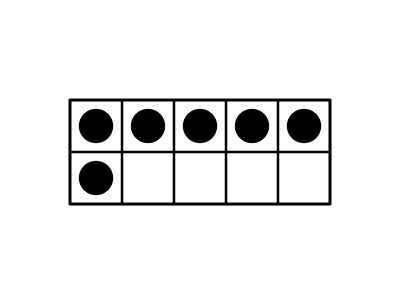 6 and ___ make 10.
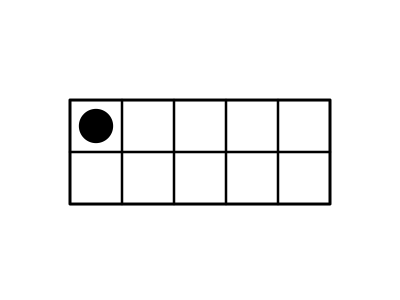 1 and ___ make 10.
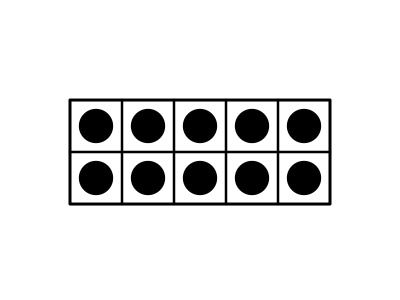 10 and ___ make 10.