This week's lessons
Math and reading every day; science and social studies take turns
- Day 1 · Monday
- MathWhat the equal sign meansI can explain that = means 'the same as'.
- Reading & WritingWhat does that word mean?I can ask questions to figure out a new word in a nonfiction book.
- ScienceTalking far awayI can name ways people use sound or light to send messages.
- Day 2 · Tuesday
- MathTrue or false?I can tell if an equation is true or false.
- Reading & WritingShared research, part 1I can help find facts in two sources to answer our question.
- Social StudiesInterview a helperI can ask good questions and learn facts from a person.
- Day 3 · Wednesday
- MathBoth sides the sameI can check equations with adding on both sides.
- Reading & WritingWhere is it? PrepositionsI can use words like in, under, on and beside to tell where something is.
- ScienceString cup phoneI can build and test a cup phone.
- Day 4 · Thursday
- MathEqual sign with subtractionI can check equations that use adding and subtracting.
- Reading & WritingShared research, part 2I can help write a class fact page from our research.
- Social Studies · CheckWorking togetherI can describe how people work together to get a big job done.
- Day 5 · Friday
- Math · CheckLesson + weekly check: true or falseI can sort equations into true and false and explain why.
- Reading & Writing · CheckShare and check: o_e and u_eI can read o_e and u_e words and explain a new word I learned.
- Science · CheckFlashlight codeI can make a light code to send a message.
This week's checks
Short checks on the last day each subject meets this week
Social Studies · Day 4
- I can ask good questions and learn facts from a person.
- I can describe how people work together to get a big job done.
Secure when: 6 of 8 correct, with at least one right on each goal
Open the checkMath · Day 5
- I can explain that = means 'the same as'.
- I can tell if an equation is true or false.
- I can check equations with adding on both sides.
- I can check equations that use adding and subtracting.
Secure when: 8 of 9 correct
Open the checkReading & Writing · Day 5
- I can read o_e, u_e and short vowel words.
- I can read the sight words how, now, down, know and just.
- I can use clues to tell what a new word means.
- I can use words like in, on and by to tell where something is.
- I can write a fact with a capital and a period.
Secure when: 8 of the 10 words in items 1 and 2, 4 of the 5 sight words, item 4 (the meaning), and 3 of items 5 to 8.
Open the checkScience · Day 5
- I can name ways people use sound or light to send messages.
- I can build and test a cup phone.
- I can make a light code to send a message.
Secure when: 6 of 8 correct, including item 1 (3 readable messages) and item 2 (tells how the light carried the message).
Open the check
Reading About Our World: Lights by the Sea
Read it aloud. Your child reads the sentences marked with a star. Builds science knowledge.
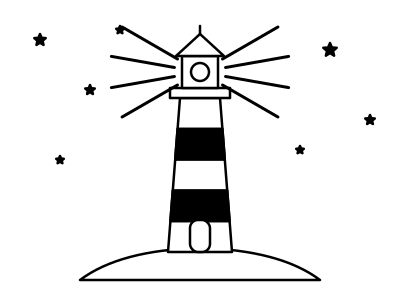
A Tall Tower
A lighthouse is a tall tower near the sea. At the top is a very bright light.
A Signal for Ships
At night, sailors cannot see rocks in the water. The lighthouse light is a signal that warns them. It helps them find the safe way to shore. A ship can go home by the flash.
Each Light Is Different
Lighthouses flash in different patterns. One might flash every few seconds. Another might stay on and then blink. Sailors use the pattern to tell which lighthouse they see. On foggy days, some lighthouses also sound a loud horn.
Words to know
- lighthouse: a tower with a bright light that helps ships
- signal: a light or sound that sends a message
- pattern: something that repeats in the same way
Talk about it
- Where is a lighthouse?
- What does a lighthouse light warn sailors about?
- Why would a horn help more than a light on a foggy day?
Home Connection
Five-minute ideas for the whole family, with things you already have
Math
The equal sign means both sides are the same amount.
Do: Write 5 + 3 = 4 + 4 on paper. Build each side with beans and check that both sides are the same. Then try 6 + 2 = 9 and decide if it is true or false.
Talk: Is 7 = 3 + 4 true? How do you know?
Reading & Writing
Researchers ask questions and find answers together.
Do: Pick a question together, like "What do squirrels eat?" Find the answer in a library book or by asking someone who knows. Write home, rope, cute, tube and hope for your child to read.
Talk: What question would you like to find out about?
Science
People use sound and light to send messages far away.
Do: Make a cup phone with 2 paper cups and a long string; a grown-up pokes the holes. Or send a flashlight code: 1 flash means yes, 2 flashes mean no.
Talk: What sounds and lights send messages, like a doorbell or a traffic light?
Social Studies
We can learn by asking people questions, and people work together to get big jobs done.
Do: Your child asks a family member or neighbor 3 questions about their job.
Talk: What did you learn from your interview?
This week's words: how, now, down, know, just
Celebrate a true or false equation, a research question and a message sent with sound or light.
Math catch-up: The Hanger Balance
10 minutes, if this week's math check was not secure · 1.OA.D.7
Many children think the answer must come after the equal sign, so they call 9 = 5 + 4 wrong. A homemade balance shows that = means 'the same as' on both sides.
You need: a plastic or wire coat hanger, 2 paper lunch bags, clipped to the hanger ends with clothespins, 20 same-size objects, such as spoons or clothespins
- Hang the bags on each end of the hanger and hold it up by the hook (or hang it on a doorknob). Put 9 spoons in the left bag.
- Put 5 spoons and then 4 spoons in the right bag. Ask: "Is it level?" (Yes.) Write 9 = 5 + 4 and read it as "9 is the same as 5 plus 4."
- Empty the bags. Put 6 + 2 on the left and 4 + 4 on the right. Ask: "True or false?" Check with the hanger.
- Try one false one: 7 on the left and 3 + 3 on the right. Ask: "What would make it true?" (One more spoon on the right.)
Try again
- True or false? 10 = 3 + 7
- True or false? 1 + 3 = 2 + 2
- True or false? 6 = 4 + 1
Specials This Week
Weeks 7–12 unit • ~90 min/week per subject
Non-Locomotor Skills and Balance
Practicing non-locomotor movements (bending, stretching, twisting, shaking, swaying), developing static and dynamic balance.
Discovering Color and Texture
Primary and secondary colors, warm and cool colors, mixing colors, identifying and creating textures (rough, smooth, bumpy, soft).
Pitch and Melody
High/low sounds, step/skip in melody, identifying melodic contour (up, down, same), singing simple melodies.
For guiding principles and full standards reference, visit How to use this curriculum
As an Amazon Associate, we earn from qualifying purchases. Book and supply links on this page are affiliate links — using them supports this curriculum at no extra cost to you.