This week's lessons
Math and reading every day; science and social studies take turns
- Day 1 · Monday
- MathSubtract by thinking additionI can use an adding fact to subtract.
- Reading & WritingPictures and words both teachI can tell what I learned from the pictures and what I learned from the words.
- Social StudiesWhat is government?I can tell what a government is and name some jobs it does.
- Day 2 · Tuesday
- MathCount back or count up?I can choose to count back or count up to subtract.
- Reading & WritingSteps in a life cycleI can describe how one stage of a butterfly's life leads to the next.
- ScienceShadow puppet showI can make shadow puppets and explain why they make shadows.
- Day 3 · Wednesday
- MathGet to 10 first to subtractI can take away to 10 first, then take the rest.
- Reading & WritingFact or picture labelI can add a picture with a label to teach a fact.
- Social StudiesServices government givesI can name things our government gives everyone, like parks, roads and libraries.
- Day 4 · Thursday
- MathSubtraction stories within 20I can solve subtraction stories and name my strategy.
- Reading & WritingReal words for real thingsI can sort words into groups and tell what each group means.
- Science · CheckBounce the beamI can use a mirror to send light where I want it to go.
- Day 5 · Friday
- Math · CheckLesson + weekly check: subtraction strategiesI can subtract within 20 using a strategy.
- Reading & Writing · CheckShare and check: i_eI can read i_e words and tell a fact I learned from a picture.
- Social Studies · CheckMade here, made thereI can tell goods made in my community and goods made in other places.
This week's checks
Short checks on the last day each subject meets this week
Science · Day 4
- I can make shadow puppets and explain why they make shadows.
- I can use a mirror to send light where I want it to go.
Secure when: 6 of 8 correct, including item 1 (the light lands on the target) and item 2 or 3 (says or draws what the mirror did).
Open the checkMath · Day 5
- I can use an adding fact to subtract.
- I can choose to count back or count up to subtract.
- I can take away to 10 first, then take the rest.
- I can solve subtraction stories and name my strategy.
Secure when: 8 of 10 correct, with at least 1 right on each goal and a model that matches the strategy named
Open the checkReading & Writing · Day 5
- I can read short i and long i words.
- I can read the sight words his, her, him, has and had.
- I can tell what I learned from a picture and what I learned from the words.
- I can put the stages of a life cycle in order.
- I can tell what group a word belongs to.
Secure when: 8 of the 10 words in items 1 and 2, 4 of the 5 sight words, and 4 of items 4 to 8, including a clear picture detail in item 5.
Open the checkSocial Studies · Day 5
- I can tell what a government is and name some jobs it does.
- I can name things our government gives everyone, like parks, roads and libraries.
- I can tell goods made in my community and goods made in other places.
Secure when: 8 of 10 correct, with at least one right on each goal
Open the check
Reading About Our World: Parks for Everyone
Read it aloud. Your child reads the sentences marked with a star. Builds social studies knowledge.
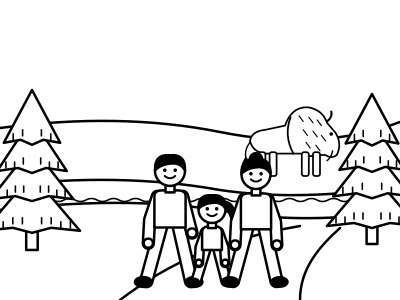
What Government Does
A government is a group of people who make rules and run things for a place. Our government takes care of roads, libraries and parks that everyone can use.
The First National Park
Long ago, in 1872, our country made Yellowstone a national park. It was the first national park in the world. It has hot springs, rivers and animals like bison.
Parks Today
Today there are many national parks. Park rangers take care of them and help visitors. Each park has its own plants and animals. We can hike and fish.
Words to know
- government: people who make rules and run things for a place
- national park: land our country keeps safe for everyone to enjoy
- ranger: a worker who takes care of a park
Talk about it
- What was the first national park in the world?
- Who takes care of national parks?
- Why do you think the government keeps parks for everyone instead of letting one person own them?
Home Connection
Five-minute ideas for the whole family, with things you already have
Math
We can subtract by thinking of an adding fact.
Do: Ask: what is 13 - 9? Think: 9 plus what makes 13? Count up from 9 on fingers: 10, 11, 12, 13. That is 4 more, so 13 - 9 = 4. Try 12 - 8 the same way.
Talk: Was it easier to count back or to count up? Why?
Reading & Writing
Pictures and words work together to teach.
Do: Look at a fact book page and talk about what the picture teaches and what the words teach. Write bike, time, slide, pin and pine for your child to read.
Talk: What did the picture teach that the words did not?
Science
Shadows form when something blocks light, and mirrors can change where light goes.
Do: In a dim room, shine a flashlight on a wall and make hand shadow puppets. Move your hand closer to the light and farther away.
Talk: How can you make your shadow bigger?
Social Studies
Government gives everyone services like parks, roads and libraries.
Do: Visit or talk about a park, library or road near you, and who takes care of it.
Talk: What would happen if no one fixed the roads?
This week's words: his, her, him, has, had
Celebrate a think-addition fact, a picture that taught something and a shadow puppet show.
Math catch-up: Is It the Whole or a Part?
10 minutes, if this week's math check was not secure · 1.OA.C.6
Children often subtract backward or add the two numbers. A number bond shows that the big number is the whole and the answer is a missing part, which must be smaller.
You need: paper and a pencil, 20 dry beans, 1 plastic cup
- Draw a number bond: one big circle on top (the whole) and two small circles under it (the parts). Write 15 in the whole and 7 in one part.
- Ask: "Is 15 the whole or a part?" (The whole.) "So the answer is a part. It must be smaller than 15."
- Say: "7 plus what makes 15?" Count on from 7 with beans: 8, 9, 10, 11, 12, 13, 14, 15. That is 8. Write 15 - 7 = 8.
- Do 12 - 5 a second way: take 2 to get to 10, then 3 more to get to 7. Ask your child which way felt easier.
Try again
- 16 grapes are in a bowl. You eat 9. How many are left? (Think: 9 + ___ = 16.)
- 13 crayons are in a box. You give away 5. How many are left? (Take 3 to get to 10, then take 2 more.)
- 17 beads are on a string. 8 beads slide off. How many are still on the string? (Think: 8 + ___ = 17.)
Specials This Week
Weeks 7–12 unit • ~90 min/week per subject
Non-Locomotor Skills and Balance
Practicing non-locomotor movements (bending, stretching, twisting, shaking, swaying), developing static and dynamic balance.
Discovering Color and Texture
Primary and secondary colors, warm and cool colors, mixing colors, identifying and creating textures (rough, smooth, bumpy, soft).
Pitch and Melody
High/low sounds, step/skip in melody, identifying melodic contour (up, down, same), singing simple melodies.
For guiding principles and full standards reference, visit How to use this curriculum
As an Amazon Associate, we earn from qualifying purchases. Book and supply links on this page are affiliate links — using them supports this curriculum at no extra cost to you.