1First Grade

    Greater than, less than, equal to

    Listening for answers

    Practice pages

    0 of 180 days complete · Saved on this device

    View all 180 days

    Math

    Greater than, less than, equal to

    I can use >, < and = to compare two numbers.

    Standards: 1.NBT.B.3

    Number practice (no timer)
    Subtraction facts within 10 (keep-up practice)
    Builds on
    Days 1 and 2: comparing with words. One-minute check: "Say a sentence about 62 and 58." (62 is greater than 58, or 58 is less than 62.)

    New words

    • >: the symbol for "is greater than"
    • <: the symbol for "is less than"
    • =: the symbol for "is equal to" or "is the same as"

    You need

    • 3 symbol cards made from paper squares: >, < and =
    • 9 straw bundles of 10 and 10 loose straws (or base-ten blocks)
    • 12 blank paper squares
    • Notebook and pencil
    1. Warm-Up · 5 min

      Fluency: subtraction facts within 10. "8 - 6?" (2) "10 - 3?" (7) "5 - 4?" (1) Spaced review from Week 15: "I have 2 ones and 9 tens. Who am I?" (92)

    2. Mini-Lesson · 10 min

      Say: "Math has short ways to write our comparing words." Show the > card. Say: "This means 'is greater than.' The wide open side faces the greater number, and the point faces the smaller number." Write 38 > 29 and read it from left to right: "38 is greater than 29." Show the < card. Write 29 < 38 and read it: "29 is less than 38." Show the = card. Write 45 = 45 and read it: "45 is equal to 45." Say: "We always read from left to right, like a sentence."

    3. Guided Practice · 10 min

      Write each pair with a space between. Your child compares, puts the right symbol card in the space, and reads the whole sentence aloud. 1) 45 _ 54 (<; 45 is less than 54) 2) 67 _ 62 (>; 67 is greater than 62) 3) 30 _ 30 (=; 30 is equal to 30) 4) 18 _ 81 (<) 5) 72 _ 27 (>) 6) 50 _ 49 (>; 5 tens is more than 4 tens) If stuck, say: "First say it in words: greater, less or equal. Then find the card that means that word."

    4. Play · 10 min

      Write and Read. Each player writes 6 two-digit numbers on the blank squares. Mix all 12 squares face down. Flip 2 and lay them side by side. Your child places the symbol card and reads the sentence. Then switch the order of the two numbers and ask: "Does the symbol change?" (Yes, unless the two numbers are equal. > becomes <, and < becomes >.) Read the new sentence. Play until the squares run out.

    5. Exit Ticket · 3-5 min

      Put the objects to one side but leave them on the table. Read each question aloud. Your child answers out loud, with objects or with a quick drawing. Check each answer together right away.

    Exit ticket

    1. Put >, < or = in the space: 36 _ 63
    2. 84 _ 81
    3. Read this: 49 < 94
    Answers
    1. <
    2. >
    3. 49 is less than 94.
    Watch for, and help or stretch
    Watch for
    Reading the symbol from right to left, or reading every symbol as "greater than."
    Try
    Point to the first number and read: "38 is ..." Then look at the symbol: is the wide side or the point next to 38?
    Extra help
    Say the comparison in words first and build both numbers before choosing the symbol.
    Stretch
    Write a true comparison with = that uses tens and ones, such as 4 tens and 6 ones = 46.

    At home (optional): Your child writes 3 comparisons with >, < and = for a family member to read aloud.
    Reading & Writing

    Listening for answers

    I can ask a question about what a speaker said.

    Standards: SL.1.3, SL.1.1.c, SL.1.6

    Phonics
    r-controlled ar (car, farm, star, park)
    Sight words
    your, our, their, these, which
    Reading
    Stone Soup (traditional, public domain) and Strega Nona's Harvest (Tomie dePaola)
    Writing
    Opinion: a book review (name the book, give an opinion, reasons, recommendation) · Handwriting: neat book-review copy
    Builds on
    Asking questions about stories (Unit 1). One-minute check: your child asks you one who, what or why question about Stone Soup.

    New words

    • speaker: the person who is talking
    • review: a short talk or piece of writing that tells what someone thinks of a book
    • follow-up question: a question that asks for more about what someone just said

    You need

    • A book you know well for your own spoken review
    • Sight word cards
    • Printed "Our Pot"
    1. Phonics & Word Work · 15 min

      ar in asking sentences. I do: read "Is the barn far?" with a voice that goes up. We do: read "Which car is your car?" "Is that our cart?" You do: your child reads far, yard, card, harp, dark, art. Dictation: far, yard, card, harp. If stuck, find ar first and box it.

    2. Sight Words · 5 min

      Review: your, our, their, these, which. Flip and Read: lay the five cards face down with last week's words. Your child flips a card, reads it and uses it in a short spoken sentence. Missed words go back in the pile.

    3. Read-Aloud & Shared Reading · 15 min

      Give a 30-second spoken review of a book you know well: name it, say if you liked it and give one reason. Your child listens, then asks two questions to learn more, such as "Why did you like it?" or "Who is in it?" Answer each one. Next, your child asks one question to clear up something that was not clear (SL.1.1.c): "What do you mean by ___?" Then switch: your child gives a short spoken review of "Our Pot" or Stone Soup, and you ask one follow-up question. Ask: "What did you learn from my answers?" (Answers vary. Look for: a detail you shared when answering.) If stuck, offer question starters on cards: Who, What, Why, Which.

    4. Writing & Handwriting · 15 min

      Your child writes two questions to ask a family member about a favorite book: "Which book do you like?" "Why do you like it?" Check the question marks. Handwriting (4 min): your child copies both questions neatly.

    5. Exit Ticket · 5 min

      Oral answers.

    Exit ticket

    1. Ask me a question about my book review.
    2. Why do listeners ask questions?
    3. Read this sentence: "Which car is your car?"
    Answers
    1. Answers vary. Look for: a real question about what was said.
    2. To learn more or to understand something that was not clear.
    3. Which car is your car?
    Watch for, and help or stretch
    Watch for
    Asking a question you already answered.
    Try
    Say: "I told you that. What else do you want to know?"
    Extra help
    Give your child the first word of each question.
    Stretch
    Your child asks a follow-up question that builds on your answer: "You said it was funny. What was the funniest part?"

    At home (optional): Your child asks a family member two questions about a favorite book or movie.

    Science

    Test and improve

    I can test my design and make it better.

    Standards: 1-LS1-1, K-2-ETS1-2

    Builds on
    Built prototype (Day 1). One-minute check: your child shows how the prototype is supposed to work.

    New words

    • test: to try something to see how well it works
    • tally: a mark you make to count, like a line for each one

    You need

    • Prototype from Day 1
    • Test items: 5 pieces of dry cereal or 5 large plastic beads and an empty plastic bowl (for grabbers), or up to 10 crackers (a new one for each try in Test 1 and Test 2; reuse any that did not break) and the zip-top bag (for shell protectors)
    • The same hardcover book each time (for shell tests)
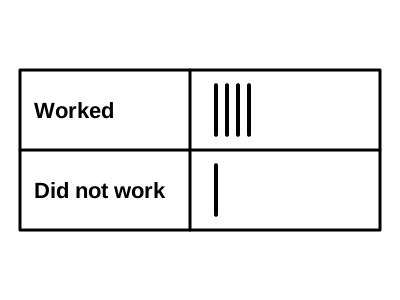
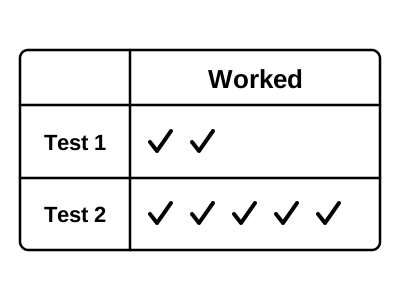
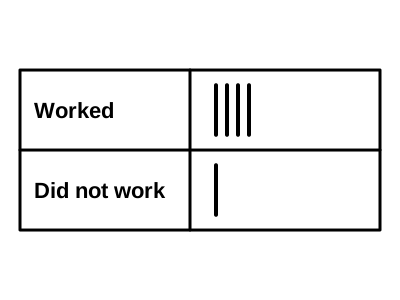
    • Tally chart: 2 rows (Test 1, Test 2) and 2 columns (Worked, Did not work)
    • Tape, craft sticks, rubber bands and paper cups for changes
    • Sketch from Week 16
    • Pencil
    1. Warm-Up / Wonder · 5 min

      Spaced review: ask: "Why do we change only one thing at a time?" (So we know which change made the difference.) Wonder question: "How many times out of 5 will your design work?" Your child predicts. Rubber band safety: point stretched rubber bands down at the table, never at faces. Choking safety: plastic beads and cereal pieces are small enough to choke on. The U.S. Consumer Product Safety Commission (CPSC) bans small parts in toys made for children under 3, so keep these items away from younger brothers and sisters, and remind your child that test items never go in mouths, noses or ears.

    2. Explore · 10–15 min

      Test 1. Grabber: your child tries to pick up a cereal piece or bead and drop it in the bowl, 5 times. Shell: put one cracker in the bag under the protector, set the book gently on top for a count of 3, then look. Use a new cracker each time, 5 times. After each try, make a tally mark in Worked or Did not work. Sample: 2 worked and 3 did not. Count: 2 + 3 = 5 tries. Ask: "What went wrong on the tries that did not work?" (Sample: the tips are too far apart; the cup got squashed.) Your child picks one change, such as moving the sticks closer, adding a second cup or adding a rubber band. Test 2: do 5 more tries the same way and tally. Sample: 4 worked and 1 did not. Ask: "Did more tries work after the change?" (In the sample, yes: 4 is 2 more than 2.) Your own numbers will vary. If stuck finding a change, watch one try in slow motion together and ask: "Where does it slip (or squash)?"

    3. Talk & Record · 5–10 min

      Your child updates the sketch with the change, using a different color, and finishes: "After my change, it worked ___ times out of 5."

    4. Exit Ticket · 3–5 min

      Ask the three questions aloud.

    Exit ticket

    1. How many tries worked in Test 1?
    2. What one thing did you change?
    3. Did your change help? How do you know?
    Answers
    1. Answers come from the tally chart. Look for: a number from 0 to 5 that matches the tallies.
    2. Answers vary. Look for: one change only.
    3. Answers vary. Look for: an answer that compares the two tally counts, such as "Yes, 4 worked this time and only 2 worked before."
    Watch for, and help or stretch
    Watch for
    Changing the test (a bigger cereal piece, or pressing harder) instead of the design.
    Try
    Say: "Same test items, same book, same way each time. Change only your design."
    Extra help
    Do 3 tries in each test instead of 5, and count the tallies together.
    Stretch
    Your child makes a second change and runs Test 3, then tells which version worked best.

    At home (optional): Your child tells a family member the two tally counts and whether the change helped.

    Practice

    Read each direction aloud. Your child works on the page; answers are in the grown-up view.

    Warm-up

    Remember?

    Math

    1. On the hundred chart, what number comes right after 39?
    2. The parts are 2 and 8. What is the whole?

    Reading & Writing

    1. for, or, but

    Math · Week 17 Day 3

    I can use >, < and = to compare two numbers.

    Look: 52 and 47

    1. Compare the tens: 5 tens and 4 tens. 52 is greater.
    2. The open side of the sign faces the greater number.
    3. Write 52 > 47. Read it: 52 is greater than 47.

    Write >, < or =.

    1. 1.
      65 ___ 56
    2. 2.
      31 ___ 39
    3. 3.
      88 ___ 88
    4. 4.
      40 ___ 14
    5. 5.
      73 ___ 77

    Circle the one that is true.

    1. 6.
      Which is true?
      • 26 < 62
      • 26 > 62
    2. 7.
      Which is true?
      • 90 > 89
      • 90 < 89
    3. 8.
      Which is true?
      • 57 = 57
      • 57 < 57

    Challenge (optional)

    Write a true sentence with < using two numbers that have the same tens.

    You need: symbol cards >, < and = (optional)

    Reading & Writing · Week 17 Day 3

    I can ask a question about what a speaker said.

    Look: ask a question about what someone said

    1. Read Barb's words aloud as if Barb is talking.
    2. Say: "Good listeners ask a question to learn more, such as: Why do you like it? Which part is the best?"
    3. Say: "We can also ask: What do you mean by ___?"

    Barb Said

    I like the tale Goat and Crow," said Barb. "Goat gave Crow a coat when Crow got wet. That is the best part!

    Read what Barb said. Circle the answer.

    1. 1.
      "I like the tale ___," said Barb.
      • Goat and Crow
      • Mark and the Cart
    2. 2.
      In the tale, Goat gave Crow a ___.
      • coat
      • boat
    3. 3.
      Barb said this part is the ___.
      • best
      • end

    Write questions you could ask Barb.

    1. 4.
      Which ___?
    2. 5.
      Why do you ___?
    3. 6.
      What do you mean when you say ___?

    Challenge (optional)

    Ask a pal: Which tale is your pick?

    Science · Week 17 Day 3

    I can test my design and make it better.

    Look: Count the tries with tallies

    1. Do 5 tries. Make a tally mark for each one: worked or did not work.
    2. Sample: 3 worked and 2 did not. 3 + 2 = 5 tries.
    3. Change one thing, then do 5 more tries and compare.

    Count the tally marks and circle the number.

    1. 1.
      A tally chart: Worked has 4 marks, Did not work has 1 mark. How many tries worked?
      • 1
      • 4
      • 5
    2. 2.
      The same tally chart. How many tries did not work?
      • 1
      • 3
      • 4
    3. 3.
      Test 1 has 2 Worked marks; Test 2 has 5 Worked marks. Did the change help?
      • yes
      • no

    Test your design and record.

    1. 4.
      Test 1: try your design 5 times. Make a tally mark for each try.
    2. 5.
      Tell one thing to change. Your grown-up writes it.
    3. 6.
      Test 2: try 5 more times after the change. Make a tally mark for each try.
    4. 7.
      Did more tries work after the change? Make a mark on yes or no.

    Challenge (optional)

    Test 1 had 1 try that worked. Test 2 had 3. How many more worked in Test 2?

    You need: your prototype, 5 test items (cereal pieces or large plastic beads with an empty plastic bowl, or crackers in a zip-top bag); small pieces are a choking hazard for children under 3, pencil