1First Grade

    Lesson + weekly check: comparing numbers

    Share and check: ar

    Practice pages

    0 of 180 days complete · Saved on this device

    View all 180 days

    MathWeekly check

    Lesson + weekly check: comparing numbers

    I can compare two-digit numbers and explain using tens and ones.

    Standards: 1.NBT.B.3

    Number practice (no timer)
    Subtraction facts within 10 (keep-up practice)
    Builds on
    Days 1 to 4: comparing two-digit numbers with words and symbols. One-minute check: "Which is greater, 40 or 39?" (40)

    New words

    • compare: decide which number is greater or less, or if they are equal

    You need

    • 6 tricky-pair cards made from paper squares: 40 and 39, 61 and 16, 58 and 85, 70 and 71, 99 and 90, 23 and 23
    • 3 symbol cards: >, < and =
    • 9 straw bundles of 10 and 10 loose straws (or base-ten blocks)
    • The stored Week 17 check and its answer key
    • Notebook and pencil
    1. Warm-Up · 5 min

      Fluency: subtraction facts within 10. "10 - 5?" (5) "8 - 7?" (1) Spaced review from Week 16: "What is right after 109 on the chart?" (110)

    2. Short Lesson: Review Game · 10 min

      Tricky Pairs. Flip each tricky-pair card. Your child places the symbol and explains with tens and ones. 40 > 39 (4 tens is more than 3 tens, even though 9 ones is a lot); 61 > 16 (6 tens and 1 ten); 58 < 85 (5 tens and 8 tens); 70 < 71 (same tens, 0 ones and 1 one); 99 > 90 (same tens, 9 ones and 0 ones); 23 = 23. If stuck, say: "Build both numbers with bundles. Which pile has more tens?"

    3. Weekly Check · 15 min

      Give the stored Week 17 check. The printed check has 10 items. It covers these goals: (1) I can compare two numbers by looking at the tens first; (2) I can compare numbers that have the same tens; (3) I can use >, < and = to compare two numbers; (4) I can make two-digit numbers and compare them. Read each pair aloud. There is no time limit. If your child is stuck, say only: "Look at the tens first." Do not give the answer. Score it with the answer key. Secure: 9 of 10 correct. If the check is secure, start Week 18. If it is not, first do the reteach step on the check page for each group of items missed, then start Week 18.

    4. Exit Ticket · 3-5 min

      After the check, ask these two questions. Then go over any missed check items together.

    Exit ticket

    1. Put >, < or = between 40 and 39.
    2. Which is less, 70 or 71? How do you know?
    Answers
    1. 40 > 39
    2. 70. The tens are the same, and 0 ones is less than 1 one.
    Watch for, and help or stretch
    Watch for
    Saying 39 is greater than 40 because of the 9.
    Try
    Build both. Ask: "Which pile has more tens?" A ten is more than 9 ones.
    Extra help
    Let your child build each check pair with bundles, and note it on the check.
    Stretch
    After the check, your child writes 3 tricky pairs of their own for you.

    At home (optional): Your child shows a family member one tricky pair and explains it.
    Reading & WritingWeekly check

    Share and check: ar

    I can read ar words and share my book review.

    Standards: RF.1.3.b, RF.1.3.g, W.1.1

    Phonics
    r-controlled ar (car, farm, star, park)
    Sight words
    your, our, their, these, which
    Reading
    Stone Soup (traditional, public domain) and Strega Nona's Harvest (Tomie dePaola)
    Writing
    Opinion: a book review (name the book, give an opinion, reasons, recommendation) · Handwriting: neat book-review copy
    Builds on
    This week's ar work and the book review. One-minute check: warm up with car, farm and star.

    New words

    • recommendation: advice about whether to read something

    You need

    • Word cards: ar words (written in step 4)
    • Sight word cards: your, our, their, these, which
    • Recording sheet
    • Book review from Day 4
    1. Review Game · 10 min

      Star Jump: lay 10 cards in a star shape: car, farm, star, park, barn, yard, dark, shark, start, cart. Your child reads a card, then does a star jump. If stuck on a word during the game (not during the check), cover all but the first sound, say it together, then uncover the rest and blend.

    2. Sight Words · 5 min

      Review: your, our, their, these, which, for, or, but, not, all. Mystery Word: give one clue at a time (It has 4 letters. It starts with y...). Your child reads the cards and points to the match. Mix this week's and last week's words.

    3. Weekly Check · 15 min

      The printed check has 8 items. It covers these goals: (1) I can read ar words; (2) I can read the sight words your, our, their, these and which; (3) I can tell how a character solves a problem; (4) I can ask a question about what someone said; (5) I can write a book review with an opinion and a reason. Give no hints. Record each answer. Secure: 8 of the 10 words in items 1 and 2, 4 of the 5 sight words, items 4 and 5, a real question in item 6, and items 7 and 8. For any part that is not yet secure, use the matching reteach step on the check page next week.

    4. Share & Listen · 10 min

      The listener asks one question about the review. Your child answers in a full sentence.

    5. Handwriting · 5 min

      Your child copies "Read it!" and the book title neatly for the top of the review. Circle the best word.

    6. Exit Ticket · 5 min

      Talk about the week.

    Exit ticket

    1. Read two ar words.
    2. Which tale did you review? Would you tell a friend to read it?
    Answers
    1. Answers vary. Look for: correct reads such as car and farm.
    2. Answers vary. Look for: a tale and a yes or no with a reason.
    Watch for, and help or stretch
    Watch for
    Mixing up their and there.
    Try
    Show both cards: "their means it belongs to them; there tells where." Read "Their dish is there." three times.
    Extra help
    Read the directions for items 7 and 8 aloud and let your child hold the review.
    Stretch
    Your child reads 3 bonus or words (corn, fork, short) to preview next week. Do not score them.

    At home (optional): Read "Our Pot" to a family member.

    ScienceWeekly check

    Show my nature design

    I can show my design and tell which living thing I copied.

    Standards: 1-LS1-1

    Builds on
    Tested design (Day 3). One-minute check: ask "Did your change help? How do you know?" (Answers come from the tally chart.)

    New words

    • present: to show and tell your work to others

    You need

    • Prototype
    • Sketch with changes
    • Tally chart from Day 3
    • 2 test items (2 cereal pieces or 2 crackers and the zip-top bag)
    • Notebook
    1. Warm-Up / Wonder · 5 min

      Spaced review: ask: "What did George de Mestral copy from a burr?" (the tiny hooks) Wonder question: "How will you explain your design so someone else understands it?"

    2. Review Game · 10 min

      Practice the 4-part talk with a hand: one finger for each part. 1) The problem. 2) The animal or plant part I copied. 3) How it works (the shape and its job). 4) What I changed and what happened. Your child practices once with the prototype. Then switch: you present a pretend design ("My problem is wet feet. I copied a duck's oily feathers...") and your child counts your 4 parts on their fingers and tells you if you missed one. If stuck on a part, point to the sketch or the tally chart for a clue.

    3. Check · 10 min

      Give the Week 17 science check. The check items are on the Week 17 check page; do not show them ahead of time. Read each part aloud. Your child answers by talking, pointing, showing with the real materials or drawing. You write down their words exactly. It is not timed; stop and finish later if your child is tired. Make a check mark next to each part your child shows on their own. The printed check has 8 items. It covers these goals: (1) I can build my design with simple materials; (2) I can test my design and make it better; (3) I can show my design and tell which living thing I copied. This week the check is a short presentation. Your child presents the design to you or another family member, shows it working once, and answers one question from the listener. Look for: all 4 talk parts (items 1, 2, 3 and 5): the problem, the living thing's part that was copied, how the shape helps it work, and the change and its result from the tally chart. Secure: all 4 talk parts (items 1, 2, 3 and 5) and at least 6 of 8 in all. If the check is not yet secure, use the reteach step on the check page that matches the items missed.

    4. Exit Ticket · 3–5 min

      Ask the three questions aloud.

    Exit ticket

    1. What problem does your design solve?
    2. Which living thing did you copy?
    3. What would you change next time?
    Answers
    1. Answers vary. Look for: the problem chosen in Week 16.
    2. Answers vary. Look for: a real plant or animal part, such as a bird's beak or a turtle's shell.
    3. Answers vary. Look for: one specific change, such as longer sticks or a stiffer cover.
    Watch for, and help or stretch
    Watch for
    Telling only how the design was built.
    Try
    Hold up finger 2 and ask: "Which living thing helped you?"
    Extra help
    Your child presents with the 4 fingers as a checklist and you give the first words of each part.
    Stretch
    Your child records a short video of the presentation (with a grown-up) or presents to a second listener and takes 2 questions.

    At home (optional): Your child presents the design to one more person, such as a grandparent on a phone call.

    Practice

    Read each direction aloud. Your child works on the page; answers are in the grown-up view.

    Warm-up

    Remember?

    Math

    1. Riddle: I have 3 tens and 9 ones. What number am I?
    2. What number goes in the blank? ___ - 6 = 6

    Reading & Writing

    Math · Week 17 check

    Weekly check

    How to give it: Read each pair aloud. Untimed. Your child writes >, < or = and explains items 9 and 10 out loud or in writing. If stuck, say only: "Look at the tens first." Do not give the answer.

    Secure when: 9 of 10 correct

    • I can compare two numbers by looking at the tens first.
    • I can compare numbers that have the same tens.
    • I can use >, < and = to compare two numbers.
    • I can make two-digit numbers and compare them.
    1. 1.
      74 ___ 47
    2. 2.
      39 ___ 60
    3. 3.
      86 ___ 81
    4. 4.
      52 ___ 59
    5. 5.
      66 ___ 66
    6. 6.
      13 ___ 31
    7. 7.
      With the cards 6 and 3, make the greatest number. Write >, < or = between it and 58.
    8. 8.
      With the cards 1 and 9, make the greatest number. Write >, < or = between it and 89.
    9. 9.
      Tell why 74 > 47 is true. Use tens and ones.
    10. 10.
      Tell why 52 < 59 is true. Use tens and ones.

    Reading & Writing · Week 17 check

    Weekly check

    How to give it: Give the check after the review game, in a quiet spot, one part at a time. It is untimed; take a stretch break between parts if needed. Read every direction aloud, but do not read the words or story for your child. Do not help except to say "Try your best" or "Skip it." Mark each item right or wrong. Items 1 and 2 (Part 1): your child reads the ar words aloud. Item 3 (Part 2): your child reads the 5 sight words. Then your child reads "The Barn Cat" aloud and you read the directions for items 4 to 8; for item 6, say the two sentences in the item and let your child ask you a question. Part 3 of the lesson follows: your child reads the Day 4 book review aloud to a listener.

    Secure when: 8 of the 10 words in items 1 and 2, 4 of the 5 sight words, items 4 and 5, a real question in item 6, and items 7 and 8.

    • I can read ar words.
    • I can read the sight words your, our, their, these and which.
    • I can tell how a character solves a problem.
    • I can ask a question about what someone said.
    • I can write a book review with an opinion and a reason.

    The Barn Cat

    A cat had a job at a farm. The cat had to keep the barn safe. A rat got in the barn! The cat had a plan. It hid in the dark by a cart. Then it ran at the rat, and the rat ran far from the barn.

    1. 1.
      tar bark harm scar charm
    2. 2.
      lard carp mart snarl yarn
    3. 3.
      your our their these which
    4. 4.
      • A rat got in the barn.
      • The cat had a nap.
    5. 5.
      • It hid in the dark, then ran at the rat.
      • It ate a tart.
    6. 6.
    7. 7.
      the barn cat
    8. 8.
      I think ___ because ___.

    Science · Week 17 check

    Weekly check

    How to give it: Read every direction, question and choice aloud. It is not timed; stop and finish later if your child is tired. Your child answers by talking, pointing, showing with the real materials or drawing, and you write their words exactly. Have the prototype, the sketch with changes, the tally chart and 2 test items. Your child presents to you or another family member. Small test items are a choking hazard for children under 3.

    Secure when: all 4 talk parts (items 1, 2, 3 and 5) and at least 6 of 8 in all.

    • I can build my design with simple materials.
    • I can test my design and make it better.
    • I can show my design and tell which living thing I copied.
    1. 1.
      Present your design. Tell the problem it solves.
    2. 2.
      Tell the plant or animal part you copied.
    3. 3.
      Tell how the shape helps it work.
    4. 4.
      Show it working once.
    5. 5.
      Tell what you changed and what happened. Use the tally chart.
    6. 6.
      Answer one question from your listener. Your grown-up writes the question and your answer.
    7. 7.
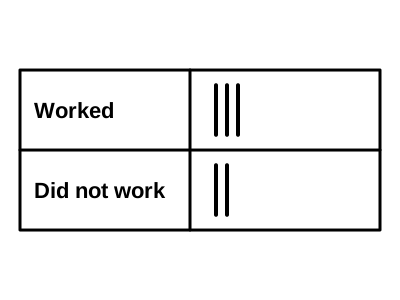
      A tally chart: Worked has 3 marks, Did not work has 2 marks. How many tries were there in all?
      • 3
      • 5
      • 6
    8. 8.
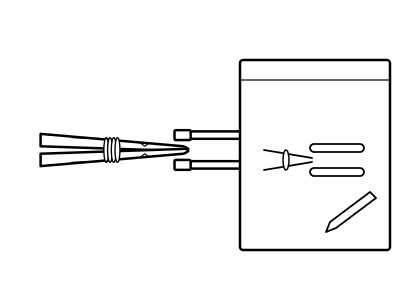
      A clothespin with 2 craft sticks taped on, and the sketch beside it. Did this builder make the design from a sketch?
      • yes
      • no