This week's lessons
Math and reading every day; science and social studies take turns
- Day 1 · Monday
- MathTaking away tensI can take tens away from tens.
- Reading & WritingExpression in readingI can read with expression that matches the words.
- ScienceDog familiesI can tell how puppies look like their parents.
- Day 2 · Tuesday
- MathThink adding to subtract tensI can use an adding fact to subtract tens.
- Reading & WritingReader's theaterI can read my part in a play with expression.
- Social StudiesNative nations long ago and todayI can tell how life for a Native nation was long ago and is today.
- Day 3 · Wednesday
- MathSubtracting tens on the chartI can hop up the hundred chart to subtract tens.
- Reading & WritingReading for meaningI can read a poem and tell what it is about.
- ScienceSeeds grow into their parents' kindI can predict what a seed will grow into.
- Day 4 · Thursday
- MathSubtracting tens in storiesI can solve stories that take away tens.
- Reading & WritingPoem page with drawingsI can copy a favorite poem and add a drawing that shows its feeling.
- Social Studies · CheckPeople who changed thingsI can ask questions about people who helped make a big change.
- Day 5 · Friday
- Math · CheckLesson + weekly check: subtracting tensI can subtract tens and explain how.
- Reading & Writing · CheckShare and check: vowel reviewI can read vowel team words and perform a poem with expression.
- Science · CheckMy evidence accountI can use my observations to explain that babies are like their parents but not exactly.
This week's checks
Short checks on the last day each subject meets this week
Social Studies · Day 4
- I can tell how life for a Native nation was long ago and is today.
- I can ask questions about people who helped make a big change.
Secure when: 6 of 7 correct, with at least one right on each goal
Open the checkMath · Day 5
- I can subtract tens from tens.
- I can explain how I subtract tens.
Secure when: 6 or 7 of the 7 items right.
Open the checkReading & Writing · Day 5
- I can read vowel team words and perform a poem with expression.
- I can read my part and tell what a poem is about.
- I can use capital letters and copy a poem neatly.
Secure when: 10 of 12 words in items 1-2, 4 of 5 sight words, some expression in item 4, and 4 of 6 on items 5-10.
Open the checkScience · Day 5
- I can tell how puppies look like their parents.
- I can predict what a seed will grow into.
- I can use my observations to explain that babies are like their parents but not exactly.
Secure when: 5 of 7 correct, including items 1 and 2 (two real pieces of evidence, one for "like" and one for "not exactly").
Open the check
Reading About Our World: The Navajo Nation
Read it aloud. Your child reads the sentences marked with a star. Builds social studies knowledge.
Many Nations
More than 570 Native nations are part of the United States today. Each nation has its own land, history and way of life.
The Diné
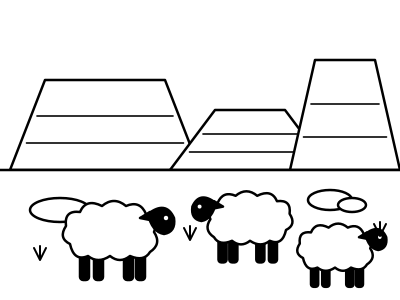
Navajo people call themselves Diné. The Navajo Nation's land is in Arizona, New Mexico and Utah. It has deserts, mesas and red rocks. For a very long time, many Diné families have raised sheep.
The Navajo Nation Today
The Navajo Nation has its own government. Its capital is Window Rock. Many people speak the Navajo language. Some kids speak it at home.
Words to know
- nation: a group of people with its own land and government
- capital: the city where a government meets
- language: the words people use to talk
Talk about it
- What do Navajo people call themselves?
- What is the capital of the Navajo Nation?
- Why might families teach their children the Navajo language at home?
Home Connection
Five-minute ideas for the whole family, with things you already have
Math
Taking away tens from tens is like taking away ones: 7 tens - 3 tens = 4 tens.
Do: Put out 7 cups of ten beans. That is 70. Take away 3 cups. How many are left?
Talk: "If 7 - 3 = 4, what is 70 - 30?"
Reading & Writing
Reading with expression shows how characters feel.
Do: Read one page of a book in a happy voice, a sad voice and a surprised voice. Write rain, feet, boat, light and coin for your child to read.
Talk: How did your voice change when you read in a surprised voice?
Science
Baby animals and young plants are like their parents, but not exactly.
Do: Look at photos of an animal family, like a litter of puppies with grown dogs, and find ways the young look like the grown-ups and ways they look different.
Talk: What will a sunflower seed grow into?
Social Studies
Native nations have lived here for a very long time and are part of our country today; people can work to make big changes.
Do: Find out which Native nations have homelands in your state today, using your state's official website or a Native nation's own website. Look at one nation's website together.
Talk: What did you learn about how that nation lives today?
This week's words: did, get, made, part, new
Celebrate subtracting tens, reading with expression and something new about a Native nation.
Math catch-up: Tens Take Away Tens
10 minutes, if this week's math check was not secure · 1.NBT.C.6
When subtracting tens, children often answer in ones (70 - 30 = 4) or add instead. Saying the problem as tens ('7 tens take away 3 tens') and counting the bundles left fixes both.
You need: 90 straws or craft sticks, 9 rubber bands, a plastic cup
- Put 6 bundles out. Say: "6 tens take away 2 tens." Your child puts 2 bundles in the cup.
- Count the bundles left by tens: 10, 20, 30, 40. Write 60 - 20 = 40.
- Ask: "Is 60 the whole or a part?" (The whole.) "So the answer must be less than 60."
- Do 90 - 60 and 70 - 70 the same way. For 70 - 70, ask: "How many bundles are left?" (None: 0.)
Try again
- A store has 80 apples in bags of 10. It sells 30 apples. How many apples are left?
- You have 90 stickers on sheets of 10. You use 30. How many stickers are left?
- A box has 70 crayons in packs of 10. 40 crayons are used. How many are left?
Specials This Week
Weeks 19–24 unit • ~90 min/week per subject
Manipulative Skills (Kicking and Dribbling)
Developing kicking skills (stationary and moving ball), dribbling with hands (bouncing) and feet (soccer style).
Value and Self-Expression
Light and dark (value), creating form and shadow, using art to express feelings, drawing self-portraits.
Form and Timbre
Identifying repeating sections (ABA, AABB format), recognizing different instrument sounds (timbre), classifying instruments (strings, woodwinds, brass).
For guiding principles and full standards reference, visit How to use this curriculum
As an Amazon Associate, we earn from qualifying purchases. Book and supply links on this page are affiliate links — using them supports this curriculum at no extra cost to you.