1First Grade

    Shapes from composite shapes

    Who is telling now?

    Practice pages

    0 of 180 days complete · Saved on this device

    View all 180 days

    Math

    Shapes from composite shapes

    I can use a new shape to build another shape.

    Standards: 1.G.A.2

    Number practice (no timer)
    Doubles with pattern blocks (keep-up practice)
    Builds on
    Day 1 (composing a new shape from 2 pieces). One-minute check: "What do 2 half-circles make?" (A circle)

    New words

    • composite shape: a shape made by putting smaller shapes together

    You need

    • Paper shape kit (an adult makes it on Week 32 Day 1 from construction paper or cereal-box cardboard and keeps it in a bag all week): 8 squares, each 2 inches on a side; 12 triangles, made by cutting 6 more 2-inch squares in half from corner to corner; 4 rectangles, 2 inches by 4 inches; 4 half-circles, made by tracing a cup about 4 inches across twice, cutting out the circles and cutting each one in half; and 4 quarter-circles, made by cutting one more circle into 4 equal parts (fold it in half, then in half again, and cut on the folds)
    • Notebook and pencil
    1. Warm-Up · 5 min

      Fluency: doubles with shape pieces. Lay out 5 triangles and 5 more. "5 + 5?" (10) Lay out 2 rectangles and 2 more. "2 + 2?" (4) Spaced review from Week 26: "A ribbon is 7 clips long. A string is 3 clips long. How many clips longer is the ribbon?" (4)

    2. Mini-Lesson · 10 min

      Put 2 squares side by side. Ask: "What shape did I make?" (A rectangle) Say: "This rectangle is a composite shape. Now I will use it to build something new." Make a second rectangle from 2 more squares. Put the 2 rectangles together along their long sides. Ask: "What shape now?" (A bigger square) "How many small squares are in it?" (4) Say: "I made a new shape, then used that new shape to make another new shape." Show one more chain quickly: 2 triangles make a square, and 2 of those squares make a rectangle.

    3. Guided Practice · 10 min

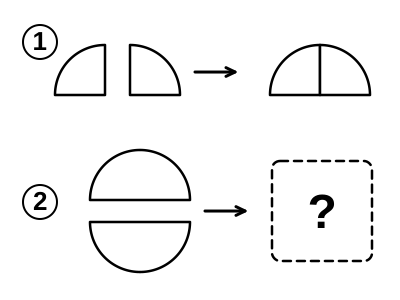
      Two-Step Builds. Clear the table after each one. Your child builds step 1, makes a second copy, then does step 2, and traces the final shape in the notebook. 1) Step 1: 2 quarter-circles make a half-circle. Step 2: 2 of those half-circles make a circle. (Uses 4 quarter-circles) 2) Step 1: 1 square and 1 triangle make a trapezoid. Step 2: turn the second trapezoid upside down and fit the 2 slanted sides together. (A long rectangle; uses 2 squares and 2 triangles) 3) Step 1: 2 triangles make a big triangle. Step 2: put 2 big triangles together along their long sides. (A square standing on its corner; uses 4 triangles) If stuck, say: "Build the step 1 shape twice. Then look for two sides that match."

    4. Play · 10 min

      Build It Bigger. Your child chooses 2 kit pieces, makes a composite shape and traces it. Then your child makes a second copy and uses the 2 copies to make a bigger shape, and tells you the shapes used. Answers vary. Then your challenge: "Make a long rectangle using only triangles." (Look for: 2 triangles make a square, then 2 squares make a rectangle; 4 triangles in all.)

    5. Exit Ticket · 3-5 min

      Put the objects to one side but leave them on the table. Read each question aloud. Your child answers out loud, with objects or with a quick drawing. Check each answer together right away.

    Exit ticket

    1. Put 2 rectangles together end to end, short side to short side. What shape do you get?
    2. How many triangles do you need to make 2 squares?
    3. Make a new shape from 3 squares. How many sides does it have?
    Answers
    1. A longer rectangle
    2. 4
    3. Answers vary. Look for: a long rectangle (4 sides) or an L shape (6 sides), with sides counted correctly.
    Watch for, and help or stretch
    Watch for
    Mixing up the steps and building the final shape from single pieces without making the step-1 shapes first.
    Try
    Have your child build the step-1 shape, say its name out loud, and put it in its own spot before starting step 2.
    Extra help
    Do only chain 1 and chain 2 of the Guided Practice, and trace each step-1 shape so your child can lay the pieces on the tracing.
    Stretch
    Ask: "The big square from the Mini-Lesson used 4 small squares. How many triangles would make the same big square?" (8)

    At home (optional): Your child builds a composite shape from blocks or paper squares and shows a family member how to use 2 of them to make a bigger shape.
    Reading & Writing

    Who is telling now?

    I can say who is telling the story at different points.

    Standards: RL.1.6, RL.1.10, SL.1.1

    Phonics
    y as long e at the end of two-syllable words (happy, puppy, sleepy), with cumulative review: final e and vowel teams
    Sight words
    such, why, went, read, need
    Reading
    Goldilocks and the Three Bears and The Three Little Pigs (traditional, public domain; our own retellings); original decodable "Jade and the Three Goats"
    Writing
    Showcase: revise with peer and adult suggestions · Handwriting: neat final copy
    Builds on
    Who is telling the story (Week 14). One-minute check: your child tells who is talking in this line: "Too hot!" said Goldilocks. (Goldilocks)

    New words

    • narrator: the voice that tells the story
    • speaker: the character who is talking
    • quotation marks: marks (" ") that show the words a character says

    You need

    • Printed "Jade and the Three Goats" (in the lesson)
    • Printed "Goldilocks and the Three Bears" (from Day 1)
    • Two signs on index cards: Narrator and Character
    • Word cards (index cards): tray, gray, trail, wait, steep, sleep, oats, bowl, beach, team, rocky, sleepy, muddy, rainy, stormy, dusty
    • Sight word cards: such, why, went, read, need
    • Lined handwriting paper
    1. Phonics & Word Work · 15 min

      Vowel teams review. I do: write trail. Say: "ai is a vowel team: two vowels, one sound, long a." Read it. Write tray: "ay is long a at the end of a word." We do: read wait, steep and oats together and name the team (ai, ee, oa). You do: your child reads gray, sleep, bowl, beach, team and tells the team and its sound (ay: long a; ee: long e; ow: long o; ea: long e; ea: long e). Then y as long e: your child reads rocky, sleepy and muddy from this week's story, plus rainy, stormy and dusty, and tells the two parts of each (rock | y, sleep | y, mud | dy, rain | y, storm | y, dust | y). Say: "Sometimes the first part is a whole word, and the y is added on." Read: "Jade went up the steep, rocky trail." Dictation: wait, sleep, oats, rainy. If stuck, frame the two letters of the team with your fingers: "These two letters are a team; this team says ___."

    2. Sight Words · 5 min

      Review: such, why, went, read, need. Clap and Read: you say a sentence with one of the words; your child claps when they hear it, then finds and reads the card.

    3. Read-Aloud & Shared Reading · 15 min

      Say: "A story has a narrator, who tells it, and characters, who talk. Quotation marks show when a character talks." Echo-read the decodable story, then your child reads it alone. Jade and the Three Goats Jade went on a hike up a steep, rocky trail. At the top, she came to a home made of gray stone. "Who lives here?" said Jade. No one was home, so she went in. On a tray, she found three bowls of oats. Jade ate the oats in the small bowl. Then Jade felt sleepy. She found three beds. She slept in the small bed. Then the three goats came home. They were muddy and happy. "Who ate my oats?" said Little Goat. "Why is a girl in my bed?" said Little Goat. Jade woke up. She did not run. "I need to tell you I am sad," said Jade. "I ate your oats and slept in your bed. That was not right." "Thank you for telling us," said Big Goat. "Next time, wait and ask." So Jade made the goats a cake. Then she read them a funny tale, and they all had a good time. Your child holds up the Narrator or Character sign for each line you point to. Ask: "Who is talking in this line: 'Who lives here?' said Jade." (Jade, a character.) "In this line: Then the three goats came home." (The narrator.) "In this line: 'Next time, wait and ask.'" (Big Goat.) Then go back to "Goldilocks and the Three Bears". Use our talk rules: one talker at a time, and add on to what the other person says. You read the narrator's words; your child reads Baby Bear's line with a small voice: "and here she is!" Ask: "Who is telling the part that says Soon the bears came home?" (The narrator.) Ask: "How do you know when a bear is talking?" (There are quotation marks, and it says said Papa Bear, said Mama Bear or said Baby Bear.) If stuck, put a finger on the quotation marks.

    4. Writing & Handwriting · 15 min

      Your child writes one narrator line and one character line about Jade, using quotation marks for the character: Jade went in. "I need a nap," said Jade. (Answers vary. Look for: one line with no quotation marks that tells what happened, and one line with quotation marks around a character's words.) Handwriting (4 min): quotation marks are two small marks at the top of the line, like tiny raindrops, at the start and the end of the words someone says.

    5. Exit Ticket · 5 min

      Oral answers.

    Exit ticket

    1. Who is talking: "I made a yummy cake!" said Jade.
    2. Who is telling this part: The goats ate the cake on the green.
    3. What marks show that a character is talking?
    Answers
    1. Jade (a character).
    2. The narrator.
    3. Quotation marks.
    Watch for, and help or stretch
    Watch for
    Saying Jade is telling the story because it is about her.
    Try
    Say: "Jade talks only when you see quotation marks. Who says Then the three goats came home? That is the narrator."
    Extra help
    Use only the Jade story today. You read the narrator lines and your child reads the character lines.
    Stretch
    Your child reads the whole Jade story with a different voice for each goat and a plain voice for the narrator.

    At home (optional): Your child reads "Jade and the Three Goats" to a family member, using a different voice for the narrator and for each character.

    Science

    Shape matters

    I can test whether the shape of paper changes how much weight it holds.

    Standards: K-2-ETS1-2

    Builds on
    Define my problem (Week 31). One-minute check: ask "What is your problem sentence?" (Answers vary.) "What is the goal for your fix?" (Answers vary.)

    New words

    • shape: the outline or form of a thing
    • strong: able to hold up weight without bending or breaking
    • fair test: a test where everything stays the same except the one thing you are testing

    You need

    • 3 sheets of printer paper, all the same size
    • 2 stacks of books the same height, set about 6 inches apart on a table (the bridge goes across the gap)
    • 1 small plastic cup (the same cup for every test)
    • About 80 pennies (or 80 other coins that are all the same kind, or 80 metal washers all the same size)
    • Engineering Journal and a pencil
    • A ruler or a strip of paper to measure the 6-inch gap the same each time
    1. Warm-Up / Wonder · 5 min

      Spaced review: ask: "What does an engineer do?" (designs and builds things to solve problems) Wonder question: "Can a flat sheet of paper hold up pennies? What if we change its shape?" Let your child predict and write the prediction in the journal. Safety: coins and other small objects are a choking hazard for children under 3. Keep them away from little brothers and sisters, and coins never go in mouths.

    2. Explore · 10–15 min

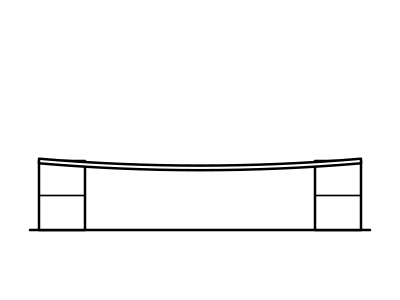
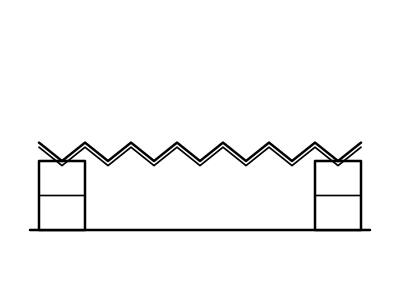
      Say: "Today we test how shape changes what paper can do. For a fair test, we keep everything the same except the shape: the same paper, the same gap, the same cup." Test 1, flat: lay one flat sheet across the gap like a bridge. Set the cup in the middle. Your child adds pennies one at a time, counting out loud, until the paper bends down and the cup touches the table or falls. Write the number of pennies it held before it fell. Test 2, folded: fold the second sheet back and forth like a fan (accordion folds about 1 inch wide) the long way. Lay it across the same gap. Set the cup in the middle and add pennies the same way. Write the number. If it still holds all 80 pennies, write "more than 80"; that still shows which shape held more. Ask: "Which shape held more pennies?" (Answers vary. Look for: the shape whose number was bigger, usually the folded one.) "What did we change?" (only the shape) "Why did we keep the paper, the gap and the cup the same?" (so it is a fair test) Say: "The folds give the paper a new shape. Shape can change how strong something is. Engineers use this idea in bridges and boxes." Optional Test 3: roll the third sheet into a tube or fold it into a U-shaped channel and test it the same way. If stuck counting a big number, move the pennies into groups of 10 as you count, then count the groups and the extras.

    3. Talk & Record · 5–10 min

      Your child draws the flat paper and the folded paper in the Engineering Journal and writes the penny number under each. Sentence frame: "The ___ paper held more pennies. Its shape ___."

    4. Exit Ticket · 3–5 min

      Ask the three questions aloud. Your child answers by talking or drawing.

    Exit ticket

    1. Sam tests a flat paper over a small gap and a folded paper over a big gap. Is that a fair test? Why?
    2. A cardboard box has folded edges. How might the folds help the box?
    3. What is one shape idea you could use in your own design?
    Answers
    1. No. The gap changed too, so we would not know if the shape made the difference.
    2. Answers vary. Look for: the folds make the box stronger so it holds its shape.
    3. Answers vary. Look for: a shape idea such as folds, a wide bottom, or tall sides.
    Watch for, and help or stretch
    Watch for
    Changing two things at once (a different paper and a new shape).
    Try
    Ask: "If we changed the paper and the shape, how would we know which one made the difference?" Keep everything the same but the shape.
    Extra help
    Do only Tests 1 and 2, and count pennies in groups of 5 together.
    Stretch
    Your child tests the tube shape too and puts the 3 results in order from fewest to most pennies.

    At home (optional): Your child finds 2 things at home with folds or curves (a paper plate rim, a cardboard box) and tells how the shape might help.

    Practice

    Read each direction aloud. Your child works on the page; answers are in the grown-up view.

    Warm-up

    Remember?

    Math

    1. I color a square green. Is it still a square? (yes or no)
    2. Write >, < or =: 23 ___ 32

    Reading & Writing

    1. The pig ate the corn in the barn.

    Math · Week 32 Day 2

    I can use a new shape to build another shape.

    Look: a shape from a new shape

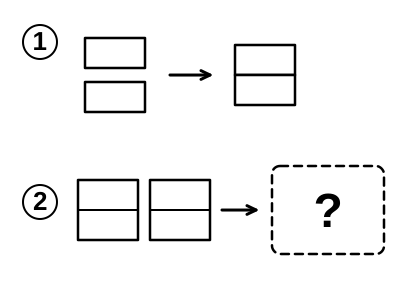
    1. 2 triangles make a square.
    2. Make another square the same way.
    3. Put the 2 squares side by side: they make a rectangle. 4 triangles in all.

    Answer about each two-step build.

    1. 1.
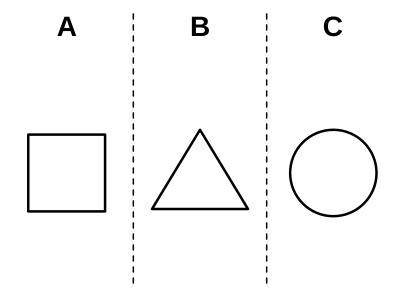
      Step 1, 2 quarter-circles make a half-circle; step 2, 2 of those half-circles go together. What shape is made in step 2? Picture A: a square; picture B: a triangle; picture C: a circle.
      • A
      • B
      • C
    2. 2.
      How many quarter-circles are used in all? ____
    3. 3.
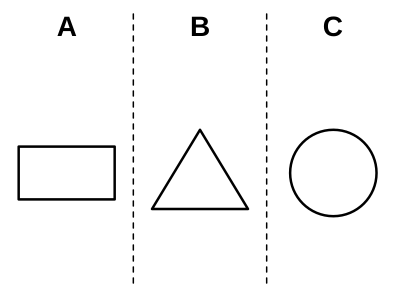
      Step 1, 2 rectangles go together along their long sides to make a square; step 2, 2 of those squares go side by side. What shape is made in step 2? Picture A: a rectangle; picture B: a triangle; picture C: a circle.
      • A
      • B
      • C
    4. 4.
      How many rectangles are used in all? ____

    Draw and count.

    1. 5.
      Draw 2 triangles that make a square. Then draw 2 of those squares side by side.
    2. 6.
      How many triangles did you draw? ____
    3. 7.
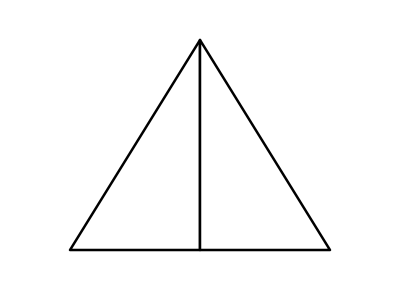
      2 triangles put together along a short side to make a big triangle. How many sides does this new shape have?
      • 3
      • 4
      • 6

    Challenge (optional)

    Put 4 squares together to make a T shape: 3 squares in a row and 1 square under the middle one. How many sides does the T shape have?

    You need: Pencil, Paper shape kit (optional, to check)

    Reading & Writing · Week 32 Day 2

    I can say who is telling the story at different points.

    Look: who is telling?

    1. The narrator tells the story: Mole went to see Toad.
    2. A character talks inside quotation marks: "Can you play?" said Mole.
    3. Look for the marks and the word said to find who is talking.

    Mole and Toad

    Mole went to see Toad. "Can you play?" said Mole. "Not now," said Toad. "I need to sleep." So Mole sat by the gate and read.

    Who is talking? Circle N for the narrator, or circle the name.

    1. 1.
      "Can you play?" said Mole.
      • N
      • Mole
      • Toad
    2. 2.
      Mole went to see Toad.
      • N
      • Mole
      • Toad
    3. 3.
      "I need to sleep."
      • N
      • Mole
      • Toad
    4. 4.
      So Mole sat by the gate and read.
      • N
      • Mole
      • Toad

    Put quotation marks around the words someone says.

    1. 5.
      Let me in, said Kate.
    2. 6.
      I am glad, said Gabe.
    3. 7.
      Why is it wet? said Mole.

    Read the word. Circle what y says.

    1. 8.
      windy
      • long e
      • long i
    2. 9.
      spy
      • long e
      • long i
    3. 10.
      lumpy
      • long e
      • long i

    Challenge (optional)

    "____," said Toad.

    Science · Week 32 Day 2

    I can test whether the shape of paper changes how much weight it holds.

    Look: Change the shape, test again

    1. Lay a flat paper across the gap. Set the cup on it and add pennies one at a time, counting.
    2. Fold a second paper like a fan. Test it the same way.
    3. Same paper, same gap, same cup. Only the shape changes.

    Is this test fair? Circle yes or no.

    1. 1.
      A flat paper and a folded paper, with the same gap and the same cup.
      • yes
      • no
    2. 2.
      A flat paper with a small cup and a folded paper with a big cup.
      • yes
      • no
    3. 3.
      Thin paper laid flat and thick cardboard folded.
      • yes
      • no

    Test, write and circle.

    1. 4.
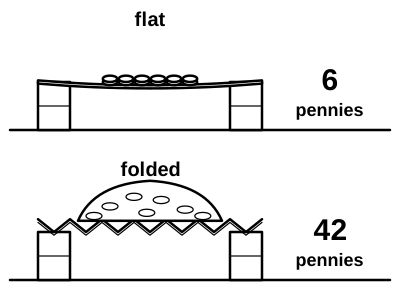
      Results: the flat paper held 6 pennies, the folded paper held 42 pennies. Which shape held more?
      • The flat paper.
      • The folded paper.
    2. 5.
      How many pennies did your flat paper hold? Write the number.
    3. 6.
      How many pennies did your folded paper hold? Write the number.
    4. 7.
      Draw your folded paper bridge with the cup on it.

    Challenge (optional)

    Why do you think a fan-folded paper is stronger than a flat one?

    You need: 3 sheets of printer paper, 2 stacks of books the same height, 1 small plastic cup, about 80 pennies (a choking hazard for children under 3), pencil