Math
Pattern block pictures
I can make a picture from shapes and tell which shapes I used.
Standards: 1.G.A.2
- Number practice (no timer)
- Doubles with pattern blocks (keep-up practice)
- Builds on
- Days 1 and 2 (composing shapes, and building with composite shapes). One-minute check: "What do 2 squares make side by side?" (A rectangle)
New words
- outline: a line around the outside edge of a shape or picture
You need
- Paper shape kit (an adult makes it on Week 32 Day 1 from construction paper or cereal-box cardboard and keeps it in a bag all week): 8 squares, each 2 inches on a side; 12 triangles, made by cutting 6 more 2-inch squares in half from corner to corner; 4 rectangles, 2 inches by 4 inches; 4 half-circles, made by tracing a cup about 4 inches across twice, cutting out the circles and cutting each one in half; and 4 quarter-circles, made by cutting one more circle into 4 equal parts (fold it in half, then in half again, and cut on the folds)
- 3 outline puzzles an adult makes before the lesson. For each one, lay the kit pieces as listed, trace around the outside edge only, then take the pieces away. House: 4 squares in a 2-by-2 block, with 2 triangles on top making one big triangle roof. Fish: 1 square turned on a corner for the body and 2 triangles for the tail (put each triangle's square corner at the body's left point, with one short side along one of the body's two left sides, so the tail makes a V). Rocket: 2 rectangles standing side by side, 1 half-circle on top and 1 triangle at each bottom corner for fins.
- Notebook and pencil
Warm-Up · 5 min
Fluency: doubles with shape pieces. "6 + 6?" (12) "7 + 7?" (14) "How many sides do 2 triangles have in all?" (6) Spaced review from Week 30: "A tally chart shows a bundle of 5 and 1 more for apples. How many apples?" (6)
Mini-Lesson · 10 min
Show the house outline. Think out loud: "The bottom part is a big square. I know 4 small squares make a big square. The roof is a big triangle. I know 2 triangles can make a big triangle." Fill the house with your child. Then make a shape count next to the house: Squares 4, Triangles 2. Ask: "How many pieces in all?" (6) Say: "Other pieces can fill an outline too, if they fit exactly. Could 2 rectangles fill the big square?" (Yes.)
Guided Practice · 10 min
Your child fills the fish outline and the rocket outline, then writes a shape count for each and the total. Answers: Fish: squares 1, triangles 2, 3 pieces in all. Rocket: rectangles 2, half-circles 1, triangles 2, 5 pieces in all. Other ways that fit exactly also count, such as 2 triangles for the fish's square body. If stuck, say: "Find the part of the outline with a curve or a point first. Which piece has that?"
Play · 10 min
Picture Maker. Your child makes a picture of their own from 6 to 10 kit pieces (a robot, a boat or a cat) and writes how many of each kind of piece it uses. You trace around the outside of the picture. Then you make a picture and trace its outline only, and your child fills it. Answers vary. Look for: pieces that fill the outline with no gaps or overlaps.
Exit Ticket · 3-5 min
Before asking, place 1 rectangle and 1 square end to end to make a long rectangle, trace around the outside, and take the pieces away. Read each question aloud. Your child answers out loud or with the kit. Check each answer together right away.
Exit ticket
- Which kit pieces could fill this outline?
- My picture uses 3 squares, 2 triangles and 1 half-circle. How many pieces in all?
- A rectangle sits with a long side on the bottom. Which kit piece could you put on top to make a doorway with a round top?
Answers
- Answers vary. Look for: 1 rectangle and 1 square, 3 squares, 6 triangles, or a mix such as 2 squares and 2 triangles.
- 6
- A half-circle
Watch for, and help or stretch
- Watch for
- Leaving gaps or letting pieces stick out past the outline.
- Try
- Run a finger along the outline. Wherever the finger touches paper instead of a piece, try a different piece.
- Extra help
- Lay one piece in each outline to start it. Your child adds the rest.
- Stretch
- Your child fills the house outline a different way, using as few pieces as possible. (Look for: 2 rectangles for the body and 2 triangles for the roof, 4 pieces.)
At home (optional): Your child makes a picture from paper shapes or blocks for a family member and tells which shapes it uses.
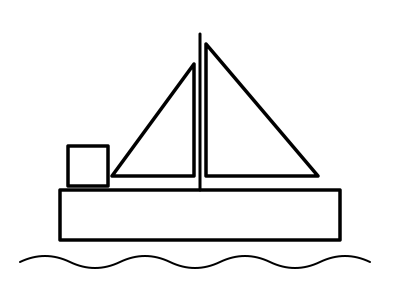 How many triangles? ____
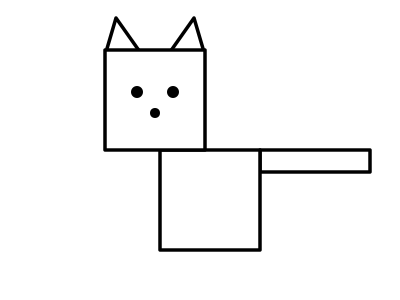 How many squares? ____