This week's lessons
Math and reading every day; science and social studies take turns
- Day 1 · Monday
- MathYear review: story problemsI can solve all kinds of story problems.
- Reading & WritingFavorite book talkI can describe a favorite book with details.
- Social StudiesIdeas to helpI can list ways we could help fix our problem.
- Day 2 · Tuesday
- MathYear review: fact strategiesI can add and subtract within 20 and tell my strategy.
- Reading & WritingMake a posterI can make a drawing or display to help explain my ideas.
- ScienceStrengths and weaknessesI can use my data to tell what each design does well and not well.
- Day 3 · Wednesday
- MathYear review: equal sign and missing numbersI can check equations and find missing numbers.
- Reading & WritingSpeak in sentencesI can speak in complete sentences when I present.
- Social StudiesVote on our planI can listen, agree and vote to choose our plan.
- Day 4 · Thursday
- MathYear review: place value and comparingI can explain tens and ones and compare numbers.
- Reading & WritingListen and askI can ask a speaker a question to learn more.
- Science · CheckImprove the winnerI can improve a design and test it again.
- Day 5 · Friday
- Math · CheckLesson + weekly check: number reviewI can show what I know about stories, facts and numbers.
- Reading & Writing · CheckShare and check: review 4I can read two-syllable words, words with endings, and -all, -old and -ind words.
- Social Studies · CheckTake actionI can do my part to help our community.
This week's checks
Short checks on the last day each subject meets this week
Science · Day 4
- I can use my data to tell what each design does well and not well.
- I can improve a design and test it again.
Secure when: 6 of 8 correct, including items 1 and 2 (one change and a fair retest) and item 3 (a comparison that matches the data).
Open the checkMath · Day 5
- I can solve story problems.
- I can add and subtract within 20.
- I can tell if an equation is true and find a missing number.
- I can compare two-digit numbers.
Secure when: 9 or 10 of the 10 items right.
Open the checkReading & Writing · Day 5
- I can read two-syllable words and words with endings.
- I can read words in the all, old and ind families.
- I can speak in complete sentences and use the four kinds of sentences.
- I can tell about a book and ask a question to learn more.
Secure when: 12 of 15 words in items 1-3, 4 of 5 family words in item 4, 4 of 5 sight words in item 5, and 3 of 4 on items 6-9.
Open the checkSocial Studies · Day 5
- I can list ways we could help fix our problem.
- I can listen, agree and vote to choose our plan.
- I can do my part to help our community.
Secure when: 6 of 8 correct, with at least one right on each goal
Open the check
Reading About Our World: Let's Vote!
Read it aloud. Your child reads the sentences marked with a star. Builds social studies knowledge.
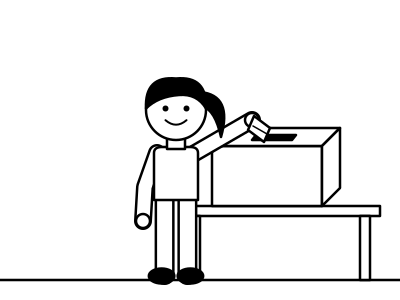
A Group Choice
Sometimes a group must make one choice together. Should the class plant flowers or pick up litter? A vote can help decide.
How a Vote Works
Each person gets one vote. Everyone votes for the choice they like best. Then the votes are counted. The choice with the most votes wins. I will vote for the swing.
Grown-Ups Vote Too
In our country, citizens who are 18 or older can vote to choose leaders. Voting lets people have a say in their community. Grown-ups who vote choose leaders like mayors and governors.
Words to know
- vote: make a choice that gets counted
- citizen: a member of a country
- choice: something you pick
Talk about it
- How many votes does each person get?
- Which choice wins a vote?
- Why is it fair for each person to get only one vote?
Home Connection
Five-minute ideas for the whole family, with things you already have
Math
We use strategies like making ten, doubles and counting on to add and subtract within 20.
Do: Play Make 10 Go Fish with playing cards from Ace (1) to 9: ask for the card that makes 10 with a card in your hand.
Talk: Which strategy do you like best? Show me with 8 + 5.
Reading & Writing
Speakers talk in full sentences, and listeners ask questions.
Do: Your child gives a 1-minute book talk to the family: the title, the best part and why. Then write picnic, rested, jumping and sunsets for your child to read.
Talk: What question can you ask after someone shares?
Science
Data show what each design does well and not well, so we can improve it.
Do: Ask your child which design worked better and what they will change to make it even better.
Talk: What did your design do well? What did it not do well?
Social Studies
Citizens share ideas, vote on a plan and act to help.
Do: With a grown-up, do one small helping action for your community, like picking up litter with gloves on; a grown-up picks up anything sharp or broken.
Talk: How did your action help?
This week's words: picture, change, off, play, away
Celebrate a favorite strategy, a book talk and a helping action.
Math catch-up: Act It Out First
10 minutes, if this week's math check was not secure · 1.OA.A.1
In year review stories, children often add every pair of numbers they hear. Acting out the story in order before writing an equation shows what is joining, leaving or being compared.
You need: 20 dry beans or buttons, 1 plastic cup, paper and a pencil
- Tell: "13 marbles were in a bag. Some rolled away. 8 are left." Your child puts out 13 beans and pushes beans into the cup until 8 are left.
- Count the beans in the cup: 5. Write 13 - 5 = 8.
- Tell a three-number story: "3 red cars, 5 blue cars and 7 green cars." Your child finds a ten first (3 + 7) and adds the 5: 15.
- Tell a comparing story with 11 and 6. Your child lines up two rows and counts the extras: 5.
Try again
- 14 marbles were in a bag. Some rolled away. Now 9 are left. How many rolled away?
- 2 red cars, 6 blue cars and 8 green cars are in a box. How many cars?
- Jo has 12 shells. Kai has 7 shells. How many more shells does Jo have?
Specials This Week
Weeks 31–36 unit • ~90 min/week per subject
Games, Cooperation, and Safety
Participating in cooperative games, understanding rules, demonstrating sportsmanship, identifying safe practices in physical activity.
Art and Storytelling
Creating art that tells a story, illustrating favorite books, connecting art to nature and emotions.
Music and Storytelling/Performance
Creating music to tell a story, composing simple rhythmic patterns, preparing and presenting a short musical performance.
For guiding principles and full standards reference, visit How to use this curriculum
As an Amazon Associate, we earn from qualifying purchases. Book and supply links on this page are affiliate links — using them supports this curriculum at no extra cost to you.