This week's lessons
Math and reading every day; science and social studies take turns
- Day 1 · Monday
- MathHalvesI can split a shape into 2 equal parts.
- Reading & WritingStory and facts about rabbitsI can compare a storybook and a fact book on the same topic.
- ScienceBuild design AI can build my first design.
- Day 2 · Tuesday
- MathFair halves or not?I can tell if two parts are equal.
- Reading & WritingPictures in two booksI can compare how two books use pictures.
- Social StudiesSpot a problemI can find a problem in our community and tell why it matters to me.
- Day 3 · Wednesday
- MathFourths and quartersI can split a shape into 4 equal parts.
- Reading & WritingType it upI can use a tablet or computer with help to publish my writing.
- ScienceBuild design BI can build my second design.
- Day 4 · Thursday
- MathHalves or fourths: which is bigger?I can tell that more equal shares make smaller shares.
- Reading & WritingPublishing togetherI can work with someone to publish a page.
- Social Studies · CheckLearn about our problemI can ask questions and find facts to learn more about our problem.
- Day 5 · Friday
- Math · CheckLesson + weekly check: equal sharesI can make and name halves and fourths.
- Reading & Writing · CheckShare and check: review 3I can read r-controlled, ou/oi and consonant-le words.
- Science · CheckTest both designsI can test two designs and record what happens.
This week's checks
Short checks on the last day each subject meets this week
Social Studies · Day 4
- I can find a problem in our community and tell why it matters to me.
- I can ask questions and find facts to learn more about our problem.
Secure when: 6 of 7 correct, with at least one right on each goal
Open the checkMath · Day 5
- I can split shapes into halves and fourths.
- I can name the shares.
- I can tell that a half is bigger than a fourth of the same shape.
Secure when: 5 or 6 of the 6 items right.
Open the checkReading & Writing · Day 5
- I can read r-controlled and ou/oi words.
- I can read words that end in consonant-le.
- I can compare a tale and a fact text, and their pictures.
- I can use capitals and end marks to publish my writing.
Secure when: 12 of 15 words in items 1-3, 4 of 5 consonant-le words in item 4, 4 of 5 sight words in item 5, and 4 of 5 on items 6-10. Note any team your child mixes up (such as ou and oi) for next week's warm-ups.
Open the checkScience · Day 5
- I can build my first design.
- I can build my second design.
- I can test two designs and record what happens.
Secure when: 6 of 8 correct, including items 1 and 2 (the same test for both designs, recorded) and item 3 (tells which kept more).
Open the check
Reading About Our World: Test, Then Try Again
Read it aloud. Your child reads the sentences marked with a star. Builds science knowledge.
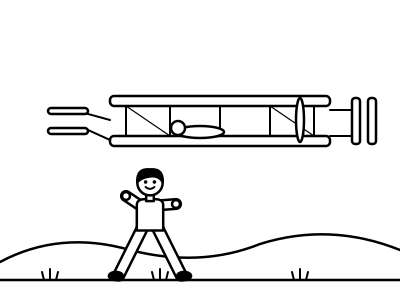
Two Brothers
Wilbur and Orville Wright wanted to build a flying machine. They owned a bicycle shop in Dayton, Ohio. First they built gliders. A glider flies with no engine.
Test and Fix
The brothers tested their gliders on windy sand hills near Kitty Hawk, North Carolina. The plane did not stay up. When a glider did not fly well, they studied what went wrong and changed the design to improve it.
Success!
They kept testing and improving for years. On December 17, 1903, their airplane made the first powered, controlled flight. It lasted 12 seconds.
Words to know
- glider: a flying machine with no engine
- test: try something to see how it works
- improve: make better
Talk about it
- What did the Wright brothers build first?
- How long did the first powered flight last?
- Why did the brothers keep changing their gliders?
Home Connection
Five-minute ideas for the whole family, with things you already have
Math
Halves are 2 equal parts; fourths, or quarters, are 4 equal parts.
Do: Share a sandwich, a tortilla or a paper square. A grown-up cuts it into halves, then into fourths. Check that the parts are the same size.
Talk: Which is bigger: a half or a fourth of the same sandwich? Why?
Reading & Writing
Some books tell a story and some give facts about the same topic.
Do: Read a story and a fact book about the same animal. Write storm, shirt, mouth, point and joy for your child to read.
Talk: Which book was a story, and which gave facts?
Science
Engineers build and test more than one design.
Do: Your child shows you design A and design B and tells how they will test them.
Talk: How will you know which design works better?
Social Studies
Good citizens notice problems in their community and learn about them.
Do: On a walk, notice a problem in your community, like litter in a park or a broken sign.
Talk: Why does this problem matter to you?
This week's words: home, us, try, kind, hand
Celebrate fair shares, a story and a fact book compared, and two designs built.
Math catch-up: Match the Edges
10 minutes, if this week's math check was not secure · 1.G.A.3
Children often call any 2 parts 'halves,' even when one part is bigger, and think a fourth is bigger than a half because 4 is bigger than 2. Folding with edges matched and laying pieces on top of each other shows both ideas.
You need: 3 sheets of paper or paper napkins, crayons
- Fold a sheet so the edges do not match. Unfold and lay one part over the other. Ask: "Same size?" (No.) Fold again with edges matched: halves.
- Fold a second sheet in half, then in half again. Unfold. Count the parts: 4 equal parts, called fourths or quarters.
- Lay one fourth on top of one half. Ask: "Which covers more?" (The half.) Say: "More shares means smaller shares."
- Your child colors one half of one sheet and one fourth of another, then says which colored part is bigger.
Try again
- A sandwich is cut into 2 parts that are not the same size. Are the parts halves?
- A pizza is cut into fourths. How many equal parts are there?
- Which is bigger: half of a cracker or a fourth of the same cracker?
Specials This Week
Weeks 31–36 unit • ~90 min/week per subject
Games, Cooperation, and Safety
Participating in cooperative games, understanding rules, demonstrating sportsmanship, identifying safe practices in physical activity.
Art and Storytelling
Creating art that tells a story, illustrating favorite books, connecting art to nature and emotions.
Music and Storytelling/Performance
Creating music to tell a story, composing simple rhythmic patterns, preparing and presenting a short musical performance.
For guiding principles and full standards reference, visit How to use this curriculum
As an Amazon Associate, we earn from qualifying purchases. Book and supply links on this page are affiliate links — using them supports this curriculum at no extra cost to you.