1First Grade

    Change unknown: hide it in a cup

    Where and what happened

    Practice pages

    0 of 180 days complete · Saved on this device

    View all 180 days

    Math

    Change unknown: hide it in a cup

    I can find how many were added when the middle number is missing.

    Standards: 1.OA.A.1, 1.OA.B.4

    Number practice (no timer)
    Think addition: 10 - 8 is 8 + ? = 10
    Builds on
    Day 1 stories with the unknown at the end, and Week 2 parts and wholes. One-minute check: "3 and what make 8?" Your child uses counters (5).

    New words

    • count up: start at one number and count forward to reach another number

    You need

    • 20 counters
    • A cup
    • Number line 0 to 10
    • Notebook and pencil
    1. Warm-Up · 5 min

      Fluency: think addition. "10 - 7: think 7 and what make 10?" (3) Do 10 - 9 (1) and 10 - 6 (4). Spaced review from Day 1: "6 + 3 = ?" (9)

    2. Mini-Lesson · 10 min

      Say: "Today the missing number is in the middle." Tell a story: "You have 3 apples. Your aunt gives you some more. Now you have 8. How many did she give you?" Put 3 counters on the table. Say: "Some more are hiding under this cup." Write 3 + ? = 8. Say: "We start at 3. We need to get to 8. Let's count up." Put a finger on 3 on the number line. Count up while your child holds up a finger for each number: "4, 5, 6, 7, 8." Ask: "How many fingers?" (5) Lift the cup to show 5 counters. Say: "3 + 5 = 8. She gave you 5 apples." Then say: "We can also think 8 - 3 = 5. The fact family helps."

    3. Guided Practice · 10 min

      Hide counters under the cup each time. Your child counts up from the first number to the total, keeping track on fingers, then lifts the cup to check. 1) "4 birds are in a nest. Some more fly in. Now there are 9." (4 + ? = 9; 5) 2) "6 books are on a shelf. You add some. Now there are 10." (6 + ? = 10; 4) 3) "2 kids are on the slide. Some more climb up. Now there are 7." (2 + ? = 7; 5) 4) "9 pretzels are in a bag. You eat some. Now there are 6." (9 - ? = 6; 3) For number 4, ask: "Did the number go up or down?" (Down, so some were taken away.) Count up from 6 to 9 (7, 8, 9) to find the 3 that were eaten. If stuck, say: "Put your finger on the first number. Count up to the last number. Each finger you hold up is one hiding under the cup."

    4. Play · 10 min

      Cup Trick. You put a number of counters on the table, then secretly slide some under the cup. You tell your child how many there are in all. Example: "4 are out. There are 10 in all. How many are under the cup?" (6) Your child counts up from 4 to 10 and says the equation 4 + 6 = 10. Lift the cup to check. Then your child does the trick for you. Play 5 rounds, keeping totals at 10 or less.

    5. Exit Ticket · 3-5 min

      Put the objects to one side but leave them on the table. Read each question aloud. Your child answers out loud, with objects or with a quick drawing. Check each answer together right away.

    Exit ticket

    1. You have 3 stickers. You get some more. Now you have 8. How many did you get?
    2. Solve 6 + ? = 9.
    3. Solve 2 + ? = 7.
    Answers
    1. 5 stickers
    2. 3
    3. 5
    Watch for, and help or stretch
    Watch for
    Saying the total as the answer, such as 8 instead of 5.
    Try
    Ask: "Is 8 the number we started with, the number that came, or the total?" Point to each part of the equation.
    Extra help
    Show the hidden counters in a clear cup at first, then switch to the cup you cannot see through.
    Stretch
    Use totals from 11 to 15, such as 9 + ? = 14 (5). Ask your child to explain the counting-up path.

    At home (optional): Play Cup Trick with a family member, using 10 coins or beans.
    Reading & Writing

    Where and what happened

    I can use pictures and words to tell the setting and the big events.

    Standards: RL.1.7, RL.1.3, RF.1.3.a

    Phonics
    Digraphs th, wh and ck (thin, when, duck)
    Sight words
    one, two, do, who, does
    Reading
    Can I Play Too? (Mo Willems); original decodable "Chick and Duck"
    Writing
    Personal narrative: telling a small moment with I, me and my · Handwriting: lowercase u, y, v, w, x, z
    Builds on
    Using picture clues for feelings (Day 1). One-minute check: show one page of the picture book; your child names the feeling and the clue.

    New words

    • event: something that happens in a story
    • setting: where and when a story happens

    You need

    • Can I Play Too? (Mo Willems), optional read-aloud; any picture book with clear character faces, such as a friendship story, works
    • Event cards: 3 index cards you sketch with one story event each
    • Letter cards for building ck words
    • Sight word cards
    • Printed "Chick and Duck"
    1. Phonics & Word Work · 15 min

      I do: Say: "When a short word ends in /k/ right after a short vowel, we usually spell it ck." Build back with cards: b-a-ck. We do: build sick and duck together. You do: your child builds and reads back, sick, duck, lock, then changes one part each time: back, pack, peck, neck, nick, tick, tuck, duck. Read: "Jack can pick up a rock." "Who can get the sock?" Dictation: back, sick, duck, lock. If stuck, say: "Short vowel, then /k/ at the end? Use the two-letter ck."

    2. Sight Words · 5 min

      Review: one, two, do, who, does. Swat It: spread the cards on the table. Say a word; your child taps it with a clean spatula, reads it and spells it. Then your child calls a word for you to swat.

    3. Read-Aloud & Shared Reading · 15 min

      Before reading, sketch three event cards from the picture book (a stick drawing and two words each, such as "friends play", "new friend asks", "they find a way"). Mix them up. Your child puts them in order and explains each, using a picture detail from the book. Ask: "Where does this story happen?" (Answers vary. Look for: a place shown in the pictures, such as outside or a park.) Ask: "What is the big problem?" (Answers vary. With Can I Play Too?: a new friend wants to play catch but it is hard for him. Look for: a problem from the story.) Ask: "How do they solve it?" (Answers vary. Look for: the solution in the story.) Then partner-read "Chick and Duck". Ask: "Where does the race end?" (at the shed)

    4. Writing & Handwriting · 15 min

      Your child writes a sentence that names the setting of "Chick and Duck" and one event: "Chick and Duck sat on a log. Then they ran to the shed." Handwriting (4 min): model each letter large in the air, then on paper while saying the path aloud. v: slant down, slant up; w: slant down, up, down, up. Your child writes each letter 3 times on lined paper and circles the best one.

    5. Exit Ticket · 5 min

      Oral answers.

    Exit ticket

    1. Spell the word duck aloud.
    2. Where does the story happen? Show me a picture clue.
    3. Tell two events in order.
    Answers
    1. d-u-c-k
    2. Answers vary. Look for: a place and a picture detail that shows it.
    3. Answers vary. Look for: two events in the right order.
    Watch for, and help or stretch
    Watch for
    Spelling final /k/ with only k or only c (duk, duc).
    Try
    Make a ck card your child can hold up whenever they hear a short vowel followed by /k/ at the end.
    Extra help
    Use two event cards instead of three.
    Stretch
    Your child draws and labels a fourth event card for what might happen next, then explains it.

    At home (optional): Find 3 things at home whose names end in ck (sock, clock, rock). Say each name and spell the ending.

    Science

    Can sound make things move?

    I can test whether a sound can make rice jump when no one touches the bowl.

    Standards: 1-PS4-1

    Builds on
    Shaking things make sound. One-minute check: ask your child to say the claim from last week. (Shaking things make sound.) Then ask: "Do you think it can work the other way?"

    New words

    • stretched: pulled tight

    You need

    • Plastic or metal bowl (not glass)
    • Plastic wrap
    • A large rubber band
    • About 20 grains of uncooked rice (or a pinch of salt, which jumps more easily)
    • Metal pot and wooden spoon
    • Sound Journal
    • Crayons
    1. Warm-Up / Wonder · 5 min

      Spaced review: ask: "What is evidence?" (What you saw or heard that shows your claim is true.) Wonder question: "We know shaking makes sound. Can sound make something shake?" Your child predicts yes or no.

    2. Explore · 10–15 min

      1) Grown-up stretches plastic wrap tightly over the bowl, like a drum, and holds it on with the rubber band. 2) Your child sprinkles about 20 grains of rice on top. 3) Test 1: your child taps the plastic with one finger. Ask: "What happened?" (The rice jumped. My finger touched it.) 4) Test 2, no touching: hold the pot in the air about 6 inches from the bowl, not touching the bowl or the table. Bang the pot hard with the spoon 3 times. Your child watches the rice. Ask: "What happened?" (The rice hopped.) "Did anyone touch the bowl?" (No.) 5) Test 3: bang the pot from across the room. Ask: "What happened this time?" (The rice moved less, or did not move.) Say: "The sound traveled through the air and made the plastic shake. The rice shows us the shaking." If stuck (the rice does not move): pull the plastic tighter, use salt instead of rice, hold the pot closer and bang harder, or your child sings a loud, low "ahhh" a few inches to the side of the bowl, not blowing on it.

    3. Talk & Record · 5–10 min

      Your child draws the bowl, the rice in the air and the pot with zigzag sound lines going toward the bowl. Sentence frame: "The sound made the ___ shake, and the rice jumped." (plastic)

    4. Exit Ticket · 3–5 min

      Ask the two questions aloud.

    Exit ticket

    1. When the rice jumped from the pot bang, did anyone touch the bowl?
    2. What made the rice jump?
    Answers
    1. No.
    2. The sound from the pot made the plastic shake, and the shaking made the rice jump.
    Watch for, and help or stretch
    Watch for
    Thinking a bump to the table or a puff of air from the spoon moved the rice.
    Try
    Hold the pot in the air, away from the table, and bang it from the side. Then try your child's loud voice from the side of the bowl, so no breath blows on the rice.
    Extra help
    Do only Test 2, three times. Your child says "bang" and "jump" each time.
    Stretch
    Your child tries a soft bang and a hard bang and tells which made the rice jump higher.

    At home (optional): Your child shows the dancing rice to a family member and explains: "Sound made the plastic shake."

    Practice

    Read each direction aloud. Your child works on the page; answers are in the grown-up view.

    Warm-up

    Remember?

    Math

    1. There are 9 blocks. 4 are red. The rest are blue. How many are blue?
    2. Hana has 3 crackers. Malik has 8 crackers. How many fewer crackers does Hana have?

    Reading & Writing

    1. rod, cub, wet
    2. you, are, they

    Math · Week 4 Day 2

    I can find how many were added when the middle number is missing.

    Look: 5 + ? = 7

    1. You have 5 apples. Your aunt gives you some more. Now you have 7.
    2. Put a finger on 5. Count up to 7: 6, 7. That is 2 counts.
    3. 5 + 2 = 7. She gave you 2 apples.

    Listen to the story. Count up from the first number. Write the missing number.

    1. 1.
      4 ducks are in the pond. Some more swim in. Now there are 6. How many swam in?
    2. 2.
      1 fish is in the tank. You add some. Now there are 5. How many did you add?
    3. 3.
      7 kids sit on the rug. Some more sit down. Now there are 10. How many sat down?
    4. 4.
      5 cars are in the lot. Some more park. Now there are 8. How many parked?

    Count up. Write the missing number.

    1. 5.
      5 + ? = 9
    2. 6.
      3 + ? = 6
    3. 7.
      1 + ? = 8
    4. 8.
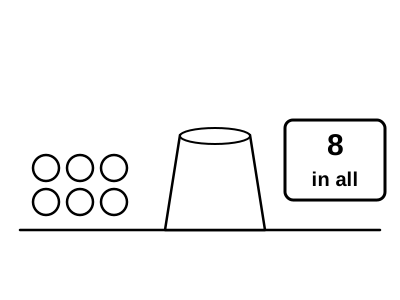
      6 counters next to an upside-down cup, and a card that says 8 in all. How many are under the cup?

    Challenge (optional)

    You had 2 shells. You found some more. Now you have 10. How many did you find? Show how you know.

    You need: 10 counters and a cup (optional)

    Reading & Writing · Week 4 Day 2

    I can use pictures and words to tell the setting and the big events.

    Look: setting and big events

    1. Read "At the Dock" together. Ask: "Where are Jack and Mom?" (on the dock)
    2. Say: "That is the setting. Now let's find the big events, the most important things that happen."
    3. Point to each event in order with one finger at a time.

    At the Dock

    Jack and Mom sat on the dock. A duck sat with them. Then a big fish hit the dock! Jack got wet. Mom and Jack ran back to the shack.

    Write 1, 2 and 3 to put the big events in order.

    1. 1.
      Jack got wet.
    2. 2.
      A big fish hit the dock.
    3. 3.
      Mom and Jack ran back to the shack.

    Say the picture name. Write ck at the end.

    1. 4.
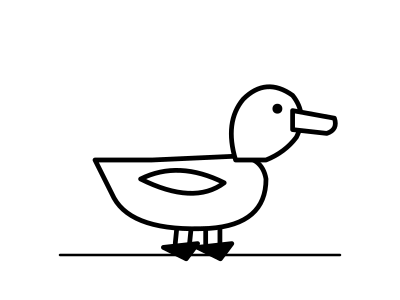
      A duck. d u ___
    2. 5.
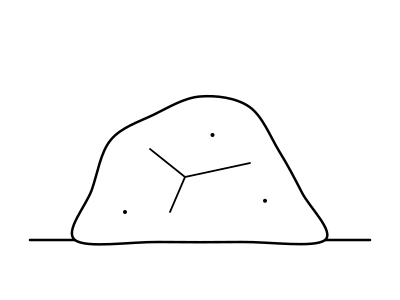
      A rock. r o ___
    3. 6.
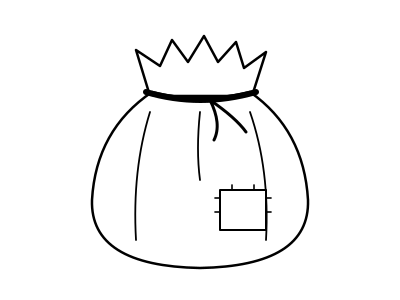
      A sack. s a ___
    4. 7.
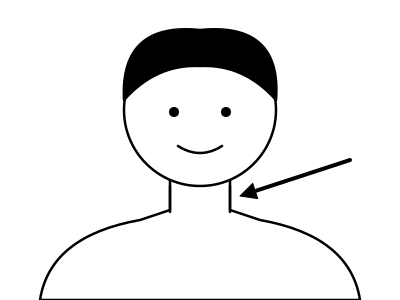
      A neck. n e ___

    Challenge (optional)

    Jack and Mom sat on the ___.

    Science · Week 4 Day 2

    I can test whether a sound can make rice jump when no one touches the bowl.

    Look: Make rice jump with sound

    1. Stretch plastic wrap tight over a bowl. Sprinkle rice on top.
    2. Bang a pot near the bowl. No one touches the bowl.
    3. The rice hops. The sound made the plastic shake.

    Look at each picture. Circle yes or no.

    1. 1.
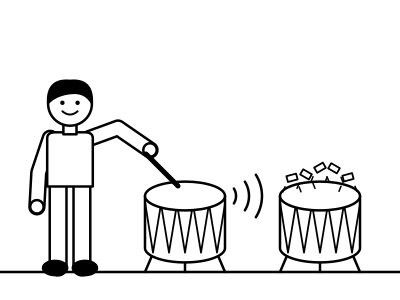
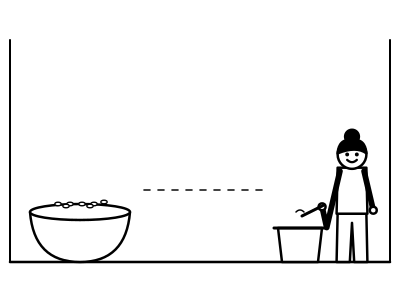
      A person hitting one drum; on a second drum nearby, which no one touches, small paper bits are hopping. Did the sound make the second drum shake?
      • yes
      • no
    2. 2.
      A bowl drum with rice at one end of a big room; at the far end a person taps a pot very softly. Will the rice jump high?
      • yes
      • no
    3. 3.
      A big truck rumbles past the house. A plastic cup on the shelf buzzes. Did the sound make the cup shake?
      • yes
      • no

    Circle or draw.

    1. 4.
      Where should the pot be to make the rice hop the most?
      • A pot being banged close to the bowl drum.
      • A pot being banged far across the room.
    2. 5.
      Can a sound make something move with no hands touching it?
      • yes
      • no
    3. 6.
      Draw salt on a bowl drum when it is quiet. Then draw it again when a loud sound is near.

    Challenge (optional)

    Why do we use tiny rice or salt and not big rocks?

    You need: crayons