This week's lessons
Math and reading every day; science and social studies take turns
- Day 1 · Monday
- MathResult unknown reviewI can solve adding and taking stories where the end is missing.
- Reading & WritingPictures tell us moreI can use the pictures to describe how characters feel.
- Social StudiesWhat is fair?I can tell what fair means and spot when something is fair or not fair.
- Day 2 · Tuesday
- MathChange unknown: hide it in a cupI can find how many were added when the middle number is missing.
- Reading & WritingWhere and what happenedI can use pictures and words to tell the setting and the big events.
- ScienceCan sound make things move?I can test whether a sound can make rice jump when no one touches the bowl.
- Day 3 · Wednesday
- MathSubtraction as a missing partI can subtract by thinking what number to add.
- Reading & WritingI, me and myI can use I, me and my correctly when I tell about myself.
- Social StudiesTalking and listening rulesI can follow our talking rules: take turns, look at the speaker and add on to their idea.
- Day 4 · Thursday
- MathStart unknown: what was there first?I can solve a story when the first number is missing.
- Reading & WritingA small momentI can write about one small moment with details.
- Science · CheckSound makes things shakeI can feel and see sound make something vibrate.
- Day 5 · Friday
- Math · CheckLesson + weekly check: missing numbers in storiesI can find the missing number at the start, middle or end of a story.
- Reading & Writing · CheckShare and check: th, wh, ckI can read th, wh and ck words and listen and respond to a friend's story.
- Social Studies · CheckBeing a good classmateI can show honesty, kindness and responsibility in my learning space.
This week's checks
Short checks on the last day each subject meets this week
Science · Day 4
- I can test whether a sound can make rice jump when no one touches the bowl.
- I can feel and see sound make something vibrate.
Secure when: 6 of 8 correct, including item 1 (shows the shaking) and item 2 (gives real evidence).
Open the checkMath · Day 5
- I can solve adding and taking stories where the end is missing.
- I can find how many were added when the middle number is missing.
- I can subtract by thinking what number to add.
- I can solve a story when the first number is missing.
Secure when: 7 of 8 correct, with at least 1 right on each goal
Open the checkReading & Writing · Day 5
- I can read words with th, wh and ck.
- I can read the sight words one, two, do, who and does.
- I can use the pictures and words to tell how a character feels, where the story happens and what happens.
- I can use I, me and my correctly.
Secure when: 8 of the 10 words in items 1 and 2, 4 of the 5 sight words, and 4 of the other 5 items.
Open the checkSocial Studies · Day 5
- I can tell what fair means and spot when something is fair or not fair.
- I can follow our talking rules: take turns, look at the speaker and add on to their idea.
- I can show honesty, kindness and responsibility in my learning space.
Secure when: 6 of 8 correct, with at least one right on each goal
Open the check
Reading About Our World: What Is Fair?
Read it aloud. Your child reads the sentences marked with a star. Builds social studies knowledge.
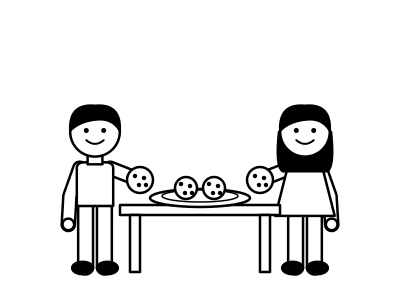
Fair Means Everyone
Being fair means everyone gets a chance. When two friends share a snack, each friend gets a part. I get one, and you get one.
Taking Turns
Sometimes there is only one swing. Friends can take turns. One friend swings, then the next friend swings. Taking turns is a fair way to share.
Talking and Listening
In a talk, people take turns too. One person talks. The others look at the speaker and listen. Then the next person talks. Everyone gets a chance to be heard.
Words to know
- fair: giving everyone a chance
- share: let others use or have some too
- listen: pay attention to what someone says
Talk about it
- What does being fair mean?
- What can friends do when there is only one swing?
- Two children both talk at the same time. Why is that hard for the people listening?
Home Connection
Five-minute ideas for the whole family, with things you already have
Math
In a story problem, the missing number can be the start, the change or the total.
Do: Show 9 beans. While your child closes their eyes, hide some under a cup. Your child counts the beans left out and figures out how many are hiding. Take turns hiding.
Talk: How did you figure out how many were hiding?
Reading & Writing
Pictures in a book give clues that the words do not always tell.
Do: Write thin, when, duck, sock and bath for your child to read. Then look at one page of a picture book and find something the picture shows that the words do not say.
Talk: What does this picture tell you that the words don't?
Science
Sound can make things move.
Do: Stretch plastic wrap tightly over a plastic bowl and put a few grains of rice on top. Tap a metal pot near the bowl with a wooden spoon and watch the rice. Keep rice away from children under 3.
Talk: What made the rice jump?
Social Studies
Being fair, honest and kind helps us get along.
Do: Play a board or card game together and practice taking turns, telling the truth and being kind when someone wins.
Talk: What does fair mean? Can you tell about a time something was not fair?
This week's words: one, two, do, who, does
Celebrate a hiding-beans puzzle your child solved, a picture clue your child found and a kind or fair choice your child made.
Math catch-up: Where Does the Cup Go?
10 minutes, if this week's math check was not secure · 1.OA.A.1
When the start or middle of a story is missing, children often add the two numbers they hear. Acting it out in time order, with a cup hiding the unknown, shows which number is missing.
You need: 15 dry beans, 1 plastic cup, paper and a pencil
- Say: "5 kids are on the bus. Some more get on. Now there are 9." Put 5 beans out. Hide some beans under the cup to stand for the kids who got on.
- Draw three boxes on paper: First, Then, Now. Write 5 in First and 9 in Now. Put the cup on the Then box.
- Count on from 5 to 9 with fingers: 6, 7, 8, 9. Four fingers are up, so 4 got on. Lift the cup to check: 4 beans.
- Do one story with the start missing: "Some birds were on a wire. 3 flew away. 6 are left." Put the cup on First. Put out 6 beans for the birds left, bring back the 3 that flew away, and count them all: 9 were there at the start.
Try again
- 4 kids were on the bus. Some more got on. Now there are 10 kids. How many got on?
- Some birds were on a wire. 2 flew away. Now 7 are left. How many birds were there at first?
- 4 + ___ = 9
Specials This Week
Weeks 1–6 unit • ~90 min/week per subject
Locomotor Skills and Space Awareness
Mastering basic locomotor skills (walking, running, hopping, jumping, galloping, sliding, skipping), understanding personal and general space.
Exploring Line and Shape
Different types of lines (straight, curved, zig-zag, wavy), identifying basic shapes, creating patterns with lines and shapes.
Rhythm and Beat
Identifying and keeping a steady beat, understanding basic rhythms (ta – quarter note, ti-ti – eighth notes), clapping and patting rhythms.
For guiding principles and full standards reference, visit How to use this curriculum
As an Amazon Associate, we earn from qualifying purchases. Book and supply links on this page are affiliate links — using them supports this curriculum at no extra cost to you.