Math
Subtraction stories within 20
I can solve subtraction stories and name my strategy.
Standards: 1.OA.C.6, 1.OA.A.1
- Number practice (no timer)
- Think addition to subtract
- Builds on
- Days 1 to 3: think addition, count back or count up, and get to 10 first; Week 2 taking-from stories. One-minute check: "12 - 9 = ? How did you do it?" (3; for example, 9 + 3 = 12)
New words
- left: how many are still there after some go away
You need
- 20 counters (dried beans or buttons) to be acorns
- Double ten frame on paper
- Number line 0 to 20
- A cup
- A strategy card: a paper with three boxes labeled Think Addition, Count Back or Up, and Get to 10 First
- Notebook and pencil
Warm-Up · 5 min
Fluency: think addition. "9 + 7 = 16, so 16 - 9 = ?" (7) "8 + 5 = 13, so 13 - 5 = ?" (8) Spaced review from Week 4: "Some birds sat on a wire. 3 more came. Now there are 10. How many were there at first?" (7)
Mini-Lesson · 10 min
Say: "This week you learned three ways to take away. Today you use them in stories." Tell the story: "16 acorns are under a tree. A squirrel takes 9. How many are left?" Ask: "Is something joining or going away?" (Going away.) "What equation?" (16 - 9 = ?) Show two ways on the strategy card. Think addition: "9 and what make 16? 9 + 7 = 16, so 7." Get to 10 first: "16 - 6 = 10, then 3 more, 10 - 3 = 7." Say: "Both ways give 7. 7 acorns are left." Your child says the answer in a full sentence. Now a taking-apart story: "Kai has 14 stickers. 8 are stars. The rest are hearts. How many are hearts?" (14 - 8 = 6, because 8 + 6 = 14) Your child points to the strategy card box they used.
Guided Practice · 10 min
Read each story. Your child writes the equation, solves it, says the answer in a sentence and points to the strategy used. 1) "There are 12 crackers on a plate. The family eats 3. How many are left?" (9; count back: 11, 10, 9) 2) "15 kids are at the pool. 7 go home. How many are still at the pool?" (8; 15 - 5 = 10, 10 - 2 = 8, or 7 + 8 = 15) 3) "Lee has 17 crayons. 9 are in the box. The rest are on the floor. How many are on the floor?" (8; 9 + 8 = 17) 4) "Rosa read 13 pages. Omar read 9 pages. How many more pages did Rosa read?" (4; count up from 9: 10, 11, 12, 13) 5) "There were 11 ducks. 9 flew away. How many are left?" (2; count up from 9: 10, 11) Any correct strategy is fine. If stuck, say: "Act it out with the acorns. What do you start with? What goes away? Now pick a box on the strategy card."
Play · 10 min
Squirrel Snatch. Count out a pile of 11 to 18 acorns together. The squirrel (your hand) grabs some acorns, counts them out loud and drops them in the cup. Your child tells the story ("15 acorns. The squirrel took 7."), writes the equation, solves it with a strategy and says how many are left. Then count the acorns still on the table to check. Swap roles: your child is the squirrel and you solve. Sometimes give a wrong answer on purpose so your child can catch it and explain the fix. Play 6 rounds.
Exit Ticket · 3-5 min
Put the objects to one side but leave them on the table. Read each question aloud. Your child answers out loud, with objects or with a quick drawing. Check each answer together right away.
Exit ticket
- 14 birds sat on a fence. 6 flew away. How many are left? Which strategy did you use?
- Tell me a take-away story for 13 - 9.
Answers
- 8 birds. Answers vary. Look for: 14 - 4 = 10 and 10 - 2 = 8, or 6 + 8 = 14.
- Answers vary. Look for: a start of 13, 9 going away, and 4 left.
Watch for, and help or stretch
- Watch for
- Adding the two numbers in a take-away story, such as 16 + 9 = 25.
- Try
- Ask: "Is something joining or going away?" Act it out. If something goes away, there must be fewer at the end.
- Extra help
- Use wholes up to 12 and act out every story with the acorns before writing the equation.
- Stretch
- Try a story with the start unknown: "Some apples were in a bowl. We ate 8. Now 7 are left. How many were there at first?" (15)
At home (optional): At a meal, tell one take-away story with numbers from 11 to 20, such as "There are 12 grapes. You eat 5." Your child solves it (7) and names the strategy.
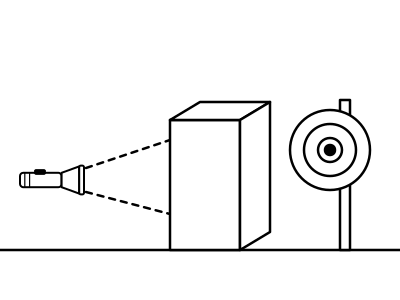 Will the light reach the target?