This week's lessons
Math and reading every day; science and social studies take turns
- Day 1 · Monday
- MathCount on from any numberI can count forward from any number up to 120.
- Reading & WritingThe lesson of the taleI can retell a folktale and tell its lesson.
- ScienceAnimal outside partsI can name outside parts of animals.
- Day 2 · Tuesday
- MathCrossing 100I can count past 100 to 120.
- Reading & WritingWhat are the characters like?I can describe a character using what they do and say.
- Social StudiesWhat is a map?I can tell what a map shows and how a map is different from a globe.
- Day 3 · Wednesday
- MathRead and write numbers to 120I can read and write numbers up to 120.
- Reading & WritingAnd, but, soI can join two ideas with and, but or so.
- ScienceWhat do the parts do?I can tell how an animal part helps it live.
- Day 4 · Thursday
- MathCount a big collectionI can count a collection and write how many.
- Reading & WritingMy opinion of the taleI can name the book, tell my opinion and give a reason with because.
- Social Studies · CheckMap my roomI can make a map of my room with symbols and a key.
- Day 5 · Friday
- Math · CheckLesson + weekly check: counting to 120I can count, read and write numbers to 120.
- Reading & Writing · CheckShare and check: ai and ayI can read ai and ay words and share my opinion.
- Science · CheckBeak toolsI can test which tool beak works best for each food.
This week's checks
Short checks on the last day each subject meets this week
Social Studies · Day 4
- I can tell what a map shows and how a map is different from a globe.
- I can make a map of my room with symbols and a key.
Secure when: 6 of 8 correct, with at least one right on each goal
Open the checkMath · Day 5
- I can count forward from any number up to 120.
- I can count past 100 to 120.
- I can read and write numbers up to 120.
- I can count a collection and write how many.
Secure when: 9 of 10 correct
Open the checkReading & Writing · Day 5
- I can read ai and ay words.
- I can read the sight words round, stop, take, thank and think.
- I can tell a tale's lesson and describe a character from what she does and says.
- I can join two ideas with and or but.
- I can tell an opinion and a reason.
Secure when: 8 of the 10 words in items 1 and 2, 4 of the 5 sight words, and 4 of items 4 to 7, with the reason found in item 7.
Open the checkScience · Day 5
- I can name outside parts of animals.
- I can tell how an animal part helps it live.
- I can test which tool beak works best for each food.
Secure when: 6 of 8 correct, including item 2 (a beak match with a reason about shape).
Open the check
Reading About Our World: Beaks Are Tools
Read it aloud. Your child reads the sentences marked with a star. Builds science knowledge.
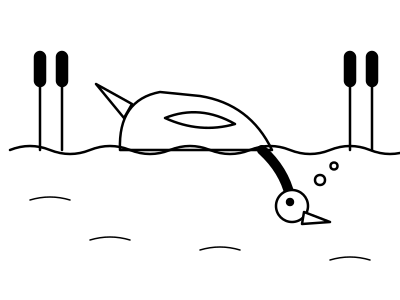
Different Beaks
Birds do not have hands. They use their beaks to get food. Each kind of bird has a beak that fits the food it eats.
Long and Strong
A hummingbird has a long, thin beak. It reaches deep inside flowers to drink sweet nectar. A woodpecker has a strong, pointed beak. It pecks holes in trees to find bugs.
Flat and Wide
A duck has a flat, wide bill. It scoops up plants and tiny animals from the water. The duck can dip in the pond to get a snack.
Words to know
- beak: the hard mouth part of a bird
- nectar: a sweet juice inside flowers
- peck: hit with a beak again and again
Talk about it
- What does a hummingbird drink?
- How does a woodpecker find bugs?
- Could a duck drink nectar from deep inside a flower? Why or why not?
Home Connection
Five-minute ideas for the whole family, with things you already have
Math
We can count past 100, all the way to 120.
Do: Count out loud together from 95 to 120. Then count backward from 110 to 100.
Talk: What number comes after 109?
Reading & Writing
Folktales and fables often teach a lesson.
Do: Tell or read a fable, like The Tortoise and the Hare. Write rain, tail, play, day and mail for your child to read.
Talk: What lesson does the tale teach? Do you agree with it?
Science
Animals have body parts that help them live.
Do: Watch a bird, a squirrel, a pet or a bug from a safe distance. Name its body parts and what each part does.
Talk: How does a bird's beak help it eat?
Social Studies
A map shows a place from above, and a globe is a model of Earth.
Do: Draw a map of your child's bedroom as if looking down from the ceiling. Add a key with simple symbols for the bed, door and window.
Talk: How is a map different from a globe?
This week's words: round, stop, take, thank, think
Celebrate counting to 120, the lesson of a tale and a map of a room.
Math catch-up: Over the Bridge to a New Ten
10 minutes, if this week's math check was not secure · 1.NBT.A.1
Counting gets stuck at the change to a new ten (after 59 some children say 50 or 'fifty-ten') and again after 100. Saying the decade names out loud and seeing the pattern on a chart smooths both bridges.
You need: a 120 chart drawn on paper (rows of 10, from 1 to 120), a small toy to use as a marker
- Point to 57 and count on together to 63. Slow down at 59 and say: "After 9 ones comes a new ten: 60."
- Say the decade names together: 10, 20, 30 ... 100. Then say: "After 100 we start over: 101, 102, just like 1, 2 with a 1 in front."
- Your child moves the toy from 97 to 104, saying each number. Write 101 to 104 together.
- Choose 2 new start numbers just before a new ten, such as 88 and 108, and count on 5 more.
Try again
- What number comes after 79?
- Count from 107 to 112. Say each number.
- Write the number one hundred nine.
Specials This Week
Weeks 13–18 unit • ~90 min/week per subject
Manipulative Skills (Throwing and Catching)
Developing underhand and overhand throwing, catching with two hands, aiming at targets.
Form and Space
Understanding 2D vs. 3D forms (cubes, spheres), exploring foreground, middle ground, background in drawings.
Tempo and Dynamics
Forte/piano (loud/soft), fortissimo/pianissimo, expressing musical ideas through tempo and dynamics.
For guiding principles and full standards reference, visit How to use this curriculum
As an Amazon Associate, we earn from qualifying purchases. Book and supply links on this page are affiliate links — using them supports this curriculum at no extra cost to you.