This week's lessons
Math and reading every day; science and social studies take turns
- Day 1 · Monday
- MathA bundle of tenI can make a ten from ten ones.
- Reading & WritingWho is telling the story?I can tell who is telling the story at different points.
- Social StudiesNorth, south, east and westI can use a compass rose to find north, south, east and west.
- Day 2 · Tuesday
- MathTeen numbers are a ten and some onesI can show a teen number as one ten and some ones.
- Reading & WritingA story told by 'I'I can tell when a character tells the story using I.
- SciencePlant outside partsI can name plant parts and tell what they do.
- Day 3 · Wednesday
- MathDecade numbers are just tensI can show 10, 20, 30 ... 90 as tens and 0 ones.
- Reading & WritingAsking, telling and exclaiming sentencesI can write a telling sentence, an asking sentence and an exclaiming sentence.
- Social StudiesMap my neighborhoodI can make a map of my street with a title, key and compass rose.
- Day 4 · Thursday
- MathTens and ones in any two-digit numberI can tell how many tens and ones are in a two-digit number.
- Reading & WritingTwo reasonsI can give two reasons for my opinion.
- Science · CheckCelery drinksI can test what happens to a celery stalk in colored water and tell the stem's job.
- Day 5 · Friday
- Math · CheckLesson + weekly check: tens and onesI can show a number as tens and ones.
- Reading & Writing · CheckShare and check: ee and eaI can read ee and ea words and say who is telling a story.
- Social Studies · CheckWhere in the world am I?I can tell my place from home to town, state, country, continent and world.
This week's checks
Short checks on the last day each subject meets this week
Science · Day 4
- I can name plant parts and tell what they do.
- I can test what happens to a celery stalk in colored water and tell the stem's job.
Secure when: 6 of 8 correct, including item 3 (the stem carried water up, with the color as evidence).
Open the checkMath · Day 5
- I can make a ten from ten ones.
- I can show a teen number as one ten and some ones.
- I can show 10, 20, 30 ... 90 as tens and 0 ones.
- I can tell how many tens and ones are in a two-digit number.
Secure when: 7 of 8 correct
Open the checkReading & Writing · Day 5
- I can read ee and ea words.
- I can read the sight words them, then, when, walk and an.
- I can tell who is telling a story: a character or the narrator.
- I can use the right end mark for telling, asking and exclaiming sentences.
- I can give two reasons for my opinion.
Secure when: 8 of the 10 words in items 1 and 2, 4 of the 5 sight words, 2 of items 4 to 6, and items 7 and 8.
Open the checkSocial Studies · Day 5
- I can use a compass rose to find north, south, east and west.
- I can make a map of my street with a title, key and compass rose.
- I can tell my place from home to town, state, country, continent and world.
Secure when: 7 of 9 correct, with at least one right on each goal
Open the check
Reading About Our World: Where in the World Am I?
Read it aloud. Your child reads the sentences marked with a star. Builds social studies knowledge.
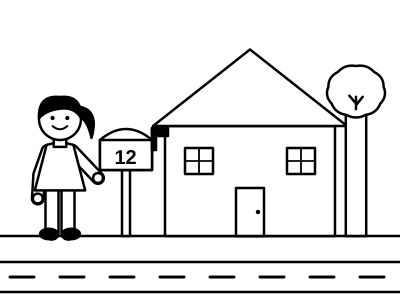
Home and Town
Your home is in a town or city. A town has streets, stores and neighbors. You can learn your street address.
State and Country
Your town is in a state. Our country, the United States, has 50 states. Each state has its own name and capital city. I live in a state.
Continent and World
The United States is on a big piece of land called North America. Big pieces of land like this are called continents. There are 7 continents. All of them are on our planet, Earth.
Words to know
- state: one part of our country
- country: a land with its own government and people
- continent: a very big piece of land
Talk about it
- How many states does the United States have?
- What continent is the United States on?
- Is a state bigger or smaller than a town? How do you know?
Home Connection
Five-minute ideas for the whole family, with things you already have
Math
A two-digit number is made of tens and ones.
Do: Put beans in small plastic cups, 10 in each cup. Make 34 with 3 cups of ten and 4 loose beans. Then make 52.
Talk: How many tens and ones are in 52?
Reading & Writing
The narrator is the one telling the story.
Do: Read a story and ask who is telling it. Write feet, green, seat, sweet and team for your child to read.
Talk: Who is telling this story? How do you know?
Science
Plant parts have jobs: roots take in water, stems carry it, and leaves help make food.
Do: Put a celery stalk in a plastic cup of water with a few drops of food coloring. Look at it again tomorrow.
Talk: What do you think the stem did with the water?
Social Studies
A compass rose shows north, south, east and west.
Do: Use a compass app or ask where the sun rises (east). Put paper signs on the walls of a room for north, south, east and west.
Talk: What is our address: street, town, state and country?
This week's words: them, then, when, walk, an
Celebrate a number built from tens and ones, a narrator your child named and a celery test.
Math catch-up: One Bundle, One Ten
10 minutes, if this week's math check was not secure · 1.NBT.B.2
Children often count a bundle of ten as 1 thing, or think the 1 in a teen number means one counter. Making bundles and taking them apart shows that a ten is ten ones and also one unit.
You need: 40 straws, craft sticks or cotton swabs, 5 rubber bands or hair ties
- Your child counts 10 straws and puts a rubber band around them. Ask: "How many straws are in the bundle?" (10) "How many bundles?" (1)
- Make 17: 1 bundle and 7 loose straws. Point to the 1 in 17: "This 1 is the whole bundle."
- Make 2 bundles and 5 loose straws. Count by tens, then ones: 10, 20, 21, 22, 23, 24, 25.
- Make 40 with bundles. Ask: "How many loose ones?" (0) Write 40 = 4 tens and 0 ones.
Try again
- 14 = ___ ten and ___ ones
- 60 = ___ tens and ___ ones
- 3 bundles of ten and 2 loose straws. How many straws?
Specials This Week
Weeks 13–18 unit • ~90 min/week per subject
Manipulative Skills (Throwing and Catching)
Developing underhand and overhand throwing, catching with two hands, aiming at targets.
Form and Space
Understanding 2D vs. 3D forms (cubes, spheres), exploring foreground, middle ground, background in drawings.
Tempo and Dynamics
Forte/piano (loud/soft), fortissimo/pianissimo, expressing musical ideas through tempo and dynamics.
For guiding principles and full standards reference, visit How to use this curriculum
As an Amazon Associate, we earn from qualifying purchases. Book and supply links on this page are affiliate links — using them supports this curriculum at no extra cost to you.