1First Grade

    Decade numbers are just tens

    Asking, telling and exclaiming sentences

    Practice pages

    0 of 180 days complete · Saved on this device

    View all 180 days

    Math

    Decade numbers are just tens

    I can show 10, 20, 30 ... 90 as tens and 0 ones.

    Standards: 1.NBT.B.2.c

    Number practice (no timer)
    Ten and some more: teen facts (10 + 3, 13 - 3)
    Builds on
    Days 1 and 2: bundles of ten and teen numbers. One-minute check: "How many straws in 2 bundles of 10?" (20)

    New words

    • decade number: 10, 20, 30, 40, 50, 60, 70, 80 or 90; only tens and 0 ones

    You need

    • 9 straw bundles of 10 and 10 loose straws (or base-ten blocks)
    • 1 die
    • Notebook and pencil
    1. Warm-Up · 5 min

      Fluency: ten and some more. "10 + 6?" (16) "14 - 4?" (10) "10 + 8?" (18) Spaced review from Week 13: "Write one hundred four." (104)

    2. Mini-Lesson · 10 min

      Say: "Today we count only bundles." Put out 1 bundle: "1 ten is 10." Add bundles one at a time while your child counts: "2 tens is 20, 3 tens is 30, ... 9 tens is 90." Write each number in a list. Point to 60. Ask: "How many tens?" (6) "How many loose ones?" (0) "That is why there is a 0 in the ones place." Now show 1 bundle and 6 loose straws next to 6 bundles. Say: "This is sixteen: 1 ten and 6 ones. This is sixty: 6 tens and 0 ones." Ask: "Which has more straws?" (Sixty.)

    3. Guided Practice · 10 min

      1) Your child builds 40, 70, 20 and 90 with bundles and writes each number. 2) You say "8 tens"; your child writes 80. You say "5 tens"; your child writes 50. 3) Build 14 and 40 side by side. Your child says each one in tens and ones. (14: 1 ten and 4 ones. 40: 4 tens and 0 ones.) If stuck, say: "Count the bundles by tens: 10, 20, 30. The last number you say is the number."

    4. Play · 10 min

      Sixteen or Sixty? Take turns rolling the die. Use the number rolled for both a teen number and a decade number: if you roll 4, build 14 and 40. Your child says which is which and how many tens each has. Then you say one of the two numbers, and your child points to the right pile. Play 6 rounds.

    5. Exit Ticket · 3-5 min

      Put the objects to one side but leave them on the table. Read each question aloud. Your child answers out loud, with objects or with a quick drawing. Check each answer together right away.

    Exit ticket

    1. How many tens are in 70?
    2. Why does 30 have a 0 in it?
    3. Which has more tens, 15 or 50?
    Answers
    1. 7
    2. There are 3 tens and no extra ones, so the ones place is 0.
    3. 50 (5 tens; 15 has only 1 ten)
    Watch for, and help or stretch
    Watch for
    Mixing up teen and decade names, such as building 60 when you said sixteen.
    Try
    Say the endings slowly: "six-TEEN" has 1 ten; "six-TY" has 6 tens.
    Extra help
    Work with 10 to 50 only, and count the bundles by tens together.
    Stretch
    Ask: "How many tens would 100 be?" (10 tens) Make 10 bundles and check.

    At home (optional): Your child counts by tens to 90 using groups of 10 coins, crayons or blocks.
    Reading & Writing

    Asking, telling and exclaiming sentences

    I can write a telling sentence, an asking sentence and an exclaiming sentence.

    Standards: L.1.1.j, L.1.2.b, RF.1.1.a

    Phonics
    Vowel teams ee and ea (feet, green, seat, read)
    Sight words
    them, then, when, walk, an
    Reading
    The Three Billy Goats Gruff (traditional, public domain); original first-person retelling "I Am the Troll"
    Writing
    Opinion: stating an opinion and giving two reasons · Handwriting: letters sitting on the line
    Builds on
    End marks (Week 11). One-minute check: ask "What goes at the end of a telling sentence?" (a period)

    New words

    • question: an asking sentence that ends with a question mark
    • exclamation: a sentence said with strong feeling that ends with an exclamation mark
    • command: a sentence that tells someone to do something

    You need

    • Cards with . ? ! drawn large
    • Sentence strips
    • Sight word cards
    • Printed "I Am Lee"
    1. Phonics & Word Work · 15 min

      Reading ee and ea sentences with end marks. I do: read "See the green tree." with a calm voice. We do: read "Can we eat a peach?" with a voice that goes up, and "The sheep is in the creek!" with a big voice. You do: your child reads tree, creek, treat, dream, sleep, steam. Dictation: tree, creek, treat, dream. If stuck reading a sentence, read the end mark first: "It is a question mark, so my voice goes up."

    2. Sight Words · 5 min

      Review: them, then, when, walk, an. Flip and Read: lay the five cards face down with last week's words. Your child flips a card, reads it and uses it in a short spoken sentence. Missed words go back in the pile.

    3. Read-Aloud & Shared Reading · 15 min

      Read troll and goat lines aloud. Your child holds up the matching end mark card. "Who is that tripping over my bridge?" (?) "Wait for my bigger brother." (.) "Go away, Troll!" (!) "It is only me." (.) Say: "A telling sentence ends with a period. An asking sentence ends with a question mark. A sentence with strong feeling ends with an exclamation mark. A command tells someone to do something; it can end with a period or an exclamation mark." (RF.1.1.a: every sentence starts with a capital.) Ask: "What kind of sentence is Go away, Troll?" (a command, with strong feeling) Then your child reads "I Am Lee" and finds one sentence that starts with a capital and ends with a period.

    4. Writing & Handwriting · 15 min

      Your child writes one of each type about the goats: a telling sentence, an asking sentence and an exclaiming sentence, plus a command: "Go away, Troll!" Your child checks the capital and the end mark on each. Handwriting (4 min): letters sitting on the line, with end marks sitting on the line too.

    5. Exit Ticket · 5 min

      Oral answers.

    Exit ticket

    1. Listen as I say it: Who is under the bridge (say it as a question). What end mark goes at the end of that sentence?
    2. Tell me a command for the goats.
    3. Read this sentence the right way: "Can we eat a peach?"
    Answers
    1. a question mark
    2. Answers vary. Look for: a sentence that tells someone to do something, such as "Run over the bridge!"
    3. Can we eat a peach? (voice goes up at the end)
    Watch for, and help or stretch
    Watch for
    Putting a question mark on any sentence that has a question word in it, such as "I know who is there?"
    Try
    Read it aloud: "Am I asking you something?" If not, it gets a period.
    Extra help
    Work with only . and ? today.
    Stretch
    Your child changes a telling sentence into a question: "The sheep is big." becomes "Is the sheep big?"

    At home (optional): Your child finds one question mark and one exclamation mark in a book at home.

    Social Studies

    Map my neighborhood

    I can make a map of my street with a title, key and compass rose.

    Standards: D2.Geo.1.K-2

    Builds on
    Map my room and directions (Weeks 13 and 14). One-minute check: your child points to north and says the trick: "Never Eat Soggy Waffles."

    New words

    • title: the name at the top of a map that tells what it shows
    • street: a road with homes or buildings along it

    You need

    • Large paper
    • Markers
    • A paper street map or a map app on a phone, zoomed in on your street or a favorite park
    • Room map from Week 13 (to compare)
    • Clipboard or a hard book (for the walk)
    1. Warm-Up / Wonder · 5 min

      Spaced review: play 30 seconds of "Point and Walk." Wonder question: "What would our street look like to a bird?"

    2. Explore · 10–15 min

      Take a short walk along your street (or the park) with your child holding the clipboard, or look at it on the map app. Look for 4 to 6 things to put on the map: your home, neighbors' homes, a tree, a stop sign, a mailbox, a crosswalk, a playground. Stay on the sidewalk with a grown-up. Back inside, look at the street on the map app. Ask: "Which way does our street run? Where is north?" Your child draws the street as 2 long lines, then adds symbols for each thing seen. They add 3 map parts: a title ("My Street"), a compass rose and a key. Compare with the room map. Ask: "Which map shows a bigger place?" (the street map) "On which map do things look smaller?" (the street map; a whole house is just a small square) If stuck placing things, ask: "What did we pass first after leaving home? What came next?"

    3. Talk & Record · 5–10 min

      Your child checks the map with the 3-part list: title, compass rose, key. Sentence frame: "On my street, the ___ is ___ of my home." (Sample: "The stop sign is east of my home.")

    4. Exit Ticket · 3–5 min

      Ask the three questions aloud.

    Exit ticket

    1. Name the 3 parts we put on our map.
    2. Which shows a bigger place: the room map or the street map?
    3. What does your street map show next to your home?
    Answers
    1. A title, a compass rose and a key.
    2. The street map.
    3. Answers vary. Look for: an answer that matches the map and the real street.
    Watch for, and help or stretch
    Watch for
    Drawing homes and trees from the side.
    Try
    Ask: "What would a bird see when it looks down at a house?" (the roof, a shape)
    Extra help
    Map 3 things: your home, a tree and one more. The grown-up draws the street lines.
    Stretch
    Your child draws a dotted line on the map for the path from home to a favorite place and tells the directions.

    At home (optional): Your child uses the street map to show a family member the way to one place on the street.

    Practice

    Read each direction aloud. Your child works on the page; answers are in the grown-up view.

    Warm-up

    Remember?

    Math

    1. Write the number one hundred one.
    2. Start at 14. How many do you count on to get to 16?

    Reading & Writing

    1. round, stop, take

    Math · Week 14 Day 3

    I can show 10, 20, 30 ... 90 as tens and 0 ones.

    Look: 3 tens

    1. Count the bundles by tens: 10, 20, 30.
    2. There are no loose straws.
    3. 3 tens and 0 ones is 30.

    Write the number.

    1. 1.
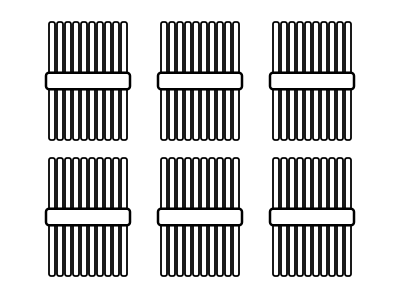
      6 bundles of 10 straws.
    2. 2.
      9 tens and 0 ones
    3. 3.
      2 tens
    4. 4.
      How many tens are in 50?

    Your grown-up says a number. Circle it.

    1. 5.
      seventeen
      • 17
      • 70
    2. 6.
      seventy
      • 17
      • 70
    3. 7.
      thirteen
      • 13
      • 30
    4. 8.
      eighty
      • 18
      • 80

    Challenge (optional)

    Which has more straws: 1 bundle and 9 loose straws, or 2 bundles? Tell why.

    Reading & Writing · Week 14 Day 3

    I can write a telling sentence, an asking sentence and an exclaiming sentence.

    Look: telling, asking and exclaiming

    1. Say: "A telling sentence ends with a period. An asking sentence ends with a question mark. A sentence with a big feeling ends with an exclamation mark."
    2. Read: The tree is green. Can I have a treat? Eek, a bee! Use your voice to show each one.
    3. Point to the end mark of each one.

    The Bee

    A bee sat on a green leaf. Can the bee see me? Eek, the bee is on my feet! The bee went back to the leaf.

    Circle the end mark that fits.

    1. 1.
      The seal is in the sea ___
      • .
      • ?
      • !
    2. 2.
      Can a sheep swim ___
      • .
      • ?
      • !
    3. 3.
      Eek, a big eel ___
      • .
      • ?
      • !
    4. 4.
      Can we meet at the beach ___
      • .
      • ?
      • !

    Write one of each kind of sentence.

    1. 5.
      A telling sentence:
    2. 6.
      An asking sentence:
    3. 7.
      An exclaiming sentence:

    Challenge (optional)

    Can the bee see me?

    Social Studies · Week 14 Day 3

    I can make a map of my street with a title, key and compass rose.

    Look: making a street map

    1. Draw the street as two long lines.
    2. Add a symbol for each thing you saw, like a small square for a home and a circle for a tree.
    3. Add the 3 map parts: a title, a compass rose and a key.

    Look at the street map. Your child circles the answer.

    1. 1.
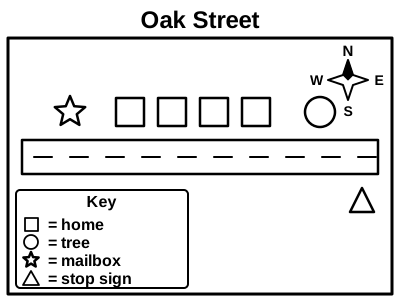
      A street map titled "Oak Street." One long street runs from east to west. Four small squares (homes) sit along the street. A circle (tree) is east of the homes. A star (mailbox) is west of the homes. A triangle (stop sign) is at the east end of the street. A key in the corner shows: square = home, circle = tree, star = mailbox, triangle = stop sign. A compass rose has N at the top. What does the circle stand for?
      • home
      • tree
    2. 2.
      What does the square stand for?
      • home
      • tree
    3. 3.
      Is the mailbox east or west of the homes?
      • east
      • west
    4. 4.
      Is the stop sign at the east end or the west end of the street?
      • east
      • west
    5. 5.
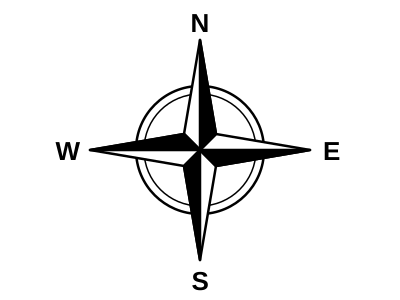
      Which part of the map shows directions?
      • The compass rose.
      • The key.

    Talk and draw. Write what your child says.

    1. 6.
      Which map part tells the name of the map?
    2. 7.
      On a street map, why does a whole house look so small?
    3. 8.
      Draw a symbol for a playground. Then draw a small key that shows what it means.

    Challenge (optional)

    Add one more thing you saw on your walk to your own street map and to its key.

    You need: crayons