This week's lessons
Math and reading every day; science and social studies take turns
- Day 1 · Monday
- MathNumber of the DayI can show one number in many ways.
- Reading & WritingCharacters and eventsI can describe the characters and the big events in a tale.
- ScienceSpines, thorns and shellsI can tell how outside parts protect plants and animals.
- Day 2 · Tuesday
- MathQuick picturesI can draw a quick picture to show tens and ones.
- Reading & WritingUsing picture bordersI can use pictures and details to describe what happens in a story.
- Social StudiesLand and water on a globeI can find land and water on a globe and name the continents and oceans.
- Day 3 · Wednesday
- MathMatching forms of a numberI can match a number to its picture and its tens and ones.
- Reading & WritingBecauseI can use because to tell why.
- ScienceCopying natureI can match a plant or animal part to an invention that works like it.
- Day 4 · Thursday
- MathPlace value riddlesI can solve riddles about tens and ones.
- Reading & WritingMy favorite characterI can write my opinion about a favorite character with a reason and an ending.
- Social Studies · CheckLandforms and waterI can name landforms and bodies of water and find them in pictures.
- Day 5 · Friday
- Math · CheckLesson + weekly check: show a number many waysI can show a number with blocks, a picture and tens and ones.
- Reading & Writing · CheckShare and check: oa and owI can read oa and ow words and share my opinion piece.
- Science · CheckNature-to-invention matchI can explain how an invention works like a living thing.
This week's checks
Short checks on the last day each subject meets this week
Social Studies · Day 4
- I can find land and water on a globe and name the continents and oceans.
- I can name landforms and bodies of water and find them in pictures.
Secure when: 6 of 8 correct, with at least one right on each goal
Open the checkMath · Day 5
- I can show one number in many ways.
- I can draw a quick picture to show tens and ones.
- I can match a number to its picture and its tens and ones.
- I can solve riddles about tens and ones.
Secure when: 9 of 10 correct
Open the checkReading & Writing · Day 5
- I can read oa and ow words.
- I can read the sight words as, with, this, that and because.
- I can describe the characters and big events in a tale.
- I can use because to tell why.
- I can write an opinion about a character with a reason and a closing.
Secure when: 8 of the 10 words in items 1 and 2, 4 of the 5 sight words, items 4 to 6, a clear opinion with a reason in item 7, and a closing in item 8.
Open the checkScience · Day 5
- I can tell how outside parts protect plants and animals.
- I can match a plant or animal part to an invention that works like it.
- I can explain how an invention works like a living thing.
Secure when: 6 of 8 correct, including item 1 (4 correct matches) and item 2 (a reason about shape or job).
Open the check
Reading About Our World: Staying Safe
Read it aloud. Your child reads the sentences marked with a star. Builds science knowledge.
Sharp Quills
A porcupine has many sharp quills on its back. When an animal comes too close, the quills help protect the porcupine.
Hard Shells
A turtle has a hard shell. The shell covers its body like a strong roof. A box turtle can even pull its head and legs inside.
Hide and Hop
Some animals stay safe by hiding. A brown toad looks like the dirt and dead leaves around it. A toad can hop and hide.
Plants Too
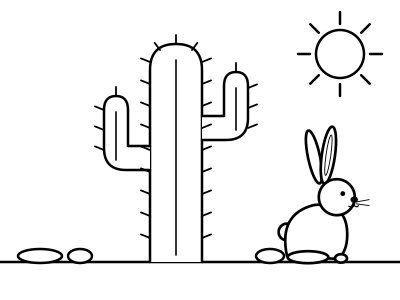
Plants cannot run away. A cactus has sharp spines. The spines keep many animals from eating it.
Words to know
- quill: a sharp, stiff spine on a porcupine
- shell: a hard cover that protects an animal
- protect: keep safe
Talk about it
- What does a porcupine have on its back?
- How does a box turtle stay safe?
- Why is it helpful for a toad to be the same color as the dirt?
Home Connection
Five-minute ideas for the whole family, with things you already have
Math
One number can be shown many ways: tens and ones, a drawing or words.
Do: Pick a Number of the Day, like 46. Your child shows it with cups of ten beans, draws it with sticks for tens and dots for ones, and says "4 tens and 6 ones."
Talk: What number has 7 tens and 0 ones?
Reading & Writing
We can give an opinion and a reason using the word because.
Do: Write boat, road, snow, grow and coat for your child to read. Then your child finishes this sentence out loud: "My favorite character is ___ because ___."
Talk: Why is that character your favorite?
Science
Spines, shells and thorns protect living things, and some inventions work like them.
Do: Look at a pinecone, a shell or a picture of a cactus (look, don't touch thorns). Then find a hook-and-loop strip on a shoe or bag; it works like burrs that stick to fur.
Talk: What animal part would you like to have, and what would it help you do?
Social Studies
Earth has land and water, with landforms like mountains, hills and islands.
Do: Look at a globe or a world map. Find where you live, then find land and water.
Talk: Which landform would you like to visit: a mountain, an island or a valley?
This week's words: as, with, this, that, because
Celebrate a Number of the Day, an opinion with a reason and a nature part that protects.
Math catch-up: Tens Say Their Name First
10 minutes, if this week's math check was not secure · 1.NBT.B.2
When a number is told as ones first, or drawn in a quick picture, children often write the digits in the wrong order (74 for 47). Building first and writing the tens digit first fixes the order.
You need: 30 straws or craft sticks, 8 rubber bands, paper and a pencil
- Say: "I have 5 ones and 2 tens." Your child builds it: 2 bundles and 5 loose.
- Ask: "How many tens?" Write the 2. "How many ones?" Write the 5: 25. Say: "The tens always go first."
- Show a quick picture: draw 3 sticks and 8 dots. Your child says the number (38) and writes it, tens first.
- Your child draws a quick picture for a number you say, with 1 stick for each ten.
Try again
- 8 tens and 1 one is ___
- Draw a quick picture of 53.
- 6 ones and 2 tens is ___
Specials This Week
Weeks 13–18 unit • ~90 min/week per subject
Manipulative Skills (Throwing and Catching)
Developing underhand and overhand throwing, catching with two hands, aiming at targets.
Form and Space
Understanding 2D vs. 3D forms (cubes, spheres), exploring foreground, middle ground, background in drawings.
Tempo and Dynamics
Forte/piano (loud/soft), fortissimo/pianissimo, expressing musical ideas through tempo and dynamics.
For guiding principles and full standards reference, visit How to use this curriculum
As an Amazon Associate, we earn from qualifying purchases. Book and supply links on this page are affiliate links — using them supports this curriculum at no extra cost to you.