This week's lessons
Math and reading every day; science and social studies take turns
- Day 1 · Monday
- MathAdding tens and tensI can add groups of ten.
- Reading & WritingPictures in my headI can find words in a poem that appeal to the senses.
- Social StudiesThen and now: toys and schoolI can compare toys and schools long ago with toys and schools today.
- Day 2 · Tuesday
- MathAdding tens to any numberI can add a group of tens to a two-digit number.
- Reading & WritingDescribing wordsI can use describing words to tell about a noun.
- ScienceBabies ask for helpI can tell how baby animals let parents know they need help.
- Day 3 · Wednesday
- MathHopping by tens on the chartI can add tens by hopping down the hundred chart.
- Reading & WritingBig, bigger, giganticI can tell the difference between words like big and gigantic.
- Social StudiesPlan a family interviewI can make questions to ask an older person about when they were young.
- Day 4 · Thursday
- MathAdding tens in storiesI can solve stories that add tens.
- Reading & WritingMy shadow poemI can write a short poem using describing words.
- Science · CheckNot all parents stayI can compare animals whose parents stay with ones whose parents leave.
- Day 5 · Friday
- Math · CheckLesson + weekly check: adding tensI can add tens and explain my thinking.
- Reading & Writing · CheckShare and check: r-controlled vowelsI can read r-controlled words and describe with adjectives.
- Social Studies · CheckWhat I learned from my interviewI can compare how an older person saw things as a child with how I see things now.
This week's checks
Short checks on the last day each subject meets this week
Science · Day 4
- I can tell how baby animals let parents know they need help.
- I can compare animals whose parents stay with ones whose parents leave.
Secure when: 6 of 8 correct, including items 5 and 6 (how each kind of baby survives).
Open the checkMath · Day 5
- I can add tens to tens.
- I can add tens to a two-digit number.
- I can explain my adding.
Secure when: 6 or 7 of the 7 items right.
Open the checkReading & Writing · Day 5
- I can read r-controlled words and describe with adjectives.
- I can find sense words in a poem and tell big from gigantic.
- I can write a short poem using describing words.
Secure when: 8 of 10 words in items 1-2, 4 of 5 sight words, 2 describing words named in item 4, and 4 of 5 on items 5-9.
Open the checkSocial Studies · Day 5
- I can compare toys and schools long ago with toys and schools today.
- I can make questions to ask an older person about when they were young.
- I can compare how an older person saw things as a child with how I see things now.
Secure when: 6 of 8 correct, with at least one right on each goal
Open the check
Reading About Our World: School Long Ago
Read it aloud. Your child reads the sentences marked with a star. Builds social studies knowledge.
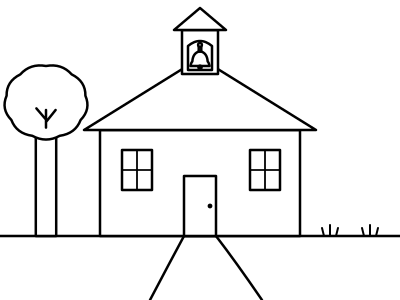
One Room for All
Long ago, many children went to a one-room school. Big and little children learned in the same room with one teacher. All the kids sat in one class.
Slates, Not Paper
Paper cost a lot, so children often wrote on small slates with chalk. They wiped the slate clean and used it again.
School Today
Today, most schools have many rooms, and children of the same age learn together. Some children learn at home. Children still read, write and do math, just like long ago.
Words to know
- long ago: a time before you and your family were born
- slate: a small, flat board to write on with chalk
- today: the time we live in now
Talk about it
- How many teachers did a one-room school have?
- What did children write on long ago?
- Why did children use slates instead of paper?
Home Connection
Five-minute ideas for the whole family, with things you already have
Math
Adding tens is like adding ones, but with tens.
Do: Show 25 with 2 cups of ten beans and 5 loose beans. Add 3 more cups of ten. How many now?
Talk: What is 40 + 20? How is it like 4 + 2?
Reading & Writing
Describing words help us make pictures in our heads.
Do: Pick a pillow or a toy and take turns saying describing words: soft, big, fluffy. Write dark, corn, fern, bird and hurt for your child to read.
Talk: What does your favorite food look, smell and taste like?
Science
Baby animals call, cry or chirp to tell parents they need help; some animal parents leave.
Do: Listen to recordings of baby animal calls on a zoo or wildlife website.
Talk: How did you let grown-ups know you needed help when you were a baby?
Social Studies
Life long ago was different from today in some ways and the same in others.
Do: Ask an older relative or neighbor what toys and school were like when they were young.
Talk: What was the same as today? What was different?
This week's words: time, look, more, write, number
Celebrate adding tens, a describing word and an interview about long ago.
Math catch-up: Bundles Go With Bundles
10 minutes, if this week's math check was not secure · 1.NBT.C.4
When adding tens, children often write the answer as ones (30 + 40 = 7) or add the tens to the ones digit. Keeping bundles with bundles makes the tens visible.
You need: 90 straws or craft sticks, 9 rubber bands, 2 plates
- Put 4 bundles on one plate and 3 bundles on the other. Ask: "How many bundles in all?" (7) "7 tens is how many straws?" Count by tens: 70.
- Write 40 + 30 = 70. Say: "4 tens and 3 tens is 7 tens, and 7 tens is 70."
- Build 23. Add 5 bundles. Ask: "Did we add any loose ones?" (No.) Count: 73. The ones digit stays 3.
- Do 2 more: a tens number plus a tens number, and a two-digit number plus a tens number.
Try again
- 20 + 50 = ___
- 25 + 40 = ___
- 22 + 60 = ___
Specials This Week
Weeks 19–24 unit • ~90 min/week per subject
Manipulative Skills (Kicking and Dribbling)
Developing kicking skills (stationary and moving ball), dribbling with hands (bouncing) and feet (soccer style).
Value and Self-Expression
Light and dark (value), creating form and shadow, using art to express feelings, drawing self-portraits.
Form and Timbre
Identifying repeating sections (ABA, AABB format), recognizing different instrument sounds (timbre), classifying instruments (strings, woodwinds, brass).
For guiding principles and full standards reference, visit How to use this curriculum
As an Amazon Associate, we earn from qualifying purchases. Book and supply links on this page are affiliate links — using them supports this curriculum at no extra cost to you.