1First Grade

    New tens in quick pictures

    Words and their real uses

    Practice pages

    0 of 180 days complete · Saved on this device

    View all 180 days

    Math

    New tens in quick pictures

    I can circle 10 ones in my drawing to make a new ten.

    Standards: 1.NBT.C.4

    Number practice (no timer)
    Make a new ten: 8 + 5 = 13 helps 28 + 5
    Builds on
    Day 1 (trading 10 ones for a ten with the kit). One-minute check: "37 + 5?" (42)

    New words

    • circle ten: draw a ring around 10 dots to show a new ten

    You need

    • Notebook and pencil
    • A crayon
    • 4 "Fix My Picture" drawings that you make before the lesson (described in Play)
    1. Warm-Up · 5 min

      Fluency: make a new ten. "9 + 4?" (13) "So 29 + 4?" (33) "6 + 6?" (12) "So 56 + 6?" (62) Spaced review from Week 13: "Count back from 104 to 97." (103, 102, 101, 100, 99, 98, 97)

    2. Mini-Lesson · 10 min

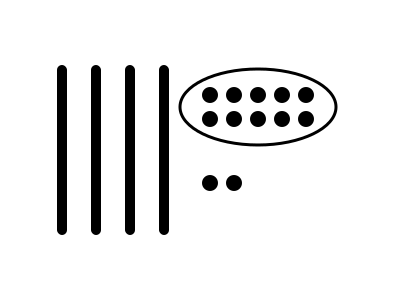
      Say: "We can make a new ten in a quick picture too." Write 46 + 8. Draw 46: 4 sticks and 6 dots. Draw 8 more dots in crayon. Ask: "How many dots now?" (14) Say: "That is enough for a new ten." Circle 10 dots with the crayon. Draw one new stick next to the others. Say: "These 10 circled dots are now 1 ten." Ask: "How many sticks?" (5) "How many dots are not circled?" (4) "What number?" (54) Write 46 + 8 = 54.

    3. Guided Practice · 10 min

      Your child draws each one, circles 10 dots, adds a new stick, and writes the equation. 1) 35 + 9 (14 dots, circle 10; 44) 2) 58 + 4 (12 dots; 62) 3) 17 + 7 (14 dots; 24) 4) 66 + 6 (12 dots; 72) 5) 79 + 5 (14 dots; 84) If stuck, say: "Count the dots. Put your pencil on the first dot and count to 10, then draw the circle."

    4. Play · 10 min

      Fix My Picture. Before the lesson, draw these 4 quick pictures, each with its answer written under it. Three have a mistake on purpose. 1) 27 + 6: 2 sticks and 13 dots, with the answer 213. (Mistake. Circle 10 dots and draw a new stick: 3 sticks and 3 dots, 33.) 2) 54 + 8: 5 sticks, 12 dots with 10 circled but no new stick, and the answer 52. (Mistake. The circled 10 is a new ten: 6 sticks and 2 dots, 62.) 3) 38 + 3: 4 sticks and 1 dot, with the answer 41. (Correct.) 4) 49 + 7: 5 sticks and 5 dots, with the answer 55. (Mistake. 9 + 7 = 16, so 5 sticks and 6 dots, 56.) Your child finds each mistake, fixes the picture and the answer, and tells what went wrong. Then your child makes 2 pictures for you to check, with or without a mistake.

    5. Exit Ticket · 3-5 min

      Put the objects to one side but leave them on the table. Read each question aloud. Your child answers out loud, with objects or with a quick drawing. Check each answer together right away.

    Exit ticket

    1. Draw 57 + 6. How many sticks and dots are there at the end? What number is it?
    2. How many dots do you circle to make a new stick?
    Answers
    1. 6 sticks and 3 dots. 63.
    2. 10
    Watch for, and help or stretch
    Watch for
    Circling 10 dots but forgetting to draw the new stick.
    Try
    Say: "The circle is a new ten. Where is its stick?" Draw it, then cross out the circled dots.
    Extra help
    Draw the dots in rows of 5 so it is easy to find 10.
    Stretch
    Ask: "Draw 75 + 9 and 79 + 5. What do you notice?" (Both are 84.)

    At home (optional): Your child draws a quick picture for 68 + 5 for a family member and explains the circled ten. (73)
    Reading & Writing

    Words and their real uses

    I can tell real-life places and times where I would use a word.

    Standards: L.1.5.c, L.1.5.a, SL.1.1.b

    Phonics
    Vowel sounds oi and oy (coin, soil, boy, toy)
    Sight words
    been, call, find, long, day
    Reading
    The Snowy Day (Ezra Jack Keats)
    Writing
    Narrative: a small moment with sense details and an ending · Handwriting: neat final copy
    Builds on
    oi and oy (Day 1). One-minute check: your child reads coin, toy, join.

    New words

    • sort: to put things into groups that go together
    • category: a group of things that are alike

    You need

    • 12 picture cards (draw or cut from magazines, one per index card): mittens, sled, scarf, snow, winter coat, a warm drink; fan, sun hat, swimsuit, sandals, sprinkler, a cold drink
    • Two header cards: winter and summer (you read them)
    • Sight word cards: been, call, find, long, day
    • Printed "Joy and the Snow Fort" (from Day 1)
    • Lined handwriting paper
    1. Phonics & Word Work · 15 min

      Spelling /oi/. I do: say "When I hear /oi/ at the end of a word, I write oy. In the middle, I write oi." Write toy and coin. We do: sort these cards into oi and oy: join, toy, oil, joy, boil, boy, coin, point. (oi: join, oil, boil, coin, point. oy: toy, joy, boy.) You do: your child spells soil, Roy, foil and checks. Read: "Roy and Joy dig in the soil." "Six toys are in the box." Dictation: soil, joy, join, toys. If stuck, ask: "Is the /oi/ at the end? Then use oy."

    2. Sight Words · 5 min

      Review: been, call, find, long, day. Word in the Bag: put the cards in a bag. Your child pulls one, reads it and uses it in a sentence. Then you take a turn.

    3. Read-Aloud & Shared Reading · 15 min

      Say: "We can sort words into groups, and we can think about where we really use them." Show the winter and summer headers. Your child sorts the 12 picture cards. (Winter: mittens, sled, scarf, snow, winter coat, warm drink. Summer: fan, sun hat, swimsuit, sandals, sprinkler, cold drink.) Then, for each card, your child tells where at home or outside we use it. Keep the talk going: after each answer, ask a follow-up such as "Why there?" or "What else do you do there?" and let your child answer again. Ask: "Where do we keep the mittens? When do you put them on?" (Answers vary. Look for: a real place and time.) Ask: "Which card would you want on a very hot day? Why?" (Answers vary. Look for: a summer card and a reason.) Ask: "Which group does the snow fort story belong in?" (winter) If stuck, act out using the item and ask: "Is it cold or hot when we do this?" Then your child rereads "Joy and the Snow Fort" and names three winter things in it. (Answers vary. Look for: snow, coat, hat, snow pants, the snow fort.)

    4. Writing & Handwriting · 15 min

      Your child writes two sentences about where they use things: "I use a sled in the snow." and "I use a fan when it is hot." or their own sentences, spelling by sounds. Your child draws one item. Handwriting (4 min): names start with a capital. Your child copies Joy, Roy and Coin with a capital at the start of each name.

    5. Exit Ticket · 5 min

      Oral answers.

    Exit ticket

    1. Sort these: boots, a beach ball, a scarf. Which go with winter?
    2. Where at home would you use a blanket? When?
    3. Read this: The boy has a toy in the soil.
    Answers
    1. Boots and a scarf go with winter (a beach ball goes with summer).
    2. Answers vary. Look for: a real place and time, such as on my bed at night.
    3. The boy has a toy in the soil.
    Watch for, and help or stretch
    Watch for
    Sorting by color or size instead of by season.
    Try
    Ask: "Would you use this when it is cold or when it is hot?"
    Extra help
    Sort 6 cards today (3 winter, 3 summer).
    Stretch
    Your child makes a third group, rain, with 3 cards of their own (an umbrella, rain boots, a raincoat).

    At home (optional): Your child finds one winter thing and one summer thing in a closet and tells you when we use each.

    Science

    Bean watch

    I can observe bean sprouts and tell how they are alike and how they are different.

    Standards: 1-LS3-1

    Builds on
    Planting beans (Week 21). One-minute check: ask "What did we plant in the cups?" (bean seeds) "What do we think will grow?" (bean plants)

    New words

    • sprout: a new root or shoot growing out of a seed
    • shoot: the part of a sprout that grows up toward the light
    • observe: to look closely and notice

    You need

    • Bean Bag Garden (set up in Week 21, Day 1)
    • The 3 bean cups from Week 21
    • 6 paper strips, each about 1 inch wide and as long as a sheet of paper
    • A crayon and tape
    • Optional: a plastic hand lens (magnifier)
    • Science Notebook
    1. Warm-Up / Wonder · 5 min

      Spaced review: ask: "Is a seedling like its grown-up plant? How?" (Yes. It is the same kind of plant, green with a stem and leaves.) Wonder question: "We planted beans from the same bag. Will all the sprouts look exactly the same?" Let your child predict. Write the prediction in the Science Notebook.

    2. Explore · 10–15 min

      Look at the Bean Bag Garden through the bag; do not open it. Ask your child to point to the root on each bean. (Answers vary: a white root growing down; some beans may also have a shoot curling up.) Count: ask "How many beans have a root?" Record the number. Ask "How many have a shoot?" Record that number. Measure the roots: hold a paper strip next to bean 1's root on the outside of the bag. Your child makes a crayon mark at the root's tip. Do the same for each bean on its own strip, and write the bean number on each strip. Lay the strips side by side with the bottom edges lined up. Ask: "Which root is longest? Are any the same length?" (Answers vary.) Ask: "Are all the sprouts alike in some ways?" (Yes. Each one has a root, and they all came from beans.) "Are they exactly the same?" (No. They have different lengths, different numbers of tiny side roots, or curl different ways.) Then check the soil cups. Ask: "Do you see any shoots yet?" (Answers vary. It is fine if nothing is up yet; bean seedlings usually come up in about 7 to 10 days.) Check back on your prediction. Say: "Sprouts of the same kind are alike, but not exactly alike, just like the kittens." If stuck, cover all but 2 sprouts and ask: "What is one thing both have? What is one thing that is different?" If no bean has sprouted at all (the room may be cold), move the bag to a warmer spot and do this lesson with the seedling and grown plant pictures from Week 21, then repeat the bag check on Thursday. Mold check: a damp bag can grow fuzzy mold after a week or two. If you see mold, keep the bag sealed and throw it away; from then on, the soil cups are your evidence. Never open a moldy bag.

    3. Talk & Record · 5–10 min

      Your child draws 2 of the sprouts in the Science Notebook and tapes the 2 paper strips beside them. Sentence frame: "My sprouts are alike because ___. They are different because ___."

    4. Exit Ticket · 3–5 min

      Ask the three questions aloud. Your child answers by talking or drawing.

    Exit ticket

    1. If you planted 5 sunflower seeds from one packet, would the sprouts all be exactly the same?
    2. Name one way your bean sprouts are alike.
    3. Name one way your bean sprouts are different.
    Answers
    1. No. They would all be sunflowers, but they would be a little different, such as in size.
    2. Answers vary. Look for: they all have a root (or a shoot), or they all came from beans.
    3. Answers vary. Look for: the roots are different lengths, some have shoots and some do not, or they curl different ways.
    Watch for, and help or stretch
    Watch for
    Calling a longer root "better" or "the winner."
    Try
    Say: "Scientists just notice and record. Different is not better or worse; it is how living things are."
    Extra help
    Measure only 2 sprouts and compare their strips.
    Stretch
    Your child measures the sprouts again on Thursday with new strips and tells which one grew the most.

    At home (optional): Your child does the finger test on the bean cups each day and tells a family member when the first shoot pokes up.

    Practice

    Read each direction aloud. Your child works on the page; answers are in the grown-up view.

    Warm-up

    Remember?

    Math

    1. 60 + 30 = ?
    2. 10 + 10 = ? It is a doubles fact.

    Reading & Writing

    Math · Week 22 Day 2

    I can circle 10 ones in my drawing to make a new ten.

    Look: 38 + 6

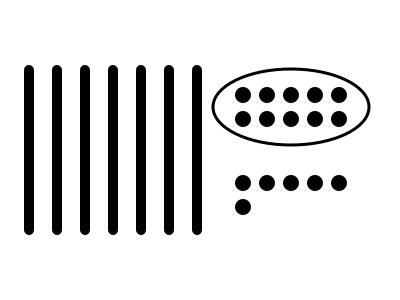
    1. Draw 38: 3 sticks and 8 dots. Draw 6 more dots.
    2. There are 14 dots. Circle 10 dots and draw 1 new stick.
    3. Now there are 4 sticks and 4 dots. 38 + 6 = 44.

    Draw a quick picture, circle 10 dots and write the answer.

    1. 1.
      25 + 9 = ____
    2. 2.
      67 + 5 = ____
    3. 3.
      49 + 8 = ____
    4. 4.
      16 + 6 = ____

    Read the quick picture.

    1. 5.
      4 sticks and 12 dots, with 10 of the dots circled. What number is it? ____
    2. 6.
      7 sticks and 16 dots, with 10 of the dots circled. What number is it? ____
    3. 7.
      5 sticks and 11 dots. You circle 10 dots and make a new stick. How many sticks are there now?
      • 5
      • 6
      • 11

    Challenge (optional)

    Draw 75 + 8. How many sticks and dots are there at the end? What number is it?

    You need: Pencil, A crayon

    Reading & Writing · Week 22 Day 2

    I can tell real-life places and times where I would use a word.

    Look: where we use words

    1. Say the word: sled.
    2. Ask: When do I use it? On a snow day. That is a winter word.
    3. Ask: Where do I use it? On a hill with snow.

    Roy Has a Box

    Roy has a box of things. He has a sled for the snow. He has a fan for a hot day. He has a hat for the sun. He has a coat for the snow.

    Read it. Circle snow day or hot day.

    1. 1.
      a sled
      • snow day
      • hot day
    2. 2.
      a fan
      • snow day
      • hot day
    3. 3.
      a coat
      • snow day
      • hot day
    4. 4.
      a sun hat
      • snow day
      • hot day

    Where or when do you use it? Finish the line.

    1. 5.
      I use a mop ____.
    2. 6.
      I use a fork ____.
    3. 7.
      I use a lamp ____.

    Challenge (optional)

    I use a ____ when it is hot.

    Science · Week 22 Day 2

    I can observe bean sprouts and tell how they are alike and how they are different.

    Look: Watch and measure the sprouts

    1. Look at the bean sprouts through the bag. Do not open it.
    2. Point to the root on each bean. Count how many have a root.
    3. Mark each root's tip on a paper strip, then line up the strips to compare.

    Look at each picture and circle the answer.

    1. 1.
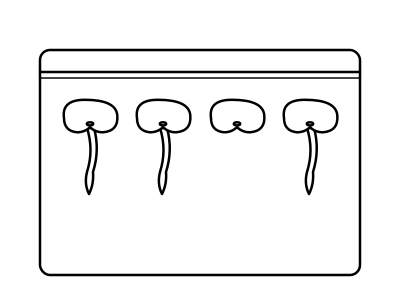
      4 beans in a bag: 3 have a white root, 1 has no root. How many beans have a root?
      • 1
      • 3
      • 4
    2. 2.
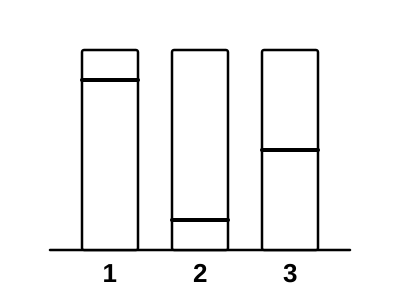
      3 paper strips lined up at the bottom: strip 1 has a mark near the top, strip 2 has a mark near the bottom, strip 3 has a mark in the middle. Which root is longest?
      • 1
      • 2
      • 3
    3. 3.
      Look at the same strips. Are all the roots the same length?
      • yes
      • no
    4. 4.
      Circle the sprout that has a shoot.
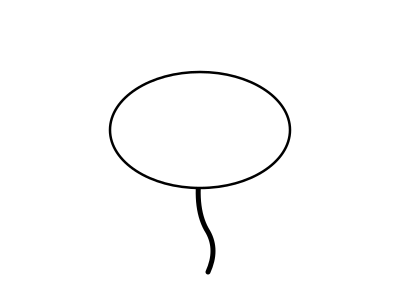
      • A bean with only a root.
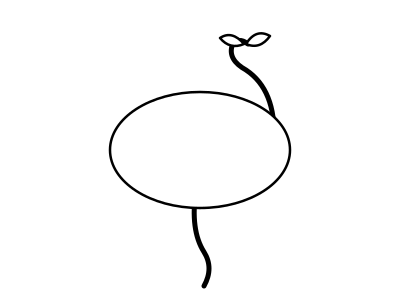
      • A bean with a root and a green shoot curling up.

    Look at your own Bean Bag Garden.

    1. 5.
      Count your beans that have a root. Write the number.
    2. 6.
      Mark each root's tip on its own paper strip. Make a mark here when your strips are lined up.
    3. 7.
      Draw 2 of your sprouts. Circle one thing that is the same on both.

    Challenge (optional)

    All 4 beans came from one bag. Why might one root grow longer than another?

    You need: your Bean Bag Garden, 4 paper strips, a crayon, tape