1First Grade

    Explain my adding

    Write my moment

    Practice pages

    0 of 180 days complete · Saved on this device

    View all 180 days

    Math

    Explain my adding

    I can write my adding steps and explain them.

    Standards: 1.NBT.C.4, 1.OA.C.6

    Number practice (no timer)
    Make a new ten: 8 + 5 = 13 helps 28 + 5
    Builds on
    Days 1 to 3 (making a new ten) and Week 9 (make a ten to add: 8 + 6 = 8 + 2 + 4). One-minute check: "28 + 2?" (30)

    New words

    • steps: the parts of your thinking, in order
    • next ten: the tens number just above a number, such as 30 for 28

    You need

    • Tens and ones kit: 9 tens and 20 ones. Use straw bundles of 10 (a rubber band around each) and loose straws, base-ten rods and unit cubes, or paper ten-strips (strips of 10 squares, cut by an adult) with beans as ones
    • 12 match cards made from paper squares: 6 problem cards (37 + 6, 49 + 5, 26 + 9, 58 + 3, 75 + 7, 14 + 8) and 6 steps cards (7 + 6 = 13, 30 + 13 = 43 / 49 + 1 = 50, 50 + 4 = 54 / 6 + 9 = 15, 20 + 15 = 35 / 58 + 2 = 60, 60 + 1 = 61 / 5 + 7 = 12, 70 + 12 = 82 / 14 + 6 = 20, 20 + 2 = 22)
    • Notebook and pencil
    • Beans and unit cubes are small parts: keep them away from children under 3.
    1. Warm-Up · 5 min

      Fluency: make a new ten. "8 + 7?" (15) "So 48 + 7?" (55) Spaced review from Week 20: "30 + 50?" (80)

    2. Mini-Lesson · 10 min

      Say: "Today you explain your adding with written steps." Write 28 + 7. Build it: 2 bundles and 8 loose, then 7 loose. Way 1, add the ones first: "8 + 7 = 15. 15 is 1 ten and 5 ones. 20 + 15 = 35." Write: 8 + 7 = 15, 20 + 15 = 35. Way 2, get to the next ten: "28 needs 2 more to make 30. Break 7 into 2 and 5. 28 + 2 = 30, 30 + 5 = 35." Write: 28 + 2 = 30, 30 + 5 = 35. Point to the kit for each step. Ask: "Did both ways get the same answer?" (Yes. 35.) "Which way do you like?" (Answers vary.)

    3. Guided Practice · 10 min

      Your child solves each one with the kit or a quick picture, writes the steps, and tells them aloud. 1) 39 + 4 (9 + 4 = 13, 30 + 13 = 43; or 39 + 1 = 40, 40 + 3 = 43) 2) 46 + 7 (6 + 7 = 13, 40 + 13 = 53; or 46 + 4 = 50, 50 + 3 = 53) 3) 65 + 8 (5 + 8 = 13, 60 + 13 = 73; or 65 + 5 = 70, 70 + 3 = 73) 4) 18 + 5 (8 + 5 = 13, 10 + 13 = 23; or 18 + 2 = 20, 20 + 3 = 23) If stuck, say: "Build it first. What did you do with your hands? Write that as a step."

    4. Play · 10 min

      Steps Match. Mix the 12 match cards and lay them face up. Your child matches each problem to its steps card and tells the steps aloud, pointing to the kit or a drawing. Answers: 37 + 6 = 43 (7 + 6 = 13, 30 + 13 = 43); 49 + 5 = 54 (49 + 1 = 50, 50 + 4 = 54); 26 + 9 = 35 (6 + 9 = 15, 20 + 15 = 35); 58 + 3 = 61 (58 + 2 = 60, 60 + 1 = 61); 75 + 7 = 82 (5 + 7 = 12, 70 + 12 = 82); 14 + 8 = 22 (14 + 6 = 20, 20 + 2 = 22). Then your child picks 2 problems and writes the steps the other way, and teaches one to a stuffed animal or a family member.

    5. Exit Ticket · 3-5 min

      Put the objects to one side but leave them on the table. Read each question aloud. Your child answers out loud, with objects or with a quick drawing. Check each answer together right away.

    Exit ticket

    1. Solve 47 + 5. Tell me your steps.
    2. For 68 + 4, which first step fits: (a) 8 + 4 or (b) 6 + 4? Then finish solving it.
    Answers
    1. 52. Answers vary. Look for: 7 + 5 = 12, 40 + 12 = 52; or 47 + 3 = 50, 50 + 2 = 52.
    2. (a). 8 + 4 = 12, 60 + 12 = 72. So 68 + 4 = 72.
    Watch for, and help or stretch
    Watch for
    Writing steps that do not match the model, such as 20 + 15 = 35 without knowing where 15 came from.
    Try
    Point to the loose ones. Ask: "How many loose ones did we have after adding?" (15) "That is your first step."
    Extra help
    Use only Way 1 (add the ones first) and build every problem.
    Stretch
    Ask: "Solve 57 + 8 both ways. Which way was easier for you? Why?" (65; answers vary)

    At home (optional): Your child explains to a family member how to solve 29 + 6 in steps. (35)
    Reading & Writing

    Write my moment

    I can write a small moment with sense words and an ending.

    Standards: W.1.3, L.1.2.b, L.1.2.e

    Phonics
    Vowel sounds oi and oy (coin, soil, boy, toy)
    Sight words
    been, call, find, long, day
    Reading
    The Snowy Day (Ezra Jack Keats)
    Writing
    Narrative: a small moment with sense details and an ending · Handwriting: neat final copy
    Builds on
    Telling the moment (Day 3). One-minute check: your child tells the moment in three complete sentences.

    New words

    • end mark: the mark at the end of a sentence: a period, a question mark or an exclamation point
    • ending: the last part of a story

    You need

    • Small moment plan and sketch (from Days 1 and 3)
    • Sight word cards: been, call, find, long, day (two sets: 10 cards for Memory Match)
    • Printed "Joy and the Snow Fort" (from Day 1)
    • Story paper with a drawing box and lines; pencil; crayons
    1. Phonics & Word Work · 15 min

      Which team? I do: say "ou and ow say /ow/. oi and oy say /oi/." Read out, cow, coin, boy. We do: read and sort down, soil, loud, toy. You do: your child reads point, crown, mouth, joy, howl, join, south, Troy and sorts them into /ow/ and /oi/. (/ow/: crown, mouth, howl, south. /oi/: point, joy, join, Troy.) Read and tell the end mark: "Is the soil wet?" (question mark: it asks) "Look at the coin!" (exclamation point: strong feeling) "The boy sat down." (period: it tells). Dictation: point, cloud, joy, town. If stuck, say the vowel sound alone and ask: "Is that /ow/ or /oi/?"

    2. Sight Words · 5 min

      Review: been, call, find, long, day. Memory Match with 10 cards: turn two over and read both. A match is kept.

    3. Read-Aloud & Shared Reading · 15 min

      Your child rereads "Joy and the Snow Fort". Ask: "What happened first?" (Joy saw the snow and went out to make tracks.) Ask: "What went wrong?" (Coin made a big hole in the fort.) Ask: "How does the story end?" (Joy and Roy go in with pink cheeks and say it was a fun day, a day of joy.) Say: "The ending tells how the characters felt. Your story will end with a feeling too."

    4. Writing & Handwriting · 15 min

      Your child writes the moment on story paper. Say: "Use First, Then and Last. Put in two sense words. End with how you felt." Model: "First, I went out in the cold, white snow. Then I made tracks. Crunch, crunch! Last, I had a hot bath. I was so glad!" Your child writes 3 or 4 sentences, spelling new words by sounds, and ends each sentence with an end mark. Then your child draws the moment. Handwriting (3 min): your child checks each sentence for a capital at the start and an end mark at the end.

    5. Exit Ticket · 5 min

      Oral answers.

    Exit ticket

    1. Which end mark goes here? Can you see the snow
    2. Read the last sentence of your story. How did you feel?
    3. Name the two sense words you used.
    Answers
    1. A question mark: it asks something.
    2. Answers vary. Look for: an ending with a feeling.
    3. Answers vary. Look for: two words for seeing, hearing, smelling, tasting or touching.
    Watch for, and help or stretch
    Watch for
    Forgetting the ending, so the story just stops.
    Try
    Ask: "How did it end? How did you feel?" Point to the Last box of the plan.
    Extra help
    Your child writes the First and Last sentences; you write the Then sentence as your child says it.
    Stretch
    Your child adds a sentence with a sound word in it, such as crunch or splash, and an exclamation point.

    At home (optional): Your child reads the story to a family member and asks them to guess the feeling before the last sentence.

    ScienceWeekly check

    Leaf hunt

    I can compare leaves from one plant and tell what is the same and what is different.

    Standards: 1-LS3-1

    Builds on
    Bean sprouts are alike but not exactly alike (Day 2). One-minute check: ask "Were all our bean roots the same length?" (No.)

    New words

    • leaf: a flat, usually green part of a plant that catches sunlight
    • compare: to look at things to find what is the same and what is different

    You need

    • 6 whole leaves from one plant. In winter, use one bush that keeps flat green leaves all year (a grown-up checks it has no berries), 6 leaves from one head of lettuce, or 6 sprigs from one bunch of parsley. Skip dry fallen leaves: leaves on the ground may come from more than one tree, and dry leaves crumble when you make rubbings
    • 1 leaf from a different kind of plant
    • A plastic hand lens (magnifier)
    • 2 sheets of white paper and a crayon with the paper peeled off (for leaf rubbings)
    • Week 22 science check page (given separately)
    • Science Notebook
    1. Warm-Up / Wonder · 5 min

      Spaced review: ask: "What is a sprout?" (a new root or shoot growing out of a seed) Check the bean cups. Wonder question: "Leaves on one plant are all the same kind. Are they all exactly alike?" Safety: a grown-up picks or chooses the leaves. Do not use plants with berries, and stay away from any plant you do not know. Leaves are never for tasting. Wash hands afterward.

    2. Review Game · 10 min

      Play "Leaf Line-Up." Your child lines the 6 leaves up from smallest to biggest. Ask: "Are they all the same size?" (No.) Look at each leaf with the hand lens. Ask: "Do they all have the same shape? The same edges, smooth or bumpy?" (mostly yes) "Do any have a hole, a spot, a bent tip or a different shade of green?" (Answers vary.) Make 2 rubbings: put 2 leaves under one sheet of paper, vein side up, and rub with the side of the crayon. Compare the veins. Then lay the leaf from the different plant next to the line. Ask: "Which leaf does not belong? How can you tell?" (Answers vary. Look for: its shape is very different.) Say: "Leaves from one plant are alike, so we can tell they are the same kind. But they are not exactly alike." If stuck, put 2 leaves on top of each other and ask: "Do the edges match exactly, or does one stick out?"

    3. Check · 10 min

      Give the Week 22 science check. The check items are on the Week 22 check page; do not show them ahead of time. Read each part aloud. Your child answers by talking, pointing, showing with the real materials or drawing. You write down their words exactly. It is not timed; stop and finish later if your child is tired. Make a check mark next to each part your child shows on their own. The printed check has 8 items. It covers these goals: (1) I can observe bean sprouts and tell how they are alike and how they are different; (2) I can compare leaves from one plant and tell what is the same and what is different. This week the check is a hands-on compare task with leaves from one plant. Look for: your child shows or tells one way the leaves from one plant are alike (shape, edges, color, veins) and one way they are different (size, spots, holes, shade), and picks out a leaf from a different kind of plant. If stuck on a part, hand your child just 2 leaves and ask: "Tell me one same and one different." Secure: 6 of 8 correct, including items 2 and 3 (one alike and one different) and item 4 or 5 (finds the other plant's leaf). If the check is not yet secure, use the reteach step on the check page that matches the items missed.

    4. Exit Ticket · 3–5 min

      Ask the three questions aloud. Your child answers by talking or drawing.

    Exit ticket

    1. If you picked 6 apples from one tree, would they all look exactly the same?
    2. How could you tell that a leaf came from a different kind of plant?
    3. Name one way leaves from one plant can be different from each other.
    Answers
    1. No. They would all be apples, but they could be different sizes, shapes or shades of red or green.
    2. Its shape (or edges) would look very different.
    3. Answers vary. Look for: size, a hole or spot, a bent tip, or a different shade of green.
    Watch for, and help or stretch
    Watch for
    Saying two leaves are different kinds just because one is bigger.
    Try
    Lay the big leaf and the small leaf side by side. Ask: "Is the shape the same?" The same shape is a good clue that it is the same kind of plant.
    Extra help
    Compare 3 leaves only. Your child can point instead of talking.
    Stretch
    Your child sorts a mixed pile of leaves from 2 different plants into 2 groups and tells how they sorted them.

    At home (optional): On a walk, your child finds 2 leaves on one plant and tells one same and one different.

    Practice

    Read each direction aloud. Your child works on the page; answers are in the grown-up view.

    Warm-up

    Remember?

    Math

    1. What is 10 less than 31?
    2. Start at 6. Count back 2. Where do you land?

    Reading & Writing

    1. perch, twirl, churn
    2. Where is the pond?

    Math · Week 22 Day 4

    I can write my adding steps and explain them.

    Look: 57 + 6, two ways

    1. Way 1, add the ones first: 7 + 6 = 13. Then 50 + 13 = 63.
    2. Way 2, get to the next ten: 57 + 3 = 60. Then 60 + 3 = 63.
    3. Both ways give 63.

    Solve and write your steps.

    1. 1.
      38 + 5 = ____
    2. 2.
      76 + 9 = ____
    3. 3.
      24 + 8 = ____

    Fill in the steps.

    1. 4.
      49 + 3: 49 + 1 = 50, then 50 + ____ = ____
    2. 5.
      66 + 7: 6 + 7 = ____, then 60 + 13 = ____
    3. 6.
      15 + 6: 15 + 5 = 20, then 20 + 1 = ____
    4. 7.
      For 58 + 5, circle the first step that fits.
      • 8 + 5
      • 5 + 5
      • 58 + 50

    Challenge (optional)

    Solve 89 + 4 two ways.

    You need: Tens and ones kit (optional): straw bundles of 10 and loose straws, or base-ten rods and cubes, Pencil, Cubes and beans are small parts: keep them away from children under 3.

    Reading & Writing · Week 22 Day 4

    I can write a small moment with sense words and an ending.

    Look: end marks and an ending

    1. A period ends a telling line: The boy sat down.
    2. A question mark ends an asking line: Can you find it?
    3. An exclamation point shows a big feeling: Look at that! End your story with how you felt.

    Snow Fort

    First, Kim and I ran out in the snow. Then we made a big snow fort. Last, we went in to get dry. I was so glad!

    Put in the end mark: a period, a question mark or an exclamation point.

    1. 1.
      Can Roy find the coin
    2. 2.
      The boy sat on the rug
    3. 3.
      Look at the big owl
    4. 4.
      Did you boil the corn

    Write your small moment. Use First, Then and Last. Put in a sense word.

    1. 5.
      First, ____.
    2. 6.
      Then ____.
    3. 7.
      Last, ____.

    Challenge (optional)

    Bam! The ____ fell down!

    Science · Week 22 check

    Weekly check

    How to give it: Read every direction, question and choice aloud. It is not timed; stop and finish later if your child is tired. Your child answers by talking, pointing, showing with the real materials or drawing, and you write their words exactly. Have the 6 leaves from one plant, 1 leaf from a different plant and the hand lens. A grown-up picks the leaves; no plants with berries. Leaves are never for tasting. Wash hands afterward.

    Secure when: 6 of 8 correct, including items 2 and 3 (one alike and one different) and item 4 or 5 (finds the other plant's leaf).

    • I can observe bean sprouts and tell how they are alike and how they are different.
    • I can compare leaves from one plant and tell what is the same and what is different.
    1. 1.
      Line up the 6 leaves from smallest to biggest. Make a mark when they are in order.
    2. 2.
      Tell one way the leaves from one plant are alike. Your grown-up writes it.
    3. 3.
      Tell one way they are different. Your grown-up writes it.
    4. 4.
      Find the leaf from a different kind of plant. Make a mark on it.
    5. 5.
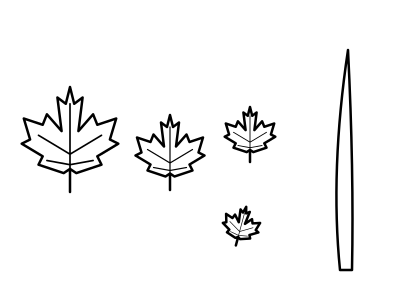
      4 maple leaves of different sizes and 1 long, thin blade of grass. Circle the leaf that is not from the maple tree.

      • The smallest maple leaf.
      • The blade of grass.
    6. 6.
      Look at the same picture. Are the 4 maple leaves all the same size?
      • yes
      • no
    7. 7.
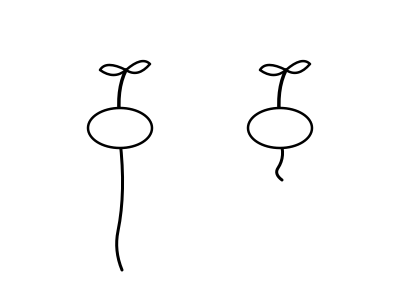
      2 bean sprouts: one with a long root, one with a short root. Are these sprouts exactly the same?
      • yes
      • no
    8. 8.
      Look at the same picture. Are both sprouts beans?
      • yes
      • no