1First Grade

    Longer and shorter

    Reading to learn

    Practice pages

    0 of 180 days complete · Saved on this device

    View all 180 days

    Math

    Longer and shorter

    I can compare two things by lining up their ends.

    Standards: 1.MD.A.1

    Number practice (no timer)
    Facts within 10 using measurement stories
    Builds on
    Comparing in Kindergarten (bigger and smaller) and Week 17 comparing numbers. One-minute check: "Which is greater, 47 or 74?" (74) Say: "Today we compare how long things are."

    New words

    • length: how long something is, from one end to the other end
    • longer: has more length
    • shorter: has less length
    • line up: put the ends at the same starting place

    You need

    • 10 household objects: a pencil, a crayon, a spoon, a shoe, a fork, a sock, a toothbrush, a book, a straw and a marker
    • A table with a straight edge
    • Notebook and crayons
    1. Warm-Up · 5 min

      Fluency: facts within 10 using measurement stories. "A worm crawled 4 steps, then 3 more steps. How many steps?" (7) "A ribbon had 9 beads. 2 fell off. How many are left?" (7) Spaced review from Week 24: "10 more than 45?" (55) "60 - 20?" (40)

    2. Mini-Lesson · 10 min

      Say: "Today we find out which thing is longer." Hold up a pencil and a crayon side by side, but with the crayon sticking out past the pencil at the bottom (a mistake on purpose). Ask: "Which is longer?" Let your child answer, then say: "Wait. The ends are not lined up. That is not fair." Lay both on the table with one end of each touching the table edge. Ask: "Now which is longer?" (Answers vary by object. Look for the one that reaches farther from the edge.) Say it both ways: "The pencil is longer than the crayon. The crayon is shorter than the pencil." Say: "Rule: to compare, line up the ends at the same starting place."

    3. Guided Practice · 10 min

      Your child compares each pair by lining up the ends at the table edge, then says two sentences: "The ___ is longer than the ___. The ___ is shorter than the ___." 1) spoon and shoe 2) sock and toothbrush 3) book and fork 4) your child's hand and the spoon (lay the hand flat with the wrist at the edge) Answers vary. Look for: ends lined up at the edge, and both sentences correct for what is on the table. If stuck, say: "Put both ends right on the edge. Which one goes farther?"

    4. Play · 10 min

      Longer or Shorter Walk. Give your child the crayon as the mystery measure. Your child walks around the room and finds 3 things shorter than the crayon and 3 things longer. For each one, your child brings it to the table and proves it by lining up the ends at the edge. Then draw one longer thing and one shorter thing in the notebook next to a drawing of the crayon, with all the left ends lined up at the margin. Swap: you pick a new mystery object (such as the toothbrush) and your child checks your finds.

    5. Exit Ticket · 3-5 min

      Put the objects to one side but leave them on the table. Read each question aloud. Your child answers out loud, with objects or with a quick drawing. Check each answer together right away.

    Exit ticket

    1. Show me how to compare a straw and a marker. What do you do first?
    2. A sock is longer than a spoon. Which is shorter?
    3. Draw two snakes, one longer than the other, with the ends lined up.
    Answers
    1. Line up the ends at the same starting place, then see which goes farther.
    2. The spoon
    3. Answers vary. Look for: left ends lined up and one snake clearly longer.
    Watch for, and help or stretch
    Watch for
    Judging by which end sticks out at the top, without lining up the bottom ends.
    Try
    Slide both bottom ends to the table edge. Ask: "Now, which one goes farther?"
    Extra help
    Use pairs that are very different in length, such as a shoe and a crayon.
    Stretch
    Find two things that are the same length. (Answers vary. Look for: lined-up ends that also finish at the same place.)

    At home (optional): Your child compares 2 shoes from the family by lining up the heels against a wall, and tells which is longer.
    Reading & Writing

    Reading to learn

    I can read a nonfiction text with help and tell what I learned.

    Standards: RI.1.10, RI.1.2, RF.1.3.d

    Phonics
    Syllables: every syllable has a vowel sound; compound words (sunset, cupcake)
    Sight words
    year, back, most, very, things
    Reading
    Original nonfiction "The Sun and the Moon" (ties to the sky science unit)
    Writing
    Shared research: choosing a question to answer · Handwriting: neat note-taking
    Builds on
    Main topic and key details in nonfiction (Unit 2) and the Unit 4 test. One-minute check: your child tells what a main topic is (what a text is mostly about).

    New words

    • nonfiction: writing that gives true facts
    • topic: what a text is mostly about
    • syllable: a word part with one vowel sound; you can clap it

    You need

    • Printed "The Sun and the Moon" (in the lesson)
    • 8 syllable cards (index cards): sun, sunset, cupcake, hilltop, bed, bedtime, cat, catfish
    • Sight word cards: year, back, most, very, things (5 index cards)
    • Printed "Sunset on the Hilltop" (in the lesson)
    • A large sheet of paper for a Sky Wonders chart
    • Lined handwriting paper
    1. Phonics & Word Work · 15 min

      I do: say "Every syllable has a vowel sound. To count syllables in a printed word, find the vowel sounds." Write sunset. Clap it: sun-set. Underline u and e. "Two vowel sounds, two syllables." Write cupcake: underline u and a. "The e at the end is silent, so it does not count. cup-cake has two syllables." Say moonlight and clap it (moon-light), just by ear. We do: read and clap sun, hilltop, bed and count. You do: your child reads each card, underlines the vowel sounds and says how many syllables: sun, sunset, cupcake, hilltop, bed, bedtime, cat, catfish. (sun 1, sunset 2, cupcake 2, hilltop 2, bed 1, bedtime 2, cat 1, catfish 2) Read: "The cupcake is in the backpack." Dictation: say each word in parts, and your child writes each part: sunset, hilltop, bathtub. If stuck, clap the word slowly with your child and stop after each clap to find its vowel.

    2. Sight Words · 5 min

      Introduce this week's words with see-say-spell-write. For each card: Say: "This word is ___. Say it with me." Your child reads it, spells it aloud while tapping each letter, writes it once while saying each letter, and reads it again. Draw a small heart over any part we must learn by heart: year (ear says /eer/: heart over ear); back (regular: ck); most (o says its name with no e at the end: heart over o); very (two syllables; y at the end says /ē/: heart over y); things (th, /i/, ng, and s for more than one: regular). Finish by reading all five cards in mixed order twice. If stuck, cover the tricky part, read the rest together, then uncover it and say the whole word.

    3. Read-Aloud & Shared Reading · 15 min

      Say: "Nonfiction teaches true facts. Readers find the topic and the details." Read "The Sun and the Moon". Your child reads only the one sentence right after each star (The sun is a star. / The sun is hot and bright. / Do not look at the sun! / It is lit by the sun. / At night, look up!); you read everything else. The Sun and the Moon (an original nonfiction text; you read it, and your child reads the sentences marked with a star) The Sun * The sun is a star. It is the star closest to Earth. The sun is a giant ball of hot, glowing gas, and it is much, much bigger than Earth. * The sun is hot and bright. It gives us light, and it warms the land, the air and the water. Each morning, the sun seems to come up in the east. Each evening, it seems to go down in the west. The sun is not really moving across our sky. Earth is spinning, like a top, and that makes the sun seem to move. * Do not look at the sun! Looking right at the sun can hurt your eyes. The Moon The moon is a ball of rock. It moves in a path around Earth. This path is called an orbit. It takes the moon about a month to go all the way around. The moon does not make its own light. * It is lit by the sun. Some nights we see a round, full moon. Other nights we see only a thin, curved slice of moon, called a crescent. The moon has many round holes called craters. Long ago, rocks from space crashed into the moon and made them. * At night, look up! You may see the moon. Sometimes you can even see it in the daytime. Ask: "What is this text mostly about?" (the sun and the moon) Ask: "Tell me two details about the sun." (Answers vary. Look for: two of these: it is a star; it is the closest star; it is much bigger than Earth; it gives light and warmth; it seems to rise in the east and set in the west; do not look at it.) Ask: "Tell me two details about the moon." (Answers vary. Look for: two of these: it is a ball of rock; it moves around Earth; it does not make its own light; it can look full or like a crescent; it has craters.) Then echo-read this week's decodable story: you read a line, your child reads it back. Sunset on the Hilltop Jen is six this year. Jen and her dad went up a hilltop at sunset. Dad had a backpack. In it was a quilt and two cupcakes. The sun went down. The sky got pink and red. "The sunset is the best part of the day," said Jen. Then it got dark. It was nighttime. Jen and Dad sat on the quilt. Jen had a cupcake. "Look, Dad! A star!" A bright dot of light was up in the sky. Then Jen could see lots and lots of stars. "Most stars are very far from us," said Dad. "I like the things we can see at night," said Jen. At bedtime, Jen and Dad went back home. "Can we come back up the hilltop?" said Jen. "Yes," said Dad. "We can come back at sunset."

    4. Writing & Handwriting · 15 min

      Start a Sky Wonders chart for our shared research. Say: "Researchers start with what they already know and what they wonder." Make two columns: We Know and We Wonder. Your child tells one thing they know about the sky and one thing they wonder; you write them, and your child copies one of the We Know notes in small, neat letters: The sun is a star. Handwriting (4 min): neat notes are small but clear. Your child writes the note inside a box you draw, keeping letters on the line.

    5. Exit Ticket · 5 min

      Oral answers. Your child reads the words from a card you write.

    Exit ticket

    1. How many syllables are in sandbox? How do you know?
    2. Read this: pigpen. Clap it.
    3. What is one fact you learned about the moon today?
    Answers
    1. 2: it has two vowel sounds, a and o.
    2. pigpen: 2 claps, pig-pen.
    3. Answers vary. Look for: a true fact from the text, such as it is lit by the sun.
    Watch for, and help or stretch
    Watch for
    Counting the silent e at the end as a vowel sound, so cupcake gets 3 syllables.
    Try
    Say the word and clap it. Ask: "Did you hear a sound for the e at the end? Then it does not count."
    Extra help
    Clap and count with spoken words only, then show the printed word and underline its vowels together.
    Stretch
    Your child finds the six different compound words in "Sunset on the Hilltop". (Sunset, Hilltop, backpack, cupcakes, nighttime, bedtime)

    At home (optional): Your child goes outside with you at sunset or after dark (with an adult) and tells you one thing they see in the sky.

    Science

    Where is the sun?

    I can tell where the sun is in the morning, at noon and in the afternoon.

    Standards: 1-ESS1-1

    Builds on
    Observing closely (Unit 4) and shadows (Unit 2). One-minute check: ask "What makes a shadow?" (something blocking light)

    New words

    • position: where something is
    • landmark: something that stays in one place that you can use to tell where things are, like a tree or a roof
    • midday: the middle of the day

    You need

    • A spot at a window or in the yard where your child can see a landmark, such as a tree, a pole or a roof
    • Masking tape or chalk to mark an X where your child stands
    • A clock
    • Sky Journal: 3 sheets of paper stapled together
    • Pencil and a yellow crayon
    1. Warm-Up / Wonder · 5 min

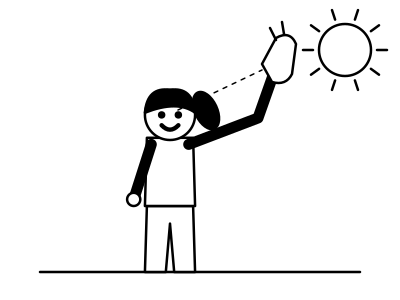
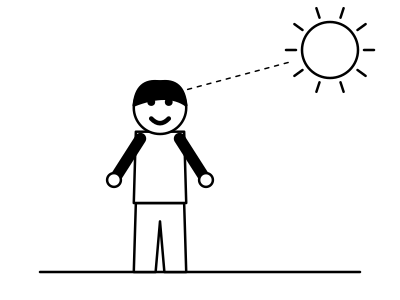
      Spaced review: ask: "Name one way a bean seedling is like a grown bean plant." (It is the same kind of plant, green with a stem and leaves.) Wonder question: "Is the sun always in the same spot in the sky?" Safety: never look straight at the sun, even for a moment. Sunglasses do not make it safe. To find the sun, stand with your back to it and look at your shadow, or hold your hand up so it blocks the sun, and look at your hand.

    2. Explore · 10–15 min

      This lesson happens in 3 short visits on one sunny day: one in the morning (about 9 o'clock), one at midday (about 12 or 1 o'clock) and one in the afternoon (about 3 o'clock). The first visit is today's lesson time; the other two take about 3 minutes each. Visit 1: choose a spot that looks toward the sunny side of the sky (in the United States, the sun crosses the south side of the sky, so pick a window or a yard spot facing south) where your child can see the landmark. Mark an X with tape or chalk. Your child stands on the X and faces the same way every time; tape a small arrow on the floor so they remember which way. In the Sky Journal, your child draws the landmark across the page. A grown-up stands beside your child. Your child holds up a flat hand at arm's length so it covers the sun, and looks only at the hand and the landmark below it, never above the hand. If the sun is in your child's eyes or they squint, stop and use the shadow instead: the sun is on the opposite side from your shadow. Ask: "Is the sun low near the ground or high up?" (low in the morning) "Is it to the left or right of the landmark?" (Answers vary.) Your child draws a yellow sun in that spot and writes the time. Visit 2 at midday: stand on the X, face the arrow and do the same. Ask: "Where is the sun now?" (higher in the sky, in a different spot) Draw it and write the time. Visit 3 in the afternoon: do the same. (lower again, farther over toward the other side) Then look at the page together. Ask: "What do you notice?" (The sun was in a different spot each time. It was low, then high, then lower on the other side.) Say: "The sun's position in the sky changes during the day." If stuck because it is cloudy, draw the landmark today and do the 3 visits on the next sunny day.

    3. Talk & Record · 5–10 min

      Your child connects the 3 suns with a dotted line. Sentence frame: "In the morning the sun was ___. At midday it was ___. In the afternoon it was ___."

    4. Exit Ticket · 3–5 min

      Ask the three questions aloud. Your child answers by talking or drawing.

    Exit ticket

    1. Where do you predict the sun will be at 9 o'clock tomorrow morning?
    2. Is it safe to look at the sun if you wear sunglasses?
    3. How can you find where the sun is without looking at it?
    Answers
    1. Low in the sky, close to where it was this morning.
    2. No. Never look straight at the sun, even with sunglasses.
    3. Answers vary. Look for: block it with a hand and look at the hand, or look at your shadow.
    Watch for, and help or stretch
    Watch for
    Standing in a different spot or facing a different way each visit.
    Try
    Show the X and the arrow. Say: "Scientists keep things the same so the only change is the sun."
    Extra help
    Do 2 visits only: morning and afternoon.
    Stretch
    Your child adds a fourth visit near dinnertime and predicts first where the sun will be.

    At home (optional): Your child shows the Sky Journal page to a family member and tells where the sun was in the morning and the afternoon.

    Practice

    Read each direction aloud. Your child works on the page; answers are in the grown-up view.

    Warm-up

    Remember?

    Math

    1. 90 - 60 = ? Think: 9 tens take away 6 tens.
    2. 50 + 20 = ?

    Reading & Writing

    1. sound, only, little

    Math · Week 25 Day 1

    I can compare two things by lining up their ends.

    Look: a straw and a pencil

    1. Line up the ends at the same starting place.
    2. Look at the other ends. The straw goes farther.
    3. The straw is longer than the pencil. The pencil is shorter than the straw.

    Circle the longer one.

    1. 1.
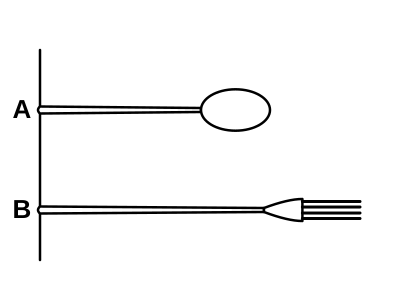
      A is a spoon and B is a fork, lying flat with their left ends lined up on a line. The fork reaches farther to the right.
      • A
      • B
    2. 2.
      A is a ribbon and B is a rope, left ends lined up. The ribbon reaches farther.
      • A
      • B
    3. 3.
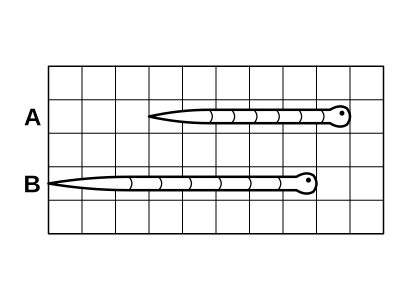
      Two snakes on a grid. Snake A is 6 squares long and starts 3 squares to the right of snake B. Snake B is 8 squares long. The ends are NOT lined up, so snake A's right end sticks out past snake B's.
      • A
      • B

    Circle or draw.

    1. 4.
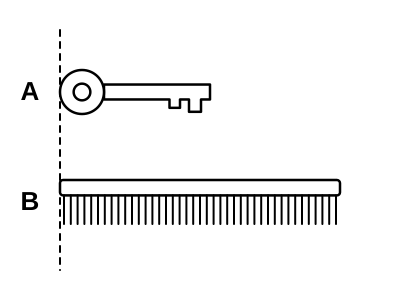
      A is a key and B is a comb, left ends lined up. The key is shorter. Circle the shorter one.
      • A
      • B
    2. 5.
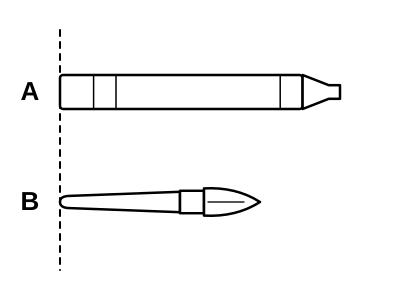
      A is a crayon and B is a paintbrush, left ends lined up. The paintbrush is shorter. Circle the shorter one.
      • A
      • B
    3. 6.
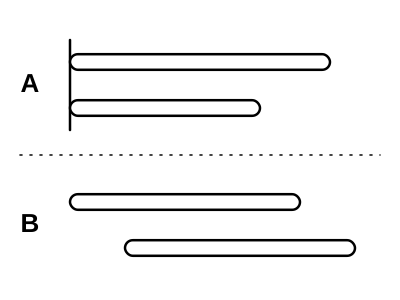
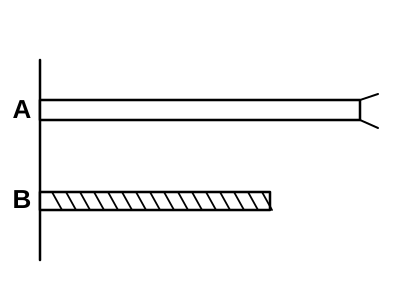
      Pair A shows two sticks with their left ends lined up on a line; pair B shows two sticks with their left ends at different places. Circle the pair that is lined up fairly.
      • A
      • B
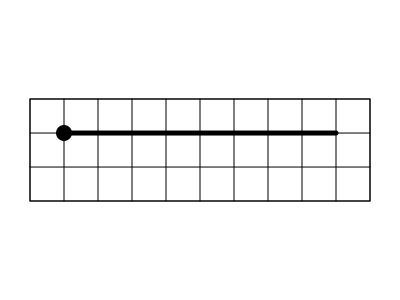
    4. 7.
      A line 8 squares long that starts at a dot. Start at the dot. Draw a line that is shorter.
    Challenge (optional)

    Draw a worm that is longer than a leaf. Line up their ends.

    You need: Pencil

    Reading & Writing · Week 25 Day 1

    I can read a nonfiction text with help and tell what I learned.

    Look: reading to learn

    1. Nonfiction tells true facts.
    2. Ask: What is it about? That is the topic.
    3. Then find the details: the facts that tell more about the topic.

    The Sun

    The sun is a big, hot star. It gives us light. Plants need the sun to grow. The sun is up in the day. Do not look up at the sun! It can hurt you.

    Read the facts. Circle the best answer.

    1. 1.
      It is about ____.
      • the sun
      • a cat
      • a plant
    2. 2.
      What does the sun give us?
      • light
      • rain
    3. 3.
      What do plants need to grow?
      • the sun
      • the dark

    Put the two words together. Write the new word.

    1. 4.
      lap + top
    2. 5.
      dust + pan
    3. 6.
      pan + cake
    4. 7.
      rain + coat

    Challenge (optional)

    One thing I know: the sun ____.

    Science · Week 25 Day 1

    I can tell where the sun is in the morning, at noon and in the afternoon.

    Look: Find the sun safely

    1. Stand on the X and face the landmark. Never look right at the sun.
    2. Hold up a flat hand to block the sun, and look only at your hand.
    3. In the morning the sun is low. At midday it is high.

    Look at each picture. Circle low or high.

    1. 1.
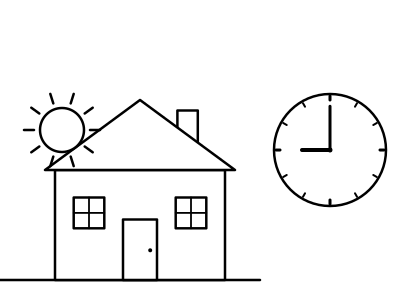
      A house with the sun just above the roof on the left side, a clock showing 9 o'clock.
      • low
      • high
    2. 2.
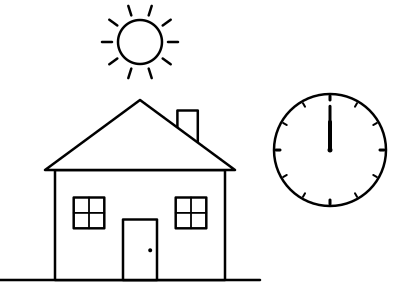
      The same house with the sun high above it, a clock showing 12 o'clock.
      • low
      • high
    3. 3.
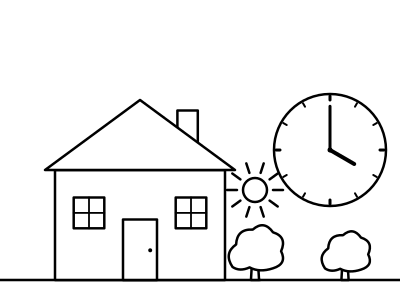
      The same house with the sun near the treetops on the right side, a clock showing 4 o'clock.
      • low
      • high

    Circle or draw.

    1. 4.
      Which is the safe way to find the sun?
      • A child holding up a hand to block the sun and looking at the hand.
      • A child staring up at the sun.
    2. 5.
      Does the sun stay in the same spot in the sky all day?
      • yes
      • no
    3. 6.
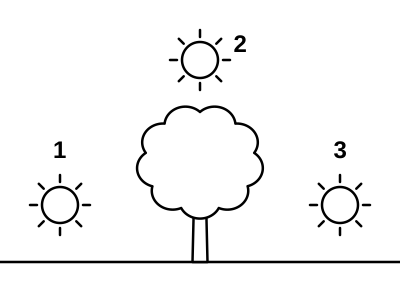
      3 suns over a tree: sun 1 low on the left, sun 2 high in the middle, sun 3 low on the right. Which sun shows midday?
      • 1
      • 2
      • 3
    4. 7.
      Draw your landmark and the sun at midday.

    Challenge (optional)

    Your shadow is in front of you. Where is the sun?

    You need: crayons