This week's lessons
Math and reading every day; science and social studies take turns
- Day 1 · Monday
- MathLonger and shorterI can compare two things by lining up their ends.
- Reading & WritingReading to learnI can read a nonfiction text with help and tell what I learned.
- ScienceWhere is the sun?I can tell where the sun is in the morning, at noon and in the afternoon.
- Day 2 · Tuesday
- MathOrder three by lengthI can put three things in order from shortest to longest.
- Reading & WritingCounting syllablesI can count syllables in a printed word by finding the vowel sounds.
- Social StudiesNeeds and wantsI can sort things into needs and wants.
- Day 3 · Wednesday
- MathCompare with a stringI can use a string to compare two things that cannot touch.
- Reading & WritingContext cluesI can use the other words in a sentence to figure out a new word.
- ScienceShadow stickI can trace a shadow and see how it changes during the day.
- Day 4 · Thursday
- MathIf A is longer than B ...I can use clues to tell which is longest.
- Reading & WritingOur research questionI can help choose a question and find where to look for answers.
- Social Studies · CheckNot enough for everyoneI can explain why we must choose when there is not enough.
- Day 5 · Friday
- Math · CheckLesson + weekly check: comparing lengthsI can order three things and compare two using a third.
- Reading & Writing · CheckShare and check: syllablesI can count syllables and read compound words.
- Science · CheckPredict the sunI can predict where the sun will be later in the day.
This week's checks
Short checks on the last day each subject meets this week
Social Studies · Day 4
- I can sort things into needs and wants.
- I can explain why we must choose when there is not enough.
Secure when: 6 of 8 correct, with at least one right on each goal
Open the checkMath · Day 5
- I can put three things in order by length.
- I can use a string to compare two things.
- I can use clues to tell which is longest.
Secure when: 5 or 6 of the 6 items right.
Open the checkReading & Writing · Day 5
- I can count syllables and read compound words.
- I can tell what a nonfiction text is about and use clues to figure out a new word.
- I can help choose a question to answer.
Secure when: 6 of 8 syllable counts in items 1-2, 5 of 6 compound words in items 3-4, 4 of 5 sight words, and 3 of 4 on items 6-9.
Open the checkScience · Day 5
- I can tell where the sun is in the morning, at noon and in the afternoon.
- I can trace a shadow and see how it changes during the day.
- I can predict where the sun will be later in the day.
Secure when: 5 of 7 correct, including item 1 (the cards in order) and item 3 (a prediction that fits: low on the sunset side, or set).
Open the check
Reading About Our World: The Sun's Daily Trip
Read it aloud. Your child reads the sentences marked with a star. Builds science knowledge.
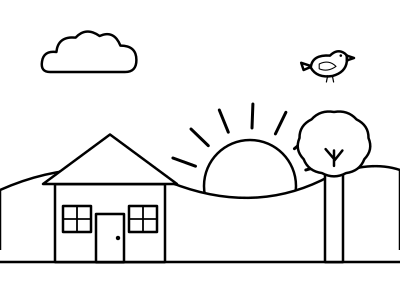
Up in the East
Each morning, the sun comes up in the east. This is called sunrise. The sun is up in the east.
High at Midday
As the day goes on, the sun seems to climb higher. Around lunchtime, it is high in the sky. Shadows are short then. Never look right at the sun. It can hurt your eyes.
Down in the West
In the afternoon, the sun seems to sink lower. Shadows grow long. In the evening, the sun goes down in the west. This is called sunset. The sun only seems to move. Really, Earth is spinning.
Words to know
- sunrise: when the sun comes up in the morning
- sunset: when the sun goes down in the evening
- spin: turn around and around
Talk about it
- Where does the sun come up?
- When are shadows short?
- It is early morning and your shadow is very long. Where in the sky is the sun?
Home Connection
Five-minute ideas for the whole family, with things you already have
Math
To compare lengths, line things up at the same starting point.
Do: Pick 3 shoes from the family. Line up the heels on the floor and put them in order from shortest to longest.
Talk: The spoon is longer than the pencil, and the pencil is longer than the crayon. Which is longer, the spoon or the crayon?
Reading & Writing
Every syllable has a vowel sound, and compound words are two small words put together.
Do: Clap the syllables in each family member's name. Write sunset, cupcake, bathtub and popcorn for your child to read.
Talk: Which name has the most syllables?
Science
The sun seems to move across the sky in a pattern every day.
Do: Stand a stick or toy in a sunny spot outside. Trace its shadow with chalk in the morning, at noon and in the afternoon. Never look right at the sun.
Talk: How did the shadow change during the day?
Social Studies
Needs are things we must have, wants are things we would like, and we can't have everything.
Do: Sort grocery items or pictures from an ad into needs and wants.
Talk: Why can't we have everything we want?
This week's words: year, back, most, very, things
Celebrate shoes in order, clapped syllables and a shadow traced three times.
Math catch-up: Ends at the Start Line
10 minutes, if this week's math check was not secure · 1.MD.A.1
Children often judge length by which end sticks out farthest, without lining up the other ends. A start line, like a wall, makes the comparison fair.
You need: a book to stand on its side as a wall, 4 household objects of different lengths (a spoon, a crayon, a sock, a pencil), a piece of string or yarn
- Stand the book on its side. Your child pushes the spoon and the pencil against it, side by side.
- Ask: "Which one goes farther?" Say: "The ends must start at the same place. Then we look at the other end."
- Use the string for two things that cannot touch, such as a door and a table. Cut or pinch the string to one length and hold it to the other.
- Give a clue game: "The sock is longer than the spoon. The spoon is longer than the crayon. Which is longest?" Check with the real objects.
Try again
- A rope is longer than a stick. The stick is longer than a crayon. Which is the longest?
- A rope is longer than a stick. The stick is longer than a crayon. Which is the shortest?
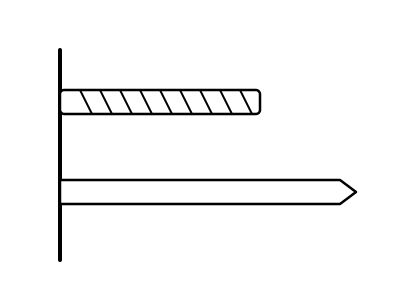 Which is longer?
Specials This Week
Weeks 25–30 unit • ~90 min/week per subject
Fitness Components (Cardiovascular & Strength)
Understanding what makes the heart beat faster, engaging in activities that build cardiovascular endurance and muscular strength.
Art from Around the World
Exploring art forms from different cultures (e.g., African masks, Native American pottery, Japanese origami, Aboriginal dot painting).
Music and Movement/Cultural Music
Moving creatively to music, exploring dance from different cultures, listening to music from around the world.
For guiding principles and full standards reference, visit How to use this curriculum
As an Amazon Associate, we earn from qualifying purchases. Book and supply links on this page are affiliate links — using them supports this curriculum at no extra cost to you.