1First Grade

    Order three by length

    Counting syllables

    Practice pages

    0 of 180 days complete · Saved on this device

    View all 180 days

    Math

    Order three by length

    I can put three things in order from shortest to longest.

    Standards: 1.MD.A.1

    Number practice (no timer)
    Facts within 10 using measurement stories
    Builds on
    Day 1 (comparing two lengths by lining up the ends). One-minute check: "What do we do first when we compare two lengths?" (Line up the ends.)

    New words

    • shortest: has the least length of all
    • longest: has the most length of all
    • order: put things in a line from least to most, or most to least

    You need

    • 3 paper strips of different lengths, cut by an adult from one sheet of paper: one as long as the long side of the sheet, one about as long as a pencil, and one about as long as a crayon
    • A paper bag or pillowcase with 6 objects: a spoon, a crayon, a pencil, a sock, a toothbrush and a marker
    • Notebook and pencil
    1. Warm-Up · 5 min

      Fluency: facts within 10 using measurement stories. "A snail went 5 steps and then 5 more. How many steps?" (10) "A ribbon had 8 knots. Ana untied 3. How many knots now?" (5) Spaced review from Week 23: "50 - 30?" (20)

    2. Mini-Lesson · 10 min

      Say: "Today we put three things in order by length." Lay out the 3 paper strips in a jumble. Say: "Compare two first." Line up two strips at the table edge. Ask: "Which is longer?" Then bring the third strip. Ask: "Is it shorter than both, longer than both, or in between?" Line them up from shortest to longest with ends at the edge. Say: "This one is the shortest. This one is the longest. This one is in between." Then mix them and order them from longest to shortest. Ask: "Is the middle strip long or short?" (Both. It is longer than one and shorter than the other.)

    3. Guided Practice · 10 min

      Your child orders sets of 3, shortest to longest, lining up the ends at the table edge, and names the shortest and the longest. 1) spoon, crayon, pencil 2) sock, toothbrush, marker 3) your child's hand, the spoon and the pencil Answers vary. Look for: ends lined up, a correct order for the objects on the table, and the words shortest and longest. After each, ask: "Now say it from longest to shortest." If stuck, say: "Find the shortest one first. Put it down. Then compare the other two."

    4. Play · 10 min

      Line Up! You pull 3 objects from the bag without looking. Your child puts them in order from shortest to longest and says: "The ___ is the longest." Check together. Put them back and shake the bag. Take turns: your child pulls 3 and you order them, and sometimes make a mistake on purpose for your child to catch. Play 6 rounds.

    5. Exit Ticket · 3-5 min

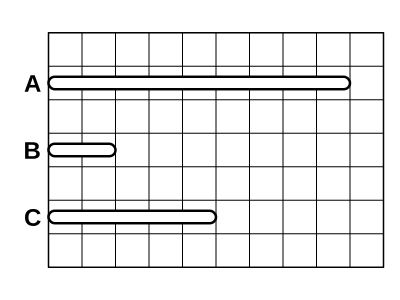
      Before asking, draw 3 lines on a sheet of paper, one under the other, with the left ends lined up at the margin. Line A is about as long as your child's finger, line B about as long as your child's hand, and line C about half as long as line A. Label them A, B and C. Read each question aloud. Your child answers out loud or by pointing. Check each answer together right away.

    Exit ticket

    1. Which line is the longest?
    2. Which line is the shortest?
    3. Say the lines in order from shortest to longest.
    Answers
    1. B
    2. C
    3. C, A, B
    Watch for, and help or stretch
    Watch for
    Ordering by width or how big the object looks, such as calling a sock longer because it is bigger.
    Try
    Say: "Long means end to end." Run a finger from one end to the other on each object.
    Extra help
    Order only two things at first, then add a third that is clearly longer than both.
    Stretch
    Order 4 things from shortest to longest, and tell which two were hardest to place.

    At home (optional): Your child orders 3 spoons or 3 shoes at home from shortest to longest and shows a family member.
    Reading & Writing

    Counting syllables

    I can count syllables in a printed word by finding the vowel sounds.

    Standards: RF.1.3.d, RF.1.3.e, RF.1.2

    Phonics
    Syllables: every syllable has a vowel sound; compound words (sunset, cupcake)
    Sight words
    year, back, most, very, things
    Reading
    Original nonfiction "The Sun and the Moon" (ties to the sky science unit)
    Writing
    Shared research: choosing a question to answer · Handwriting: neat note-taking
    Builds on
    Syllables (Day 1). One-minute check: your child claps sunset and says how many syllables.

    New words

    • vowel sound: the sound a, e, i, o or u (or a vowel team) makes in a word
    • silent e: an e at the end of a word that makes no sound of its own

    You need

    • 10 printed words on a list: rabbit, cupcake, sun, sunset, cake, bathtub, rain, catnip, hot, hotdog
    • A highlighter or yellow crayon
    • Sight word cards: year, back, most, very, things
    • Printed "The Sun and the Moon" and "Sunset on the Hilltop" (from Day 1)
    • The Sky Wonders chart (from Day 1) and lined paper
    1. Phonics & Word Work · 15 min

      Count syllables in printed words. I do: highlight the vowels in rabbit: a and i. "Two vowel sounds, two syllables: rab-bit." Highlight the vowels in rain: a and i. "ai is a team, and a team makes one sound. One syllable." We do: cupcake (u, a and a silent e: 2) and sun (1). You do: your child highlights the vowels in each word on the list, decides how many vowel sounds, and writes the number: rabbit, cupcake, sun, sunset, cake, bathtub, rain, catnip, hot, hotdog. (1 syllable: sun, cake, rain, hot. 2 syllables: rabbit, cupcake, sunset, bathtub, catnip, hotdog.) Then your child reads each 2-syllable word part by part and then whole. Read: "The rabbit is in the bathtub." Dictation: hotdog, catnip, cake. If stuck, say: "Silent e makes no sound, and a team makes one sound. Count only the sounds you hear."

    2. Sight Words · 5 min

      Review: year, back, most, very, things. Hop and Read: lay the cards on the floor; your child hops to the card you name, reads it and claps its syllables.

    3. Read-Aloud & Shared Reading · 15 min

      Reread "The Sun and the Moon". Your child reads the five starred sentences (only the one sentence after each star). Ask: "Why does the sun seem to move across the sky?" (Earth is spinning.) Ask: "Where does the moon's light come from?" (the sun) Ask: "What made the craters on the moon?" (Rocks from space crashed into it.) Then your child reads "Sunset on the Hilltop" and claps the compound words.

    4. Writing & Handwriting · 15 min

      Add to the We Wonder column. Say: "A research question asks something we want to find out. It ends with a question mark." Your child writes one wondering question, spelling by sounds, such as "Why is the sun hot?" (Answers vary. Look for: a real question with a question mark.) Handwriting (4 min): question marks. Your child writes 5 question marks, then copies Why is the sky dark at night?

    5. Exit Ticket · 5 min

      Oral answers.

    Exit ticket

    1. How many syllables does bedtime have?
    2. Does the e at the end of time make a syllable? Why or why not?
    3. Where does the moon's light come from?
    Answers
    1. 2 (bed-time).
    2. No. It is silent, so it makes no vowel sound.
    3. The sun.
    Watch for, and help or stretch
    Watch for
    Counting every vowel letter, even in a team, so rain gets 2.
    Try
    Say: "Two vowels side by side work as a team: one sound." Read the word aloud and count the sounds you hear.
    Extra help
    Use 5 words today, and clap each one before highlighting.
    Stretch
    Your child counts syllables in 3 more printed words: sandbox, pigpen, sunlit, and in their own name.

    At home (optional): Your child claps the syllables in the names of everyone in the family.

    Social Studies

    Needs and wants

    I can sort things into needs and wants.

    Standards: D2.Eco.2.K-2

    Builds on
    Goods and services (Unit 2). One-minute check: ask "What is a good?" (a thing you can touch and buy)

    New words

    • need: something people must have to live, like food, water, clothes and a home
    • want: something people would like to have but can live without

    You need

    • 12 picture cards (draw or cut from magazines or flyers): bread, water, a home, a coat, an apple, shoes, a toy car, candy, a video game, a bike, a juice box, fancy sneakers
    • 2 baskets, plastic bowls or cardboard boxes, labeled Needs and Wants
    • Notebook and crayons
    1. Warm-Up / Wonder · 5 min

      Spaced review: ask: "What is a service?" (work someone does for you) Wonder question: "What do people need to live?"

    2. Explore · 10–15 min

      Say: "Needs are things people must have to live: food, water, clothes and a place to live. Wants are things we would like but can live without." Your child sorts each card into the Needs or Wants basket and tells why. (Needs: bread, water, home, coat, apple, shoes. Wants: toy car, candy, video game, bike.) Then talk about the tricky ones. Juice box: ask "Do we need juice to live?" (No. We need water. Juice is a want.) Fancy sneakers: ask "Do we need shoes?" (yes) "Do we need fancy ones?" (No. That is a want.) Say: "Some things can be a need or a want depending on the kind. Shoes are a need. Fancy shoes are a want." Ask: "Can a want still be a good thing to have?" (Yes. Wants make life fun; we just need our needs first.) Ask: "A family has only enough money for bread or candy today. If they buy the candy, what do they give up?" (the bread, a need) "What do they get if they buy the bread?" (food to stay healthy) Say: "Every choice has something we get and something we give up." If stuck, ask: "Could a person stay alive and healthy without it?"

    3. Talk & Record · 5–10 min

      Your child folds a page in half, draws 2 needs on one side and 2 wants on the other. Sentence frame: "I need ___. I want ___."

    4. Exit Ticket · 3–5 min

      Ask the three questions aloud. Your child answers by talking or drawing.

    Exit ticket

    1. Is a warm blanket on a cold night a need or a want?
    2. Is a sticker book a need or a want?
    3. Why should families buy needs before wants?
    Answers
    1. A need (it keeps you warm; part of shelter and clothing).
    2. A want.
    3. Answers vary. Look for: people must have needs to live and stay healthy.
    Watch for, and help or stretch
    Watch for
    Calling everything they like a need ("I need ice cream!").
    Try
    Ask: "If you never had ice cream again, would you be OK?" (yes) "Then it is a want."
    Extra help
    Sort 6 cards with no tricky ones.
    Stretch
    Your child finds 2 tricky items at home and explains how each could be a need or a want.

    At home (optional): At the store or while putting groceries away, your child points to one need and one want.

    Practice

    Read each direction aloud. Your child works on the page; answers are in the grown-up view.

    Warm-up

    Remember?

    Math

    1. 70 - 40 = ? Think: 7 tens take away 4 tens.
    2. What is 10 more than 12?

    Reading & Writing

    1. Get out of my way!
    2. cups, beds

    Math · Week 25 Day 2

    I can put three things in order from shortest to longest.

    Look: three strips

    1. Find the shortest strip first. Put it down.
    2. Compare the other two with the ends lined up.
    3. Now the order is shortest, in between, longest.

    Write 1 under the shortest, 2 under the middle one and 3 under the longest.

    1. 1.
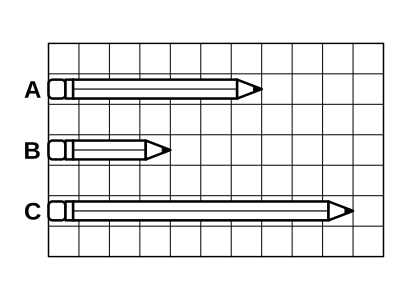
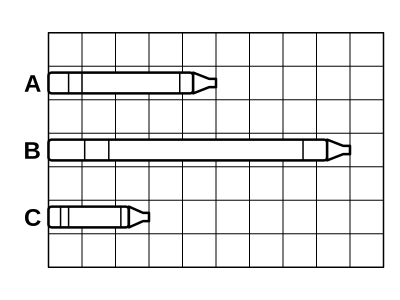
      3 crayons, left ends lined up. A is 5 squares long, B is 9 squares long, C is 3 squares long. A ____ B ____ C ____
    2. 2.
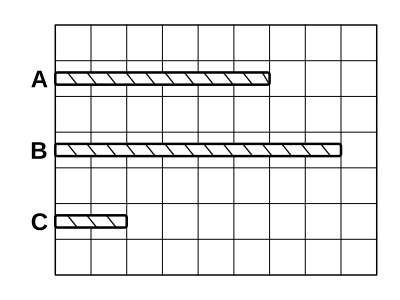
      3 pencils, left ends lined up. A is 7 squares long, B is 4 squares long, C is 10 squares long. A ____ B ____ C ____
    3. 3.
      3 straws, left ends lined up. A is 6 squares long, B is 8 squares long, C is 2 squares long. A ____ B ____ C ____

    Circle the answer.

    1. 4.
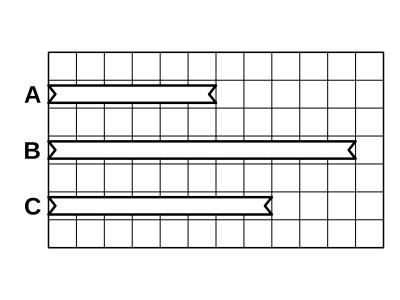
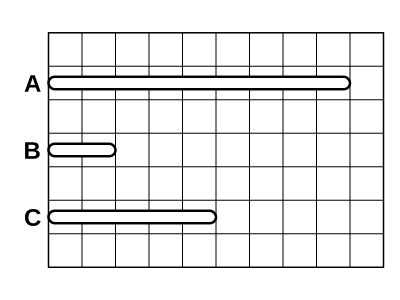
      3 ribbons, left ends lined up. A is 6 squares, B is 11 squares, C is 8 squares. Circle the longest ribbon.
      • A
      • B
      • C
    2. 5.
      The same 3 ribbons as above. Circle the shortest ribbon.
      • A
      • B
      • C
    3. 6.
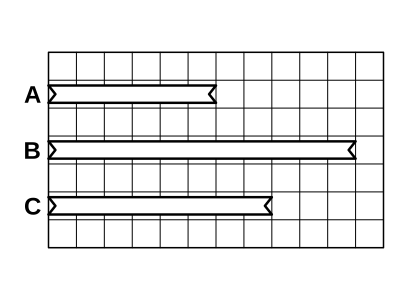
      3 sticks, left ends lined up. A is 9 squares, B is 2 squares, C is 5 squares. Circle the stick that is in between.
      • A
      • B
      • C
    4. 7.
      The same 3 sticks. Circle the order from shortest to longest.
      • B, C, A
      • A, C, B
      • C, B, A
    5. 8.
      Draw 3 lines in order from shortest to longest. Line up the left ends.

    Challenge (optional)

    Draw a fourth line that is longer than all 3 of your lines. Where does it go in the order?

    You need: Pencil

    Reading & Writing · Week 25 Day 2

    I can count syllables in a printed word by finding the vowel sounds.

    Look: counting syllables

    1. Every syllable has one vowel sound.
    2. In sunset, u and e make two vowel sounds: sun-set. Two syllables.
    3. In cake, the e at the end is silent. One vowel sound, one syllable.

    Pam at the Pond

    Pam went to the pond at sunrise. She sat on a big rock. Then a catfish swam up! It had a long tail. Pam went back home at sunset.

    Read the word. How many vowel sounds do you hear? Write the number.

    1. 1.
      sunrise
    2. 2.
      rock
    3. 3.
      tail
    4. 4.
      handbag

    Read the word. Draw a line between the two parts.

    1. 5.
      cobweb
    2. 6.
      pigtail
    3. 7.
      dishpan

    Challenge (optional)

    Clap your name. It has ____ claps.

    Social Studies · Week 25 Day 2

    I can sort things into needs and wants.

    Look: need or want?

    1. Needs are things people must have to live: food, water, clothes and a place to live.
    2. Wants are things we would like but can live without.
    3. Ask: "Could a person stay alive and healthy without it?" If yes, it is a want.

    Listen. Circle yes if it is a need. Circle no if it is a want.

    1. 1.
      a warm coat in a cold winter
      • yes
      • no
    2. 2.
      a toy truck
      • yes
      • no
    3. 3.
      clean water to drink
      • yes
      • no
    4. 4.
      a place to live
      • yes
      • no
    5. 5.
      a bag of candy
      • yes
      • no
    6. 6.
      a big TV
      • yes
      • no

    Ask each question. Write what your child says.

    1. 7.
      Milk is food. Is a milkshake a need or a want? Why?
    2. 8.
      Name 2 needs every family has.
    3. 9.
      A family has money for rice or for a toy today. Which should they buy first? Why?

    Challenge (optional)

    Draw one want you would like to save up for someday.