This week's lessons
Math and reading every day; science and social studies take turns
- Day 1 · Monday
- MathParts of a clockI can find the hour hand and minute hand.
- Reading & WritingThe author's reasonsI can find the reasons an author gives for a point.
- ScienceMoon watchI can observe the moon and draw its shape.
- Day 2 · Tuesday
- MathTime to the hourI can tell and write time to the hour.
- Reading & WritingMore reasonsI can tell which reasons support the author's point.
- Social StudiesWhy people saveI can explain why people save money.
- Day 3 · Wednesday
- MathMeasurement mini-projectI can measure my room with one unit.
- Reading & WritingWrite our answerI can help write the answer to our research question.
- ScienceThe moon changes shapeI can find a pattern in how the moon looks.
- Day 4 · Thursday
- MathQuarter review: numbers, tens and lengthI can show what I learned this quarter.
- Reading & WritingPrefix un- and root wordsI can use un- to figure out what a word means.
- Social Studies · CheckWhat do banks do? + Quarter 3 reviewI can tell how a bank keeps money safe and review what I learned this quarter.
- Day 5 · Friday
- Math · CheckLesson + weekly check: telling time to the hourI can tell and write time to the hour.
- Reading & Writing · CheckShare and check + Quarter 3 reviewI can read two-syllable words and show what I learned this quarter.
- Science · CheckSky check and Q3 reviewI can tell the sun and moon patterns I have found.
This week's checks
Short checks on the last day each subject meets this week
Social Studies · Day 4
- I can explain why people save money.
- I can tell how a bank keeps money safe and review what I learned this quarter.
Secure when: 7 of 9 correct, with at least one right on each goal
Open the checkMath · Day 5
- I can read and write time to the hour.
- I can draw the hands for a time to the hour.
Secure when: 6 of the 6 items right.
Open the checkReading & Writing · Day 5
- I can read two-syllable words and show what I learned this quarter.
- I can tell the author's point and a reason.
- I can use un- to figure out what a word means.
Secure when: 80 percent in each part: 4 of 5 words in item 1, 5 of 6 in item 2, 36 of 45 sight words in item 3, and the point plus one reason (items 4-7, 3 of 4 right). Items 8-9 should both be right.
Open the checkScience · Day 5
- I can observe the moon and draw its shape.
- I can find a pattern in how the moon looks.
- I can tell the sun and moon patterns I have found.
Secure when: 7 of 9 correct, including items 1 and 2 (the sun and moon patterns) and item 8 or 9 (one parents-and-young idea).
Open the check
Reading About Our World: The Changing Moon
Read it aloud. Your child reads the sentences marked with a star. Builds science knowledge.
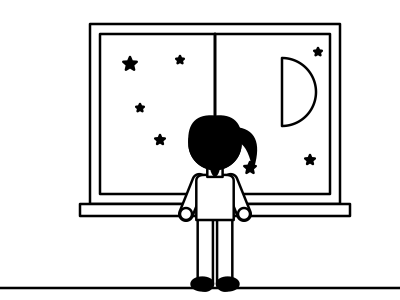
No Light of Its Own
The moon does not make its own light. Sunlight shines on the moon, and the moon reflects it back to us.
Shapes in the Sky
Some nights the moon looks like a full circle. Other nights it looks like half a circle or a thin curve. Some nights we can barely see it. At night I can see it in the sky.
A Monthly Pattern
Each shape is called a phase. The moon goes through all its phases in about a month. Then the pattern starts again. Sometimes you can even see the moon in the daytime sky.
Words to know
- moon: the big, round object we see in the night sky
- reflect: bounce light back
- phase: the shape the moon seems to have
Talk about it
- Does the moon make its own light?
- About how long does it take the moon to go through all its shapes?
- Tonight the moon is full. Will it still look full in two weeks? How do you know?
Home Connection
Five-minute ideas for the whole family, with things you already have
Math
The short hand tells the hour; when the long hand points to 12, it is o'clock.
Do: Look at a clock with hands at times on the hour, like 7 o'clock or 12 o'clock, or draw clocks together. Your child tells the time.
Talk: Where does the long hand point at 3 o'clock?
Reading & Writing
Authors give reasons to support their points.
Do: Read a short fact text and find one reason the author gives. Write rainbow, inside, sunshine and mailbox for your child to read.
Talk: What reason did the author give?
Science
The moon seems to change shape in a pattern.
Do: Look at the moon on each evening this week that it can be seen, and your child draws its shape. Sometimes the moon is out in the daytime too.
Talk: How did the moon's shape change?
Social Studies
People save money for later, and banks keep money safe.
Do: Make a save jar from a clean plastic container and choose a goal to save for.
Talk: What would you save for, and why?
This week's words: help, before, much, line, right
Celebrate a time told to the hour, an author's reason and a week of moon drawings.
Math catch-up: Short Word, Short Hand
10 minutes, if this week's math check was not secure · 1.MD.B.3
Children often read the long hand as the hour. 'Short word (hour), short hand' gives them a way to tell the two hands apart.
You need: a paper plate clock with numbers 1 to 12, 2 paper strips, one short and one long, attached with a brad, or held in place with a finger
- Hold the two hands side by side. Say: "Hour is a short word, so the short hand tells the hour."
- Set the clock to 4:00. Cover the long hand with your finger. Ask: "Where does the short hand point?" (4) Say: "4 o'clock."
- Uncover the long hand. Say: "When the long hand points straight up to 12, it is o'clock." Write 4:00.
- Your child sets 3 times you say, such as 11:00. Check that the short hand is on the hour and the long hand is on 12.
Try again
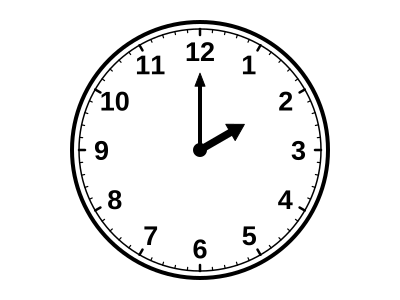 What time does the clock show?
- Draw hands to show 7:00.
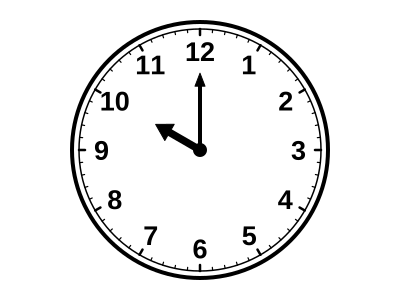 What time does the clock show?
Specials This Week
Weeks 25–30 unit • ~90 min/week per subject
Fitness Components (Cardiovascular & Strength)
Understanding what makes the heart beat faster, engaging in activities that build cardiovascular endurance and muscular strength.
Art from Around the World
Exploring art forms from different cultures (e.g., African masks, Native American pottery, Japanese origami, Aboriginal dot painting).
Music and Movement/Cultural Music
Moving creatively to music, exploring dance from different cultures, listening to music from around the world.
For guiding principles and full standards reference, visit How to use this curriculum
As an Amazon Associate, we earn from qualifying purchases. Book and supply links on this page are affiliate links — using them supports this curriculum at no extra cost to you.