Math
Parts of a clock
I can find the hour hand and minute hand.
Standards: 1.MD.B.3
- Number practice (no timer)
- Facts within 10 (keep-up practice)
- Builds on
- Counting to 12 and writing numbers 1 to 12 (Week 13). One-minute check: "Count from 1 to 12." (1, 2, 3 ... 12)
New words
- clock: a tool that shows the time
- hour hand: the short hand on a clock; it points to the hour
- minute hand: the long hand on a clock
You need
- 1 paper plate
- 2 clock hands cut by an adult from a cereal box: one short (about as long as a finger) and one long (about as long as a crayon)
- 1 brass paper fastener. An adult pokes the hole in the middle of the plate with a pencil. Keep the fastener away from children under 3.
- A marker
- A real clock with hands, or a printed picture of one
- Notebook and pencil
Warm-Up · 5 min
Fluency: facts within 10. "6 + 3?" (9) "10 - 4?" (6) "5 + 5?" (10) Spaced review from Week 26: "A pencil is 6 clips long. A crayon is 4 clips long. How many clips longer is the pencil?" (2)
Mini-Lesson · 10 min
Show the real clock. Say: "This is a clock. It shows the time." Ask: "What numbers do you see?" (1 to 12) Point to the hands. Say: "This short hand is the hour hand. This long hand is the minute hand." Some clocks have a third thin hand that keeps ticking around. We do not use it this year. Now make the paper plate clock. The adult writes 12 at the top, 6 at the bottom, 3 on the right and 9 on the left. Your child writes the other numbers in order, going the way the numbers count up: 1 and 2 between 12 and 3, and so on. The adult attaches both hands with the fastener in the middle. Ask: "Which hand is the hour hand?" (The short one.)
Guided Practice · 10 min
Your child points and answers on the paper clock and the real clock. 1) "Point to the hour hand." (The short hand) 2) "Point to the minute hand." (The long hand) 3) "What number is at the top?" (12) 4) "What number is at the bottom?" (6) 5) "Move the hour hand around the clock and count the numbers as you pass them." (1, 2, 3 ... 12) 6) "Point the short hand to 7 and the long hand to 12." If stuck, say: "Hour is a short word, and the hour hand is the short hand."
Play · 10 min
Hand Hunt. Call out a setting and your child moves the hands on the paper clock: "Short hand on 2, long hand on 12." "Short hand on 9, long hand on 12." "Short hand on 11, long hand on 12." "Short hand on 4, long hand on 12." Then your child calls out settings for you, and you make one mistake on purpose (such as putting the long hand on the hour) for your child to catch. Play 8 rounds in all.
Exit Ticket · 3-5 min
Put the objects to one side but leave them on the table. Read each question aloud. Your child answers out loud, with objects or with a quick drawing. Check each answer together right away.
Exit ticket
- Which hand is the hour hand, the short one or the long one?
- Show me: put the hour hand on 5 and the minute hand on 12.
- What number is on the right side of the clock, across from 9?
Answers
- The short one
- Look for: the short hand pointing to 5 and the long hand pointing to 12.
- 3
Watch for, and help or stretch
- Watch for
- Mixing up the two hands.
- Try
- Say: "Short word, short hand: hour." Hold the two hands side by side.
- Extra help
- Color the hour hand red and the minute hand blue so they are easy to tell apart.
- Stretch
- Ask: "Which number comes just after 12 on the clock?" (1) "Why is that different from a number line?" (The clock goes around and starts again.)
At home (optional): Your child finds a clock with hands at home or in a store and shows a family member the hour hand and the minute hand.
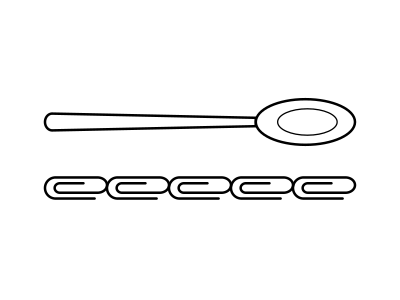 How many paper clips long is the spoon?
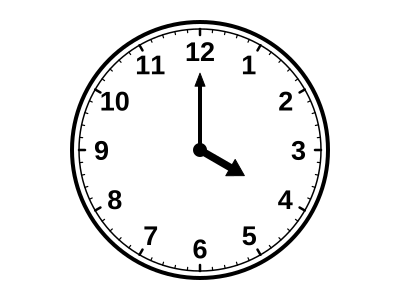
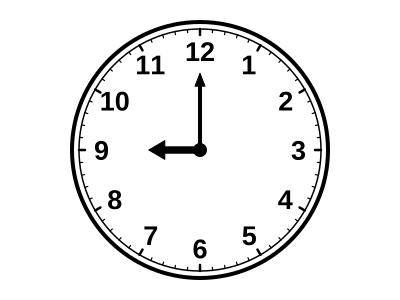
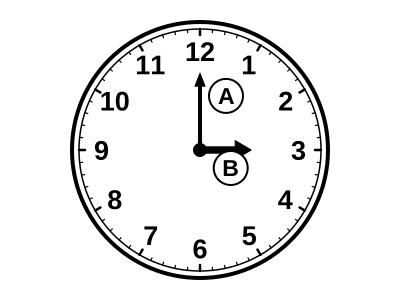 Circle the minute hand.
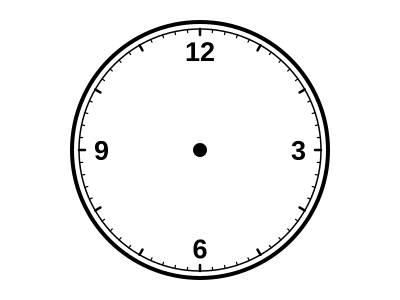 Write the other numbers.