    1First Grade

    Lesson + weekly check: measuring length

    Share and check: two-syllable words

    Practice pages

    0 of 180 days complete · Saved on this device

    View all 180 days

    MathWeekly check

    Lesson + weekly check: measuring length

    I can measure length with same-size units.

    Standards: 1.MD.A.2

    Number practice (no timer)
    Adding lengths: how many more clips?
    Builds on
    Days 1 to 4: measuring with same-size units, no gaps and no overlaps, and comparing measures. One-minute check: "Can we trust a measure made with big and small clips mixed?" (No)

    New words

    • length unit: the same-size thing we use to measure, like a paper clip or a cube

    You need

    • 25 paper clips, all the same size
    • 30 linking cubes or same-size building bricks
    • 3 objects for the review game and 3 for the check: a fork, a sock and a book (game); a pencil, a spoon and a toothbrush (check)
    • The stored Week 26 check and its answer key
    • Notebook and pencil
    • Paper clips, beans and cubes are small parts: keep them away from children under 3.
    1. Warm-Up · 5 min

      Fluency: adding lengths. "A cup is 4 clips tall. A bottle is 5 clips taller. How tall is the bottle?" (9 clips) Spaced review from Week 24: "10 more than 77?" (87) "38 + 20?" (58)

    2. Short Lesson: Review Game · 10 min

      Measure Match. You lay 3 measuring lines while your child looks away: the fork with clips that have a gap, the sock with cubes measured the right way, and the book with clips that start partway along. Your child checks each line, says what is right or wrong, fixes it, and says the length in a sentence. Answers vary for the lengths. Look for: the gap fixed, the start moved to the end, and the sock left alone. If stuck, say: "Check the three rules: start at the end, no gaps, no overlaps."

    3. Weekly Check · 15 min

      Give the stored Week 26 check. The printed check has 6 items. It covers these goals: (1) I can measure length with same-size units, with no gaps and no overlaps; (2) I can explain the measuring rules; (3) I can tell how many units longer one thing is. Measure each object yourself first and write your counts on the answer key. Read each item aloud. There is no time limit. If your child is stuck, say only: "Where does the first unit go?" Do not give the answer. A length counts as right if it is within 1 unit of your count. Secure: 5 or 6 of the 6 items right. If the check is secure, start Week 27. If it is not, first do the reteach step on the check page for each group of items missed, then start Week 27.

    4. Exit Ticket · 3-5 min

      After the check, ask these two questions. Then go over any missed check items together.

    Exit ticket

    1. A book is 9 cubes long. A notebook is 7 cubes long. How many cubes longer is the book?
    2. If you measured with spaces between the cubes, would your number be too big or too small?
    Answers
    1. 2 cubes
    2. Too small
    Watch for, and help or stretch
    Watch for
    Counting from 0 at the first clip, or skipping a unit when counting.
    Try
    Touch each unit as you count it, starting with 1 on the first one.
    Extra help
    Measure each check object together once before your child measures it alone, and note it on the check.
    Stretch
    After the check, your child picks one more object, measures it, and writes the sentence: "The ___ is ___ paper clips long."

    At home (optional): Your child measures 2 things at home with same-size units and explains the rules to a family member.
    Reading & WritingWeekly check

    Share and check: two-syllable words

    I can read two-syllable words and compare two texts.

    Standards: RF.1.3.e, RI.1.9, RF.1.3.g

    Phonics
    Two-syllable words with closed syllables (rabbit, napkin, picnic)
    Sight words
    name, good, man, say, great
    Reading
    Two original texts on the same topic: "The Moon" (a fact sheet) and "Moon Watch" (a child's journal)
    Writing
    Shared research: gathering facts from two sources to answer our question · Handwriting: fact cards
    Builds on
    This week's two-syllable words and the two moon texts. One-minute check: warm up with picnic, rabbit, napkin.

    New words

    • similar: almost the same

    You need

    • Word cards: 10 two-syllable words (written in step 4)
    • 10 game cards (index cards): rabbit, picnic, napkin, muffin, basket, sunset, insect, blanket, cricket, magnet
    • Sight word cards: name, good, man, say, great, year, back, most, very, things
    • Printed "The Moon: A Fact Sheet" and "Moon Watch" (from Day 1)
    • Recording sheet
    • The moon chart and fact cards (from Days 3 and 4)
    • Lined handwriting paper
    1. Review Game · 10 min

      Split and Read: lay 10 cards face down: rabbit, picnic, napkin, muffin, basket, sunset, insect, blanket, cricket, magnet. Your child flips a card, chops the air with a hand between the two parts, reads each part and then the whole word. If stuck on a word during the game (not during the check), cover all but the first sound, say it together, then uncover the rest and blend.

    2. Sight Words · 5 min

      Review: name, good, man, say, great, year, back, most, very, things. Word in the Bag: your child pulls a card, reads it and uses it in a sentence.

    3. Weekly Check · 15 min

      The printed check has 9 items. It covers these goals: (1) I can read two-syllable words and compare two texts; (2) I can find facts in a source; (3) I can split a word into two parts. Give no hints. Record each answer. Secure: 8 of 10 words in items 1-2, 4 of 5 sight words, one true way alike and one true difference in item 4, and 4 of 5 on items 5-9. For any part that is not yet secure, use the matching reteach step on the check page next week.

    4. Share & Listen · 10 min

      Your child presents the moon chart and the fact cards to a listener, who asks one question about the moon. Your child answers in a complete sentence.

    5. Handwriting · 5 min

      Your child copies the labels full and half neatly under drawings of the moon, then copies crescent from the word bank. Circle the best word.

    6. Exit Ticket · 5 min

      Talk about the week.

    Exit ticket

    1. Read a two-syllable word and tell where you split it.
    2. Which moon text did you like better? Why?
    Answers
    1. Answers vary. Look for: a correct read and a split between the middle consonants, such as nap | kin.
    2. Answers vary. Look for: a text and a reason.
    Watch for, and help or stretch
    Watch for
    Splitting in the wrong place, such as ra | bbit.
    Try
    Before the check (not during it), review: "Find the two vowels. Split between the two consonants in the middle."
    Extra help
    Read both texts aloud right before item 4 and keep the chart from Day 1 in view.
    Stretch
    Your child reads 3 bonus words: contest, trumpet, problem. Do not score them.

    At home (optional): Your child keeps drawing the moon on clear nights this week and shares the drawings on Friday.

    Social StudiesWeekly check

    Pretend store

    I can shop at a pretend store and choose what to buy.

    Standards: D2.Eco.5.K-2, D2.Eco.1.K-2

    Builds on
    Prices at the store (Day 3). One-minute check: ask "Which costs more, a 3-dollar item or a 5-dollar item?" (the 5-dollar item)

    New words

    • budget: the amount of money you have to spend
    • left over: what is still there after you use some

    You need

    • 6 play items with price tags in whole dollars: a ball (4 dollars), a book (3 dollars), a box of crayons (2 dollars), an apple (1 dollar), a toy car (5 dollars), a kite (6 dollars). Use real things from home with sticky-note tags
    • 10 pretend dollar bills (paper rectangles marked $1)
    • A small plastic or metal tray to be the cash register
    • Week 26 social studies check page (given separately)
    • Pencil
    1. Warm-Up / Wonder · 5 min

      Spaced review: ask: "What is a price?" (how much money something costs) Wonder question: "If you have 10 dollars, can you buy everything you want?"

    2. Review Game · 10 min

      Play "Pretend Store." You are the store worker; your child is the shopper with 10 pretend dollars. Before shopping, your child tells which items are needs and which are wants. (The apple is a need; the others are wants.) Your child chooses what to buy and pays by counting out dollar bills for each price. After each item, count the dollars left together. Example: buy the ball (4 dollars): 10 - 4 = 6 left. Then the book (3 dollars): 6 - 3 = 3 left. Then the crayons (2 dollars): 3 - 2 = 1 left. Ask: "Can you also buy the kite?" (No. It costs 6 dollars, and only 1 dollar is left.) Ask: "What did you give up?" (Answers vary: the kite or the toy car.) Then switch roles and play again. If stuck subtracting, line up the dollar bills and take away one bill for each dollar of the price, then count what is left.

    3. Check · 10 min

      Give the Week 26 social studies check. The check items are on the Week 26 check page; do not show them ahead of time. Read each part aloud. Your child answers by talking, pointing, showing with the real materials or drawing. You write down their words exactly. It is not timed; stop and finish later if your child is tired. Make a check mark next to each part your child shows on their own. The printed check has 8 items. It covers these goals: (1) I can tell what I get and what I give up when I make a choice; (2) I can find and read prices on things at a store; (3) I can shop at a pretend store and choose what to buy. This week the check is a pretend shopping task with whole-dollar prices and 10 pretend dollars. Look for: choices that fit within 10 dollars, and an explanation of one choice and what your child gave up to make it. If stuck on a part, let your child move the dollar bills onto the price tags to see what is left. Secure: 6 of 8 correct, with at least one right on each goal. If the check is not yet secure, use the reteach step on the check page that matches the items missed.

    4. Exit Ticket · 3–5 min

      Ask the three questions aloud. Your child answers by talking or drawing.

    Exit ticket

    1. You have 8 dollars. A toy costs 5 dollars. How many dollars are left after you buy it?
    2. You have 3 dollars left. Can you buy a 4-dollar snack?
    3. Tell one thing you gave up in our store, and why.
    Answers
    1. 3 dollars.
    2. No. It costs 1 dollar more than you have.
    3. Answers vary. Look for: an item they did not buy and a reason, such as "I chose the ball because I play with it every day."
    Watch for, and help or stretch
    Watch for
    Spending all the money on the first item and getting upset.
    Try
    Before buying, ask: "If you buy this, how many dollars will be left? What else could you still buy?"
    Extra help
    Start with 5 dollars and 3 items priced 1, 2 and 3 dollars.
    Stretch
    Your child plans a shopping list first that spends exactly 10 dollars, then shops.

    At home (optional): Your child sets up a pretend store at home and sells items to a family member, counting the dollars left after each sale.

    Practice

    Read each direction aloud. Your child works on the page; answers are in the grown-up view.

    Warm-up

    Remember?

    Math

    1. A rope is longer than a ribbon. The ribbon is longer than a string. Which is the shortest?
    2. Riddle: I have 8 tens and 8 ones. What number am I?

    Reading & Writing

    1. because, that

    Math · Week 26 check

    Weekly check

    How to give it: Before the check, measure the pencil, the spoon and the toothbrush yourself and write your counts on this key. Give your child the same paper clips, all the same size. Read every item aloud. It is untimed. If your child is stuck, say only: "Where does the first unit go?" Do not give the answer. A length is right if it is within 1 unit of your count. 5 or 6 right: start Week 27. 3 or 4 right: redo Day 2 Guided Practice before Week 27. 2 or fewer right: redo Day 1 and Day 2 before Week 27.

    Secure when: 5 or 6 of the 6 items right.

    • I can measure length with same-size units, with no gaps and no overlaps.
    • I can explain the measuring rules.
    • I can tell how many units longer one thing is.
    1. 1.
      Measure the pencil with paper clips. The pencil is ____ paper clips long.
    2. 2.
      Measure the spoon with paper clips. The spoon is ____ paper clips long.
    3. 3.
      Measure the toothbrush with paper clips. The toothbrush is ____ paper clips long.
    4. 4.
      If you leave gaps between the clips, is your count more or less than it should be? What if clips lie on top of each other?
    5. 5.
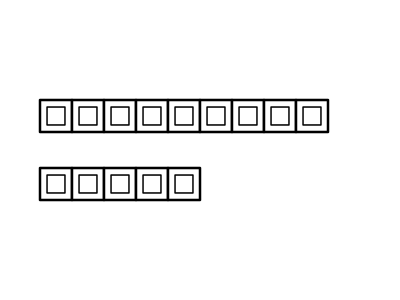
      Two cube trains with left ends lined up: the top train has 9 cubes and the bottom train has 5 cubes. How many cubes longer is the top train? ____
    6. 6.
      Why must all the clips be the same size? Tell why.

    Reading & Writing · Week 26 check

    Weekly check

    How to give it: Give it in one sitting, untimed. Read each direction aloud. For items 1-3, your child reads each word aloud and you tick the ones read right; give no hints. For item 4, you may read The Moon fact sheet and Moon Watch aloud first; your child tells one way they are alike and one way they are different, and you write the answers. Your child reads Insects aloud before items 5-7. For item 8, say: Write the two parts of tunnel. For item 9, say the word rabbit twice.

    Secure when: 8 of 10 words in items 1-2, 4 of 5 sight words, one true way alike and one true difference in item 4, and 4 of 5 on items 5-9.

    • I can read two-syllable words and compare two texts.
    • I can find facts in a source.
    • I can split a word into two parts.

    Insects

    An insect has six legs. A cricket is an insect. It can hop, and it can chirp at sunset. An ant is an insect. It can dig in the sand.

    1. 1.
      bandit fabric trumpet ribbon zigzag
    2. 2.
      public mascot until goblet button
    3. 3.
      name good man say great
    4. 4.
      Same? Not the same?
    5. 5.
      How many legs does an insect have?
      • six
      • two
      • ten
    6. 6.
      Which one can chirp?
      • a cricket
      • an ant
    7. 7.
      Is an ant an insect?
      • yes
      • no
    8. 8.
      tunnel ____ / ____
    9. 9.
      Spell it: ____

    Social Studies · Week 26 check

    Weekly check

    How to give it: Read every question and choice aloud, and point to each picture as you name it. This week the check is a pretend shopping task with whole-dollar prices and 10 pretend dollars. Your child answers by talking, pointing, circling, acting it out or drawing; write their words exactly on the line. It is not timed; stop and finish later if your child is tired. Do not show the page ahead of time. Your child may move the pretend dollar bills for items 5 to 7. Make a check mark next to each part your child shows on their own.

    Secure when: 6 of 8 correct, with at least one right on each goal

    • I can tell what I get and what I give up when I make a choice.
    • I can find and read prices on things at a store.
    • I can shop at a pretend store and choose what to buy.
    1. 1.
      You can go to the pool or to a birthday party on Saturday. You pick the party. What do you give up?
    2. 2.
      What is the benefit of picking the party?
    3. 3.
      A scarf costs 9 dollars. A belt costs 6 dollars. Which costs more?
      • scarf
      • belt
    4. 4.
      At the store, a sign under the milk says $3. What does the sign tell you?
    5. 5.
      You have 10 dollars. You buy a puzzle for 5 dollars. How many dollars are left?
    6. 6.
      Then you buy a yo-yo for 2 dollars. How many dollars are left now?
    7. 7.
      Can you buy a drum for 4 dollars with what is left?
      • yes
      • no
    8. 8.
      Tell one thing you bought at our pretend store and why you chose it.