1First Grade

    Digital clocks

    One or more?

    Practice pages

    0 of 180 days complete · Saved on this device

    View all 180 days

    Math

    Digital clocks

    I can read and write times on a digital clock.

    Standards: 1.MD.B.3

    Number practice (no timer)
    Make 10 with clock numbers (keep-up practice)
    Builds on
    Day 1 (half past). One-minute check: set the paper clock to 3:30. "What time is it?" (Half past 3, or 3:30)

    New words

    • digital clock: a clock that shows the time with numbers only, like 4:30
    • minutes: on a digital clock, the numbers after the two dots; 00 means o'clock and 30 means half past

    You need

    • The paper plate clock from Week 27
    • A digital clock (on a microwave, oven or phone), or times written on paper to show what one looks like
    • 6 paper squares for cards
    • Notebook and pencil
    • The paper fastener on the clock is a small part: keep it away from children under 3.
    1. Warm-Up · 5 min

      Fluency: make 10 with clock numbers. "2 and what clock number make 10?" (8) "9?" (1) "6?" (4) Spaced review from Week 19: "10 more than 45?" (55) "10 less than 45?" (35)

    2. Mini-Lesson · 10 min

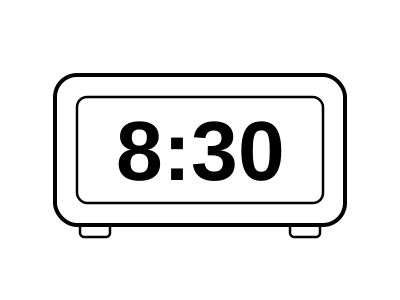
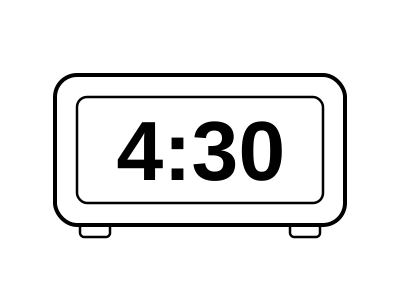
      Write 4:00 and 4:30 in the notebook. Say: "A digital clock has two parts. The number before the two dots is the hour. The numbers after the two dots are the minutes." Point to each part. Say: "00 means zero minutes after the hour: exactly 4 o'clock. 30 means 30 minutes after the hour: half past 4." Set the paper clock to 4:00 next to the written 4:00. Then move it to 4:30: long hand to 6, short hand halfway between 4 and 5. Ask: "On the digital time, what changed?" (00 became 30.) "On the clock with hands, what changed?" (The long hand moved to 6 and the short hand moved halfway to 5.) Show a real digital clock. Say: "A real digital clock shows every minute, like 4:17. This year we read it when it shows 00 or 30." Ask: "A digital clock says 8:30. Where is the long hand?" (On 6) "Where is the short hand?" (Halfway between 8 and 9)

    3. Guided Practice · 10 min

      You write a digital time. Your child sets the paper clock and says the time in words. 1) 7:00 (7 o'clock) 2) 7:30 (half past 7) 3) 10:30 (half past 10) 4) 1:00 (1 o'clock) 5) 5:30 (half past 5) Then you set the paper clock and your child writes the digital time. 6) 9:30 7) 12:00 8) 2:30 If stuck, say: "Write the hour first, from the short hand. Then look at the long hand: on 12, write 00; on 6, write 30."

    4. Play · 10 min

      Two Ways Each. Write these 6 cards and mix them face down: 3:30, 11:00, 6:30, half past 1, 8 o'clock, half past 12. Your child flips a card, sets the paper clock to match, and says or writes the time the other way. Answers: 3:30 is half past 3; 11:00 is 11 o'clock; 6:30 is half past 6; half past 1 is 1:30; 8 o'clock is 8:00; half past 12 is 12:30. Then your child writes a new card for you, and you set the clock and write the other way.

    5. Exit Ticket · 3-5 min

      Before asking, set the paper clock to 10:00. Read each question aloud. Your child answers out loud or writes the time. Check each answer together right away.

    Exit ticket

    1. Write the time on my clock the way a digital clock shows it.
    2. A digital clock shows 11:30. Say the time in words.
    3. On a digital clock, what does 30 after the two dots tell you?
    Answers
    1. 10:00
    2. Half past 11
    3. It is half past the hour: 30 minutes after the hour.
    Watch for, and help or stretch
    Watch for
    Writing 4:30 as 4:6 because the long hand points to 6.
    Try
    Say: "The long hand on 6 means it has gone halfway around: 30 minutes. We write 30, not 6." Move the long hand from 12 to 6 again while saying "half an hour."
    Extra help
    Write a frame for your child to fill in: ___:___. Under it write the two choices for the minutes: 00 (long hand on 12) and 30 (long hand on 6).
    Stretch
    Your child writes all the half-hour times from 1:30 to 6:30 in a list. (1:30, 2:30, 3:30, 4:30, 5:30, 6:30) Ask: "What pattern do you see?" (The hour goes up by 1 each time and the 30 stays the same.)

    At home (optional): When the microwave or oven clock shows a time ending in :00 or :30, your child reads it to a family member and shows the same time on the paper clock.
    Reading & Writing

    One or more?

    I can match nouns and verbs in sentences, like 'He hops' and 'They hop'.

    Standards: L.1.1.c, SL.1.6, RF.1.3.f

    Phonics
    Inflectional endings -s and -es (cats, hops, wishes, boxes)
    Sight words
    too, mean, same, tell, boy
    Reading
    The Tiny Seed (Eric Carle), optional; original story "Pip the Seed"; original decodable text "A Bean Grows"
    Writing
    Shared research: new question 'What do plants need?' · Handwriting: labels and captions
    Builds on
    -s and -es endings (Day 1). One-minute check: your child reads foxes, cups and wishes and tells which ending each has.

    New words

    • noun: a naming word for a person, animal, place or thing
    • verb: an action word, like hop or dig
    • match: to go together in the right way

    You need

    • 14 picture cards you draw on index cards (stick figures are fine): 1 frog, 2 frogs, 1 dog, 2 dogs, 1 bee, 2 bees, 1 fox, 2 foxes, 1 bug, 2 bugs, 1 pig, 2 pigs, 1 duck, 2 ducks
    • 8 sentence strips you write (in the lesson)
    • Sight word cards: too, mean, same, tell, boy (two sets: 10 cards for Memory Match)
    • Printed "A Bean Grows" (from Day 1)
    • Printed "Pip the Seed" (from Day 1)
    • Lined handwriting paper and a pencil
    1. Phonics & Word Work · 15 min

      One or more? I do: hold up 1 frog. Say: "The frog hops. One frog: the action word gets the -s." Hold up 2 frogs: "The frogs hop. More than one frog: the naming word gets the -s, and the action word does not." Say both and point to where the s goes. We do: with the dog cards, build The dog digs. / The dogs dig. With the bee cards: The bee buzzes. / The bees buzz. You do: your child matches each strip to the right picture card and reads it: The fox naps. The foxes nap. The bug runs. The bugs run. The pig sits. The pigs sit. The duck quacks. The ducks quack. Read: "The boy kicks. The kids kick." Then your child chooses: "The cats (nap / naps)." (nap) "The hen (pecks / peck)." (pecks) Dictation: The frog hops. The frogs hop. If stuck, ask: "How many? One? Then the action word gets the s."

    2. Sight Words · 5 min

      Review: too, mean, same, tell, boy. Memory Match with 10 cards: turn two over and read both. A match is kept. Then your child says a sentence with same, such as "We have the same hat."

    3. Read-Aloud & Shared Reading · 15 min

      Your child reads "A Bean Grows" aloud with you (choral reading: you read together), then reads Step 5 and Step 6 alone. Ask: "The text says the napkin stays wet. Is that one napkin or more?" (One.) Ask: "Find the sentence Kids can grow beans. How many kids?" (More than one.) Then reread "Pip the Seed" aloud. Ask: "Pip said 'Too dry.' Why was the windowsill not a good spot?" (No dirt and no water there.) Ask: "What happened to Pip after the rain fell?" (Pip drank up the water, swelled, and a root and shoot grew.) Ask: "Tell me one sentence about one seed and one about many seeds." (Answers vary. Look for: one seed sprouts / the seeds blow away, with the verb matching.) If stuck, hold up one finger, then all ten fingers, as you say each sentence.

    4. Writing & Handwriting · 15 min

      Your child says, then writes, two sentence pairs about plants, with one and more than one. Model on the board: The bean grows. The beans grow. Your child picks two pairs from these frames and writes them: The bean ___. The beans ___. The plant ___. The plants ___. (Answers vary. Look for: one bean or plant with an -s verb and many beans or plants with no -s, such as The plant needs sun. The plants need sun.) Handwriting (4 min): the letter s. Start like a c, curve back the other way and curl at the bottom. Your child writes s 5 times, then the word stems twice.

    5. Exit Ticket · 5 min

      Oral answers. Your child reads the sentences from a card you write.

    Exit ticket

    1. Fix this sentence: The pigs digs in the mud.
    2. Read this and tell me if it is one or more: The bells ring.
    3. Finish this sentence so it matches: The rabbit ___ (hop or hops).
    Answers
    1. The pigs dig in the mud.
    2. The bells ring. More than one bell.
    3. The rabbit hops.
    Watch for, and help or stretch
    Watch for
    Putting an s on both words: The frogs hops.
    Try
    Tell your child: "One s is enough. If the naming word has the s, the action word does not." Read the sentence both ways and listen.
    Extra help
    Use the real objects first: one spoon, then two spoons. "The spoon drops. The spoons drop." Then move to the picture cards.
    Stretch
    Your child writes a pair about a family member and the family: My dad naps. My dad and I nap.

    At home (optional): Your child tells 3 one-and-more sentence pairs about things at home, such as The cup drips. The cups drip.

    Science

    Stars at night

    I can explain when we can see stars in the sky.

    Standards: 1-ESS1-1

    Builds on
    Moon watch (Week 27). One-minute check: ask "Can we sometimes see the moon in the daytime?" (yes) "What shape was the moon the last time you drew it?" (Answers vary.)

    New words

    • star: a giant ball of hot, glowing gas very far away that makes its own light
    • bright: giving off or full of a lot of light
    • dim: giving off only a little light

    You need

    • A flashlight (a grown-up checks that it works)
    • A bright room: a room with the lights on and the curtains open in the daytime
    • A dark room: a closet, a bathroom with no window, or any room with the lights off and the curtains shut
    • Sky Journal (from Unit 5)
    • 1 sheet of black or dark blue paper
    • A white crayon or white colored pencil
    • Optional: a library book with photos of the night sky
    1. Warm-Up / Wonder · 5 min

      Spaced review: ask: "Where does the sun rise?" (in the east) "What does the moon's shape do after it is round?" (It gets thinner.) Wonder question: "Where do the stars go in the daytime?" Let your child guess; do not give the answer yet.

    2. Explore · 10–15 min

      Say: "Stars make their own light. Our sun is a star too. It is the star closest to us, so it looks big and very bright." Go to the bright room. Turn on the flashlight and shine it at a wall, a little way off. Ask: "Can you see the flashlight's spot on the wall?" (Answers vary: it is hard to see, or it is very faint.) Now go to the dark room with the same flashlight. Shine it at a wall from the same distance. Ask: "Now can you see the spot?" (Yes, it is easy to see.) Ask: "Did the flashlight change?" (No.) "What changed?" (the room: it got dark) Say: "The flashlight was shining the whole time. In the bright room, all the other light made its spot hard to see. Stars are like the flashlight. They are in the sky in the day and at night. In the daytime, the sun makes the whole sky so bright that we cannot see the dim stars. When the sky gets dark at night, we can see them." Ask: "So when can we see stars?" (at night, when the sky is dark) "Are the stars still up there at lunchtime?" (Yes, but the sky is too bright to see them.) Say: "Stars show at night, every clear night. That is a pattern we can predict." Plan a star watch for tonight or the next clear night: after dark, a grown-up and your child go outside or to a window, turn off the room lights, and wait a few minutes for their eyes to get used to the dark. Note for grown-ups: city lights and clouds hide many stars. Seeing only a few is normal; a cloudy night is data too. If stuck, go back to the bright room and the dark room and shine the flashlight again, then ask: "Which room is like the daytime sky? Which is like the night sky?" Safety: never look straight at the sun, even for a moment, and never point a tube, a flashlight or anything else at it. Sunglasses do not make it safe.

    3. Talk & Record · 5–10 min

      Your child draws the night sky with a white crayon on the black paper and tapes it into the Sky Journal. Sentence frame: "We can see stars when ___." (Sample: "We can see stars when the sky is dark at night.")

    4. Exit Ticket · 3–5 min

      Ask the three questions aloud. Your child answers by talking or drawing.

    Exit ticket

    1. Name the star that we see in the daytime.
    2. You wake up in the middle of a clear night and look out the window. Will you see stars or not? Why?
    3. Why can't we see the other stars at noon?
    Answers
    1. The sun.
    2. Yes, you will see stars because the sky is dark.
    3. The sun makes the sky too bright, so the dim stars do not show (they are still there).
    Watch for, and help or stretch
    Watch for
    Thinking the stars go away or turn off during the day.
    Try
    Shine the flashlight in the bright room again. Ask: "Did the flashlight turn off, or was it just hard to see?" (just hard to see) Say: "Stars are the same."
    Extra help
    Do only the flashlight demo and the drawing; do the star watch on a weekend night with a grown-up.
    Stretch
    On the star watch, your child counts how many stars they can see through one window pane, then tries again on another clear night and compares.

    At home (optional): Your child does the star watch with a grown-up after dark and draws what they see in the Sky Journal.

    Practice

    Read each direction aloud. Your child works on the page; answers are in the grown-up view.

    Warm-up

    Remember?

    Math

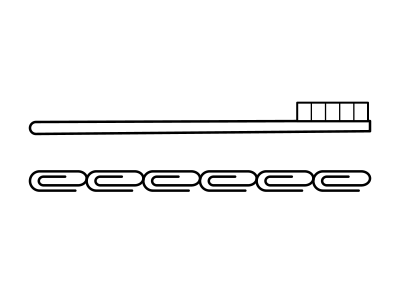
    1. A toothbrush with 6 same-size paper clips laid end to end under it, no gaps. How many paper clips long is the toothbrush?
    2. How many tens and how many ones are in 92?

    Reading & Writing

    Math · Week 28 Day 2

    I can read and write times on a digital clock.

    Look: 6:00 and 6:30

    1. The number before the two dots is the hour. The numbers after the two dots are the minutes.
    2. 6:00 means 6 o'clock: the long hand is on 12.
    3. 6:30 means half past 6: the long hand is on 6 and the short hand is halfway between 6 and 7.

    Write the time the digital way.

    1. 1.
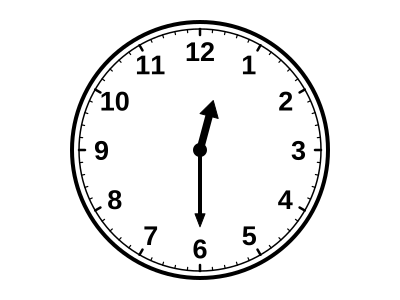
      A clock with the short hand halfway between 1 and 2 and the long hand on 6. ____
    2. 2.
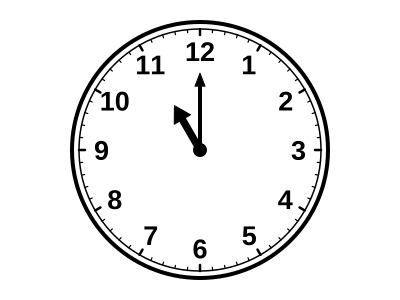
      A clock with the short hand on 11 and the long hand on 12. ____
    3. 3.
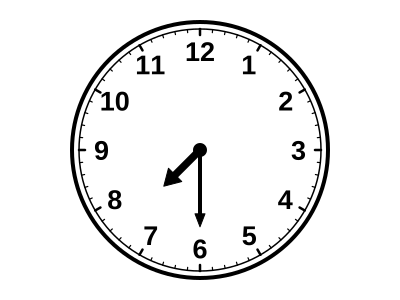
      A clock with the short hand halfway between 7 and 8 and the long hand on 6. ____
    4. 4.
      A clock with the short hand halfway between 12 and 1 and the long hand on 6. ____

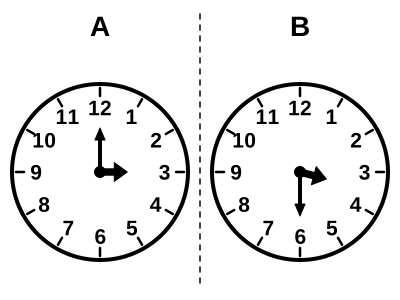
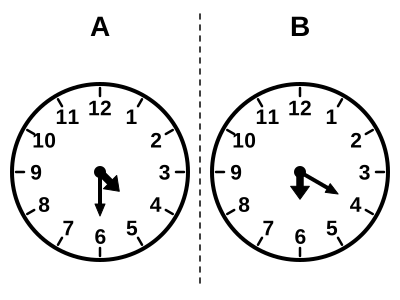
    Circle the clock with hands that shows the same time.

    1. 5.
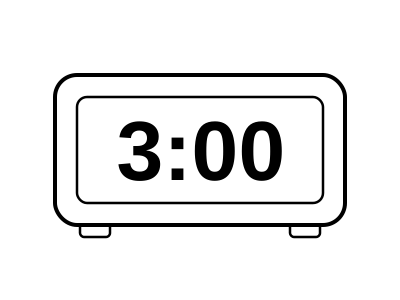
      A digital clock showing 3:00. Picture A: short hand on 3, long hand on 12; picture B: short hand halfway between 3 and 4, long hand on 6.
      • A
      • B
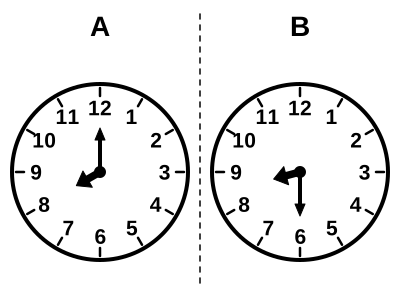
    2. 6.
      A digital clock showing 8:30. Picture A: short hand on 8, long hand on 12; picture B: short hand halfway between 8 and 9, long hand on 6.
      • A
      • B
    3. 7.
      A digital clock showing 4:30. Picture A: short hand halfway between 4 and 5, long hand on 6; picture B: short hand on 6, long hand on 4.
      • A
      • B

    Challenge (optional)

    A digital clock shows 9:30. What will it show half an hour later?

    You need: Pencil

    Reading & Writing · Week 28 Day 2

    I can match nouns and verbs in sentences, like 'He hops' and 'They hop'.

    Look: one or more?

    1. One goat: The goat eats. The action word gets the -s.
    2. More than one goat: The goats eat. The naming word gets the -s, and the action word does not.
    3. Ask: How many? Then pick the word that matches.

    Mom and the Goats

    Mom has one goat. The goat eats hay. Then Mom gets two more goats. The goats eat hay too. Now the boy fixes a big gate!

    Read the line. Circle the word that matches.

    1. 1.
      The bird ____ in the tree.
      • sing
      • sings
    2. 2.
      The kids ____ on the grass.
      • run
      • runs
    3. 3.
      The goat ____ the hay.
      • eat
      • eats
    4. 4.
      The ducks ____ in the pond.
      • swim
      • swims

    Fix it. Write the line so it matches.

    1. 5.
      The frogs jumps.
    2. 6.
      The boy run.
    3. 7.
      The girls sings.

    Challenge (optional)

    The bean grows. The beans ____.

    Science · Week 28 Day 2

    I can explain when we can see stars in the sky.

    Look: When can we see stars?

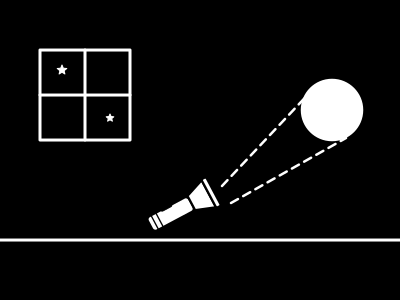
    1. Shine a flashlight at the wall in a bright room. The spot is hard to see.
    2. Shine the same flashlight in a dark room. Now the spot is easy to see.
    3. Stars are like that: they shine all the time, but we see them only when the sky is dark.

    Circle the picture that fits.

    1. 1.
      Circle the sky where you can see stars.
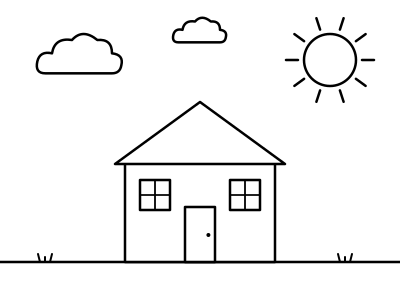
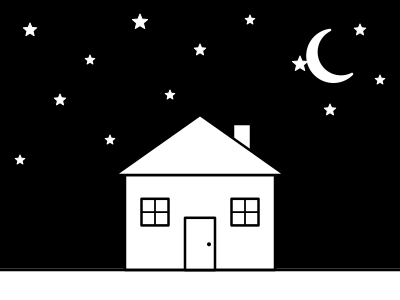
      • A bright blue daytime sky over a house.
      • A dark night sky over a house.
    2. 2.
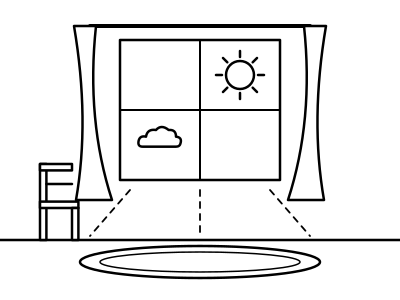
      Circle the room where the flashlight spot is easy to see.
      • A dark room.
      • A bright room with the curtains open.
    3. 3.
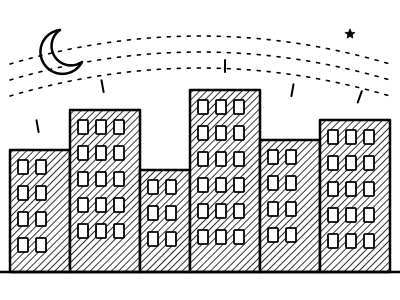
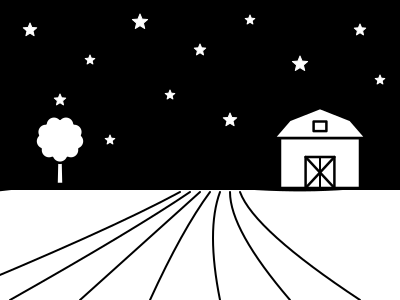
      City lights make the night sky brighter. Where will you see more stars?
      • A city with many lights at night.
      • A dark farm field at night.

    Circle yes or no, or draw.

    1. 4.
      On a sunny morning, are the stars gone from the sky?
      • yes
      • no
    2. 5.
      Clouds cover the whole sky one night. Can you see the stars?
      • yes
      • no
    3. 6.
      Circle what makes the daytime sky too bright to see the other stars.
      • The sun.
      • A lamp.
    4. 7.
      Draw the night sky you saw on your star watch, or the next one.

    Challenge (optional)

    Why do the stars seem to come out when the sun goes down?

    You need: crayons