1First Grade

    Bar graphs

    Root words

    Practice pages

    0 of 180 days complete · Saved on this device

    View all 180 days

    Math

    Bar graphs

    I can make a bar graph with three bars.

    Standards: 1.MD.C.4

    Number practice (no timer)
    Count tallies by 1s (and 5s as a shortcut)
    Builds on
    Day 2 (picture graphs). One-minute check: "On a picture graph, what does each picture stand for?" (One vote)

    New words

    • bar graph: a graph that uses colored boxes stacked into bars to show how many
    • bar: a column of colored boxes on a bar graph

    You need

    • 3 grids on grid paper, or 3 grids an adult draws in the notebook (one each for the Mini-Lesson, Guided Practice and Play), each with 3 columns of 10 boxes, each box about the size of a thumbnail, with the numbers 1 to 10 written up the left side
    • Crayons
    • The fruit and pet data from Days 1 and 2
    • Notebook and pencil
    1. Warm-Up · 5 min

      Fluency: count tallies. Draw 2 bundles of 5 and 2 marks. "How many?" (12) Spaced review from Week 17: "Which is greater, 46 or 64?" (64) "How do you know?" (6 tens is more than 4 tens.)

    2. Mini-Lesson · 10 min

      Say: "A bar graph is like a picture graph, but we color one box for each vote." On the grid, write the title Favorite Fruit and the labels Apple, Banana and Grapes under the 3 columns. Use the lesson data from Day 1: apple 6, banana 4, grapes 3. Color the apple column, counting out loud: "1, 2, 3, 4, 5, 6," starting at the bottom box with no skipped boxes. Your child colors banana and grapes. Point to the numbers up the side. Ask: "How can you tell the apple bar is 6 without counting the boxes?" (Look across from the top of the bar to the number 6.) "How is the bar graph like the picture graph?" (One box for each vote, like one sticky note for each vote.)

    3. Guided Practice · 10 min

      Your child makes a new bar graph on a fresh grid from this tally chart, which you draw: Favorite Crayon Color. Red: a bundle of 5. Blue: a bundle of 5 and 3 more. Green: 2 marks. Your child writes the title and labels, counts each tally and colors the boxes. Answers: red 5, blue 8, green 2. Ask: "Which bar is tallest?" (Blue) "How many chose green?" (2) Keep this graph for Day 4. If stuck, say: "Start at the bottom box. Color one box and say one. Stop when you reach the number in the tally."

    4. Play · 10 min

      Mystery Bars. Say clues and your child colors a bar graph on a fresh grid with the labels Cats, Dogs and Fish. 1) "Cats has 4." 2) "Dogs has 2 more than cats." 3) "Fish has 1 fewer than cats." Answers: cats 4, dogs 6, fish 3. Then your child makes up 3 clues for you, using "more than" and "fewer than," and checks the graph you color.

    5. Exit Ticket · 3-5 min

      Before asking, draw a bar graph titled Shoes by the Door with 3 bars: Sneakers 6 boxes, Boots 3 boxes, Sandals 4 boxes, with the numbers up the side. Read each question aloud. Your child answers out loud. Check each answer together right away.

    Exit ticket

    1. How many sandals are by the door?
    2. Which kind of shoe has the shortest bar?
    3. 2 more sneakers are put by the door. How many boxes tall is the sneakers bar now?
    Answers
    1. 4
    2. Boots
    3. 8
    Watch for, and help or stretch
    Watch for
    Starting a bar partway up or skipping a box, so the bar shows the wrong number.
    Try
    Your child puts a finger on the bottom box and counts each box while coloring. Check by reading the number at the top of the bar.
    Extra help
    Make the bar graph from the picture graph: your child takes one sticky note off the picture graph and colors one box for it.
    Stretch
    Ask about the Mystery Bars graph: "How many animals in all?" (13) Then your child makes Mystery Bars clues that make a total of 15.

    At home (optional): Your child shows a family member the bar graph and explains what one colored box means.
    Reading & Writing

    Root words

    I can find the root word in looks, looked and looking.

    Standards: L.1.4.c, L.1.4, RF.1.3.f

    Phonics
    Inflectional ending -ed (jumped, played, landed) with no base change
    Sight words
    follow, came, want, show, also
    Reading
    Original text "From Seed to Plant" and bean observation journal
    Writing
    Shared research: drafting our plant fact page; past-tense verbs · Handwriting: journal entries
    Builds on
    -s and -ed endings (Weeks 28 and 29). One-minute check: your child reads looks and looked and tells what is the same in both (look).

    New words

    • root word: the main word that endings are added to
    • word web: a drawing with one word in the middle and its family around it

    You need

    • A large sheet of paper for a word web, and a marker
    • Word cards (index cards): looks, looked, jumps, jumped, plays, played, rests, rested, helps, helped
    • Sight word cards: follow, came, want, show, also (two sets: 10 cards for Memory Match)
    • Printed "From Seed to Plant" (from Day 1)
    • The bean journal
    • Lined handwriting paper
    1. Phonics & Word Work · 15 min

      Word webs. I do: write look in a circle in the middle of the paper. Say: "Look is a root word. Endings make new words in its family." Draw two lines out and write looks and looked. Read each and point to look inside it. Then draw a third line and write looking. Say: "This one says looking. Next week you will learn to read -ing. Can you find look inside it?" (Your child points to look; you read the word.) We do: make a web for jump with jumps and jumped. You do: your child makes webs for play and rest, using the word cards, and reads each word (plays, played; rests, rested). Then your child sorts the 10 cards into families: look, jump, play, rest, help. Read: "Mom looks at the plant. She looked at it yesterday too." Dictation: helps, helped, looks. If stuck, cover the ending and ask: "What word is left? That is the root."

    2. Sight Words · 5 min

      Review: follow, came, want, show, also. Memory Match with 10 cards: turn two over and read both. A match is kept.

    3. Read-Aloud & Shared Reading · 15 min

      Root word hunt in "From Seed to Plant". Your child reads the journal and finds 4 words with an ending, then tells the root of each. (Answers vary. Look for: planted, plant; added, add; checked, check; looked, look; beans, bean; showed, show; curled, curl; sprouted, sprout; leaned, lean; turned, turn; filled, fill; watered, water; likes, like.) Ask: "On Day 9 the plant leaned to the window. Why do you think it did that?" (Answers vary. Look for: it was growing toward the light.) Ask: "What is the root word in watered, and what does it mean?" (water: to give a plant water.) If stuck, cover the ending with a finger.

    4. Writing & Handwriting · 15 min

      Your child adds today's page to the bean journal using one -ed word, then writes a sentence using a word from one of today's webs: "I ___ at my bean." (Answers vary. Look for: looked or a matching word, such as I looked at my bean.) Handwriting (4 min): the letters e and d. e starts in the middle, goes across, then curves up and around. d starts like a c, then a tall line up and back down. Your child writes -ed 5 times and the word looked twice.

    5. Exit Ticket · 5 min

      Oral answers. Your child reads the words from a card you write.

    Exit ticket

    1. What is the root word in sniffed?
    2. Read these words. Which one is not in the family of kick: kicks, kicked, kits?
    3. Make a new word from help with an ending.
    Answers
    1. sniff
    2. kicks, kicked, kits. kits is not in the family.
    3. Answers vary. Look for: helps or helped (helping is also right if your child says it).
    Watch for, and help or stretch
    Watch for
    Calling the first part of any word the root, such as kit in kitten.
    Try
    Ask: "Is the root a real word, and do the endings tell when or how many? kit-ten is not kit plus an ending."
    Extra help
    Build only the look web today, with real actions: your child looks, then you say what they did: "You looked."
    Stretch
    Your child makes a web for a new root word, such as fill or rain, with -s and -ed.

    At home (optional): Your child finds one root word family at home (such as the words on a cereal box or a recipe) or makes up one and tells it to a family member.

    Science

    Daylight graph

    I can make a picture graph of daylight at different times of year.

    Standards: 1-ESS1-2

    Builds on
    Daylight long or short? (Day 1). One-minute check: ask "Which season had less daylight, winter or spring?" (winter)

    New words

    • graph: a picture that shows numbers so we can compare them
    • hour: an amount of time; 60 minutes make 1 hour

    You need

    • Daylight numbers for 4 months. Either a grown-up looks up sunrise and sunset times for your town on the 21st of December, February, April and June (use NOAA's Solar Calculator online or a weather or almanac app) and works out about how many hours the sun is up, rounded to the nearest hour; or use the sample data in the Explore step
    • 4 paper strips, each about 1 inch wide and as long as the long side of a sheet of paper (11 inches), with ½-inch squares drawn along each strip (at least 16 squares; 15 squares fill about 7½ inches)
    • A yellow crayon
    • 1 sheet of paper for the graph, turned the tall way, with the title "Daylight" and 4 month labels along the bottom: December, February, April, June
    • A glue stick
    • Daylight chart from Day 1
    • Sky Journal
    1. Warm-Up / Wonder · 5 min

      Spaced review: ask: "Name the star we see in the daytime." (the sun) Wonder question: "Is there the same amount of daylight every month?"

    2. Explore · 10–15 min

      Say: "Scientists make graphs so they can compare numbers with their eyes. Each square on a strip stands for about 1 hour that the sun is up." Sample data (about how long the sun is up near Albuquerque, New Mexico, rounded to whole hours): December 21: about 10 hours; February 21: about 11 hours; April 21: about 13 hours; June 21: about 15 hours. (If you looked up your own town, use those numbers instead.) Do December first. Say: "In December, our strip gets 10 squares of daylight." Your child colors 10 squares yellow on the first strip, counting out loud. Then February: 11 squares. April: 13 squares. June: 15 squares. Check each count together by touching each yellow square. Your child glues the strips standing up above the month labels on the graph sheet, so all strips start at the bottom line. Ask: "Which strip is the longest?" (June) "Which is the shortest?" (December) "What happens to the strips from December to June?" (They get longer.) Say: "The graph shows a pattern: there is less daylight in winter and more daylight as we go toward summer." Ask: "How many more yellow squares does June have than December?" (5 more because 15 is 5 more than 10) Note for grown-ups: the exact hours depend on where you live, but the pattern (less daylight in winter, more in summer) is the same across the United States. Grade 1 compares more and less only. If stuck counting, color one square at a time while you both count, and stop at the number together.

    3. Talk & Record · 5–10 min

      Your child tapes the graph in the Sky Journal and draws a small sun above the longest strip. Sentence frame: "The month with the most daylight is ___. The month with the least daylight is ___."

    4. Exit Ticket · 3–5 min

      Ask the three questions aloud. Your child answers by talking or drawing.

    Exit ticket

    1. Look at the graph. Does April have more daylight or less daylight than February?
    2. One strip has 12 squares and one has 9 squares. Which one shows more daylight?
    3. On our graph, does daylight grow or shrink from winter toward summer?
    Answers
    1. More daylight (13 squares is more than 11).
    2. The strip with 12 squares.
    3. It grows.
    Watch for, and help or stretch
    Watch for
    Gluing the strips at different starting heights, which makes the lengths hard to compare.
    Try
    Draw one bottom line across the page. Say: "Every strip starts on this line, like runners at the same starting line."
    Extra help
    Make only 2 strips, December and June, and compare them.
    Stretch
    Your child adds a fifth strip for a fall month: a grown-up looks up the daylight for September 21 (about 12 hours near Albuquerque) and your child predicts where it fits before coloring.

    At home (optional): Your child shows the daylight graph to a family member and tells which month had the most daylight.

    Practice

    Read each direction aloud. Your child works on the page; answers are in the grown-up view.

    Warm-up

    Remember?

    Math

    1. A digital clock shows 3:30. What number does the long hand point to?
    2. Count on: 69, 70, 71, ___, ___

    Reading & Writing

    1. too, mean, same
    2. thank, think

    Math · Week 29 Day 3

    I can make a bar graph with three bars.

    Look: a bar for 5

    1. Start at the bottom box of the column.
    2. Color one box for each vote: 1, 2, 3, 4, 5.
    3. Look across from the top of the bar to the number 5 on the side.

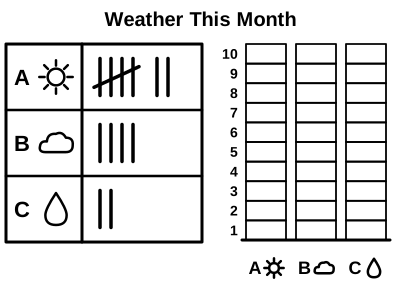
    Color the bar graph from the tally chart.

    1. 1.
      A tally chart titled Weather This Month: A, a sun: 1 bundle of 5 (4 marks with a line across) and 2 more marks. B, a cloud: 4 marks. C, a raindrop: 2 marks. Under it, an empty bar graph with 3 columns of 10 boxes and the numbers 1 to 10 up the side. Color one box for each tally mark.
    2. 2.
      Use your graph. Which bar is the tallest?
      • A
      • B
      • C
    3. 3.
      How many days had rain? ____

    Read this bar graph.

    1. 4.
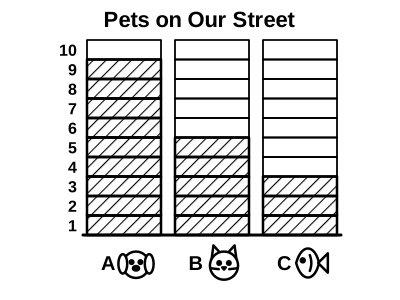
      A bar graph titled Pets on Our Street with numbers 1 to 10 up the side. Bar A, dogs: 9. Bar B, cats: 5. Bar C, fish: 3. How many cats? ____
    2. 5.
      How many dogs? ____
    3. 6.
      Which bar is the shortest? Circle the letter.
      • A
      • B
      • C

    Challenge (optional)

    2 more cats move onto the street. How tall is the cats bar now?

    You need: Crayons, Pencil

    Reading & Writing · Week 29 Day 3

    I can find the root word in looks, looked and looking.

    Look: root words

    1. Look is a root word.
    2. Add endings to make its family: looks, looked.
    3. To find the root, cover the ending: looked, look.

    Dad and the Bean

    Dad looks at the bean. Last night, he looked at it, and it was dry. Now the bean needs water. Dad fills a cup. He filled it to the top!

    Read the word. Write the root word.

    1. 1.
      turned ____
    2. 2.
      packs ____
    3. 3.
      dreamed ____
    4. 4.
      sorts ____

    Read the root word. Circle the word that is not in its family.

    1. 5.
      rock
      • rocks
      • rocked
      • rods
    2. 6.
      plant
      • plants
      • planted
      • plans
    3. 7.
      fill
      • fills
      • filled
      • fins

    Challenge (optional)

    jump: ____, ____

    Science · Week 29 Day 3

    I can make a picture graph of daylight at different times of year.

    Look: Read a daylight graph

    1. Each square on a strip stands for about 1 hour of daylight.
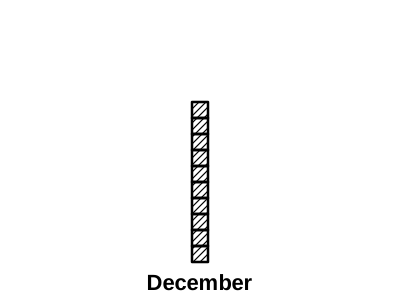
    2. Color 10 squares for December, counting out loud as you go.
    3. Glue the strips side by side. The longest strip has the most daylight.

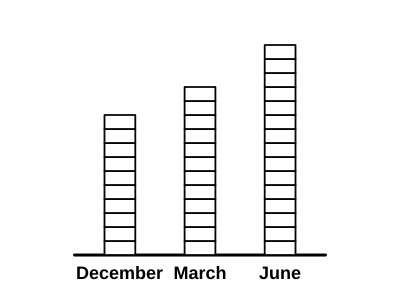
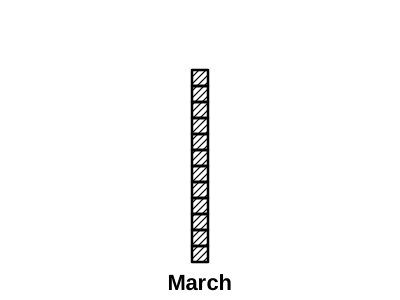
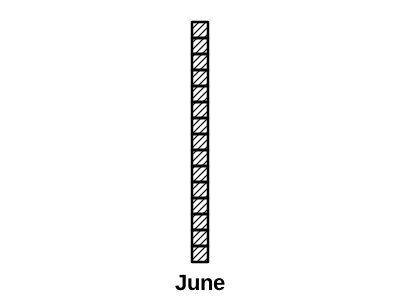
    A daylight graph like ours: December strip 10 squares, March strip 12 squares, June strip 15 squares. Look at the graph and circle the answer.
    1. 1.
      Which strip has the most daylight?
      • The December strip.
      • The March strip.
      • The June strip.
    2. 2.
      How many squares does the March strip have?
      • 10
      • 12
      • 15
    3. 3.
      How many more squares does March have than December?
      • 2
      • 3
      • 5

    Color, count and circle.

    1. 4.
      Color 14 squares on this strip. Count as you go. An empty strip of 16 squares.
    2. 5.
      One strip has 8 squares and one has 14 squares. Circle the strip with less daylight.
      • The strip with 8 squares.
      • The strip with 14 squares.
    3. 6.
      Circle the season that would have the shortest strip.
      • A sunny summer day at the beach.
      • A snowy winter day.

    Challenge (optional)

    An October strip has 11 squares. Is that more or less daylight than the June strip on this graph?

    You need: a crayon