This week's lessons
Math and reading every day; science and social studies take turns
- Day 1 · Monday
- MathComparing: how many more?I can line up two groups to find how many more.
- Reading & WritingBeginning, middle, endI can tell what happens at the beginning, middle and end of a story.
- ScienceVibration stationsI can test things to see if they shake when they make a sound.
- Day 2 · Tuesday
- MathComparing: how many fewer?I can find how many fewer one group has.
- Reading & WritingWho said it?I can describe a character using what they say and do.
- Social StudiesPeople in chargeI can tell who is in charge in different places and what their jobs are.
- Day 3 · Wednesday
- MathComparison barsI can draw two bars to show a comparing story.
- Reading & WritingTime wordsI can use first, next, then and last to tell events in order.
- ScienceStop the soundI can find a way to stop a sound and tell why it works.
- Day 4 · Thursday
- MathTurn-around factsI can switch the order of two numbers and get the same sum.
- Reading & WritingEnding my storyI can write an ending that tells how my story finished or how I felt.
- Social Studies · CheckRules in public placesI can explain how rules help at the library, the park and the store.
- Day 5 · Friday
- Math · CheckLesson + weekly check: comparingI can solve 'how many more' and 'how many fewer' stories.
- Reading & Writing · CheckShare and check: sh and chI can read sh and ch words and read my story to a listener.
- Science · CheckMy first science claimI can say what I found out and tell my evidence.
This week's checks
Short checks on the last day each subject meets this week
Social Studies · Day 4
- I can tell who is in charge in different places and what their jobs are.
- I can explain how rules help at the library, the park and the store.
Secure when: 6 of 7 correct, with at least one right on each goal
Open the checkMath · Day 5
- I can line up two groups to find how many more.
- I can find how many fewer one group has.
- I can draw two bars to show a comparing story.
- I can switch the order of two numbers and get the same sum.
Secure when: 7 of 8 correct, with at least 1 right on each goal
Open the checkReading & Writing · Day 5
- I can read sh and ch words.
- I can read the sight words you, are, they, have and what.
- I can tell the beginning, middle and end of a story in order.
- I can describe a character using what the character says and does.
Secure when: 6 of the 8 words in items 1 and 2, 4 of the 5 sight words, and 4 of the other 5 items.
Open the checkScience · Day 5
- I can test things to see if they shake when they make a sound.
- I can find a way to stop a sound and tell why it works.
- I can say what I found out and tell my evidence.
Secure when: 6 of 8 correct, including item 5 (the claim) and item 6 or 7 (one piece of evidence).
Open the check
Reading About Our World: Shake, Shake, Sound!
Read it aloud. Your child reads the sentences marked with a star. Builds science knowledge.
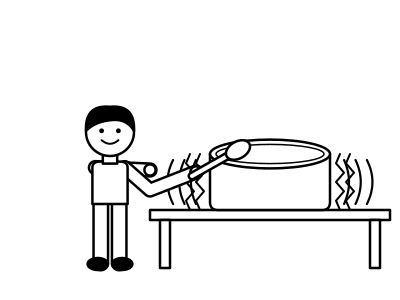
Things Shake
When something makes a sound, it shakes very fast. This fast shaking is called vibration. Hit a drum, and the top of the drum shakes. I tap a pot. It can hum.
Feel It
Put your hand gently on your throat and hum. You can feel it buzz. Try it and see! Parts inside your throat shake when you talk or sing.
Stop the Shake
Ring a bell, then hold it tight. The sound stops! When the shaking stops, the sound stops too. What can you hit?
Words to know
- vibration: a very fast shake
- throat: the front of your neck, where your voice comes from
- hum: make a sound with your mouth closed
Talk about it
- What is a very fast shake called?
- What happens to a bell's sound when you hold the bell tight?
- A guitar string is still and not shaking. Is it making a sound? How do you know?
Home Connection
Five-minute ideas for the whole family, with things you already have
Math
Comparing tells how many more or how many fewer.
Do: Line up 8 forks and 5 spoons, with each spoon under a fork. Count the forks that have no spoon partner.
Talk: How many more forks than spoons are there? How many fewer spoons?
Reading & Writing
Stories have a beginning, a middle and an end.
Do: Go on an sh and ch word hunt. Write ship, fish, chin, chop and rich for your child to read, then think of more sh and ch words together out loud.
Talk: What happened at the beginning, middle and end of a story you read this week?
Science
If you stop the shaking, the sound stops.
Do: Tap a metal pot lid with a wooden spoon and listen. Then tap it again and gently hold the lid with your hand. Listen to what happens.
Talk: Why did the sound stop when you held the lid?
Social Studies
Different people are in charge in different places, and rules help us in public places.
Do: On a trip to the library, park or store, look for one rule or sign. Talk about who made the rule and how it helps.
Talk: Who is in charge at the library? What is their job?
This week's words: you, are, they, have, what
Celebrate one comparing problem, one story your child told in order and one rule your child spotted.
Math catch-up: Partners and No Partners
10 minutes, if this week's math check was not secure · 1.OA.A.1
In comparing stories, children often answer with the bigger number. Matching objects one to one shows that 'how many more' means only the extras with no partner.
You need: 10 forks, 10 spoons, a dish towel to work on
- Lay 7 forks in a row on the towel. Lay 4 spoons in a row under them, one spoon under each fork.
- Ask: "Which forks have no spoon partner?" Your child touches and counts only those: 3. Say: "There are 3 more forks."
- Turn it around: "How many fewer spoons are there?" Point to the same empty spots. Say: "3 fewer spoons. More and fewer use the same gap."
- Try 2 new rows. Before counting, your child says what the answer is NOT: "It is not the big number."
Try again
- 8 forks and 3 spoons are on the table. How many more forks than spoons?
- 9 red blocks and 5 blue blocks are in a tower. How many fewer blue blocks are there?
- 6 cups and 6 plates are on the table. How many more cups than plates?
Specials This Week
Weeks 1–6 unit • ~90 min/week per subject
Locomotor Skills and Space Awareness
Mastering basic locomotor skills (walking, running, hopping, jumping, galloping, sliding, skipping), understanding personal and general space.
Exploring Line and Shape
Different types of lines (straight, curved, zig-zag, wavy), identifying basic shapes, creating patterns with lines and shapes.
Rhythm and Beat
Identifying and keeping a steady beat, understanding basic rhythms (ta – quarter note, ti-ti – eighth notes), clapping and patting rhythms.
For guiding principles and full standards reference, visit How to use this curriculum
As an Amazon Associate, we earn from qualifying purchases. Book and supply links on this page are affiliate links — using them supports this curriculum at no extra cost to you.