This week's lessons
Math and reading every day; science and social studies take turns
- Day 1 · Monday
- MathWhat makes a triangle a triangle?I can tell what all triangles have.
- Reading & WritingComparing two booksI can compare two books about caring for the Earth.
- ScienceWhat do engineers do?I can tell that engineers make things to solve problems.
- Day 2 · Tuesday
- MathRectangles and squaresI can tell the attributes of rectangles and squares.
- Reading & WritingReading on my ownI can read a story at my level with help when I need it.
- Social StudiesAmerican symbolsI can name American symbols and tell what they stand for.
- Day 3 · Wednesday
- MathShapes turned aroundI can tell that turning a shape does not change it.
- Reading & WritingPick my best pieceI can choose my best writing and tell why it is my best.
- ScienceProblem huntI can ask questions to find a problem at home.
- Day 4 · Thursday
- MathBuild and draw shapesI can build and draw a shape with given attributes.
- Reading & WritingAdd detailsI can listen to suggestions and add details to my writing.
- Social Studies · CheckMany governments, many flagsI can tell that our town, state, country and Native nations each have leaders and symbols.
- Day 5 · Friday
- Math · CheckLesson + weekly check: shape attributesI can tell defining attributes from ones that don't matter.
- Reading & Writing · CheckShare and check: review 1I can read short vowel, digraph, blend and oo words.
- Science · CheckDefine my problemI can say a problem in one sentence.
This week's checks
Short checks on the last day each subject meets this week
Social Studies · Day 4
- I can name American symbols and tell what they stand for.
- I can tell that our town, state, country and Native nations each have leaders and symbols.
Secure when: 7 of 9 correct, with at least one right on each goal
Open the checkMath · Day 5
- I can sort shapes by their sides, corners and being closed.
- I can tell that color, size and turning do not change a shape.
- I can draw a shape to match clues.
Secure when: 8 or 9 of the 9 items right.
Open the checkReading & Writing · Day 5
- I can read short vowel, digraph and blend words.
- I can read words with oo as in moon and oo as in book.
- I can read a story on my own and compare a tale and a list.
- I can pick my best writing and add details.
Secure when: 12 of 15 words in items 1-3, 4 of 5 oo words in item 4, 4 of 5 sight words in item 5, and 4 of 5 on items 6-10. Note any pattern missed more than once (for example, end blends) for next week's warm-ups.
Open the checkScience · Day 5
- I can tell that engineers make things to solve problems.
- I can ask questions to find a problem at home.
- I can say a problem in one sentence.
Secure when: 5 of 7 correct, including items 1, 2 and 3 (the problem, why it matters and the goal).
Open the check
Reading About Our World: Engineers Solve Problems
Read it aloud. Your child reads the sentences marked with a star. Builds science knowledge.
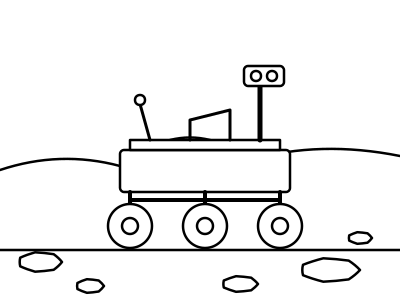
What Engineers Do
An engineer is a person who designs things to solve problems. Engineers design bridges, cars, phones and even robots. They work in many different jobs.
A Robot on Mars
Engineers built a rover named Perseverance to explore Mars. Mars is far away, so the rover had to drive and take pictures with no person on board. It landed on Mars in 2021.
Steps to Solve
Engineers ask questions about a problem. They sketch ideas, build, test and make their designs better. You can do this too! We can make a plan to fix it.
Words to know
- engineer: a person who designs things to solve problems
- design: a plan for how to make something
- rover: a machine with wheels that explores
Talk about it
- What does an engineer do?
- What is the name of the rover that explores Mars?
- Why did engineers need to test the rover before sending it to Mars?
Home Connection
Five-minute ideas for the whole family, with things you already have
Math
A shape's sides and corners tell what it is, not its color or size.
Do: Go on a shape hunt for triangles, rectangles, squares and circles. Count the sides and corners of each.
Talk: Is a square still a square when it is turned? Why?
Reading & Writing
Readers compare two books about the same kind of character or topic.
Do: Pick two books with a similar character or topic and talk about how they are alike and different. Write chest, thump, flash and stomp for your child to read.
Talk: How are the two books alike? How are they different?
Science
Engineers solve problems by designing things.
Do: Walk through your home and look for small problems, like a pile of books that slides or shoes that get mixed up.
Talk: What problem would you like to solve?
Social Studies
Symbols like the American flag stand for our country; towns, states and Native nations have leaders and symbols too.
Do: Look for the American flag in your community, and look up your state's flag together.
Talk: What does the flag stand for?
This week's words: well, large, must, big, even
Celebrate a shape hunt, two books compared and a problem worth solving.
Math catch-up: Closed, Sides, Corners
10 minutes, if this week's math check was not secure · 1.G.A.1
Children often decide a shape's name by how it usually looks, so a skinny or tipped triangle 'is not a triangle.' Checking the defining attributes (closed, straight sides, corners) gives a test that works every time.
You need: paper and scissors (adult cuts), crayons, 6 craft sticks or straws
- Cut out 3 triangles: one usual, one very skinny, one turned upside down. Run the test together: "Closed? 3 straight sides? 3 corners?" All are triangles.
- Color one triangle red and one blue. Ask: "Did the color change its name?" (No.) Say: "Color and size don't matter. Sides and corners do."
- Build a square with 4 sticks. Run the rectangle test: "Closed? 4 straight sides? 4 square corners?" (Yes.) A square is a special rectangle.
- Turn the square to stand on a corner. Ask: "Did any side or corner change?" (No. It is still a square.)
Try again
- A shape is closed and has 3 straight sides and 3 corners. It is very small and green. What shape is it?
- A square is painted red. Is it still a square?
- A closed shape has 4 straight sides that are all the same length and 4 square corners. What shape is it?
Specials This Week
Weeks 31–36 unit • ~90 min/week per subject
Games, Cooperation, and Safety
Participating in cooperative games, understanding rules, demonstrating sportsmanship, identifying safe practices in physical activity.
Art and Storytelling
Creating art that tells a story, illustrating favorite books, connecting art to nature and emotions.
Music and Storytelling/Performance
Creating music to tell a story, composing simple rhythmic patterns, preparing and presenting a short musical performance.
For guiding principles and full standards reference, visit How to use this curriculum
As an Amazon Associate, we earn from qualifying purchases. Book and supply links on this page are affiliate links — using them supports this curriculum at no extra cost to you.