This week's lessons
Math and reading every day; science and social studies take turns
- Day 1 · Monday
- MathMy own surveyI can ask a question and collect data.
- Reading & Writing-ing endingsI can read words that end in -ing.
- Social StudiesSpend, save or share?I can make a money choice and give reasons for it.
- Day 2 · Tuesday
- MathShow and share my surveyI can make a graph and tell what it shows.
- Reading & WritingReasons in a textI can find reasons the author gives.
- SciencePatterns in the sky posterI can show the sun, moon, star and daylight patterns.
- Day 3 · Wednesday
- MathReview: lengthI can order, compare and measure lengths.
- Reading & WritingFinish our researchI can add a picture and a closing to our research page.
- Social StudiesTell about my choiceI can tell my family my money plan and answer their questions.
- Day 4 · Thursday
- MathReview: timeI can tell time to the hour and half hour.
- Reading & WritingPresent our researchI can share our research and answer questions.
- Science · Unit testUnit 5 test: sky patternsI can describe and predict sky patterns.
- Day 5 · Friday
- Math · Unit testUnit 5 test: length, time and dataI can measure lengths, tell time and read data.
- Reading & Writing · Unit testUnit 5 testI can show what I know about reading to learn, word parts and endings.
- Social Studies · Unit testUnit 5 test: choices and moneyI can show what I know about needs, wants, choices, saving and trade.
This week's checks
Short checks on the last day each subject meets this week
Math · Unit 5 test
Open the unit testReading & Writing · Unit 5 test
Open the unit testScience · Unit 5 test
Open the unit testSocial Studies · Unit 5 test
Open the unit test
Reading About Our World: Spend, Save or Share
Read it aloud. Your child reads the sentences marked with a star. Builds social studies knowledge.
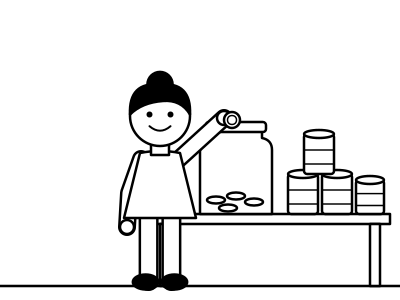
Three Choices
When you have money, you can spend it, save it or share it. Spending means buying something now. Sharing means giving to help others.
Saving for Later
Saving means keeping money to use later. Saving a little at a time can help you buy something bigger. I keep my coins in a bank.
Banks Help
A bank is a business that keeps money safe. It keeps a record of how much each person has saved. People can take their money out when they need it.
Words to know
- spend: use money to buy something
- save: keep money to use later
- bank: a place that keeps money safe
Talk about it
- What does saving mean?
- What does a bank keep a record of?
- A child wants a toy that costs more money than they have. What could the child do?
Home Connection
Five-minute ideas for the whole family, with things you already have
Math
We can ask a question, collect answers and show them on a graph.
Do: Sort socks or toys into 3 groups by color or kind. Make a bar graph by coloring one box for each thing.
Talk: How many are there in all? How many more are in the biggest group than in the smallest?
Reading & Writing
Researchers share what they learned.
Do: Your child presents their research to the family. Write jumping, reading, playing and singing for your child to read.
Talk: What was the most interesting thing you learned?
Science
The sun, moon and stars move in patterns we can predict.
Do: Your child makes a poster: the sun's path in the daytime, the moon's changing shape and stars at night.
Talk: What will the sky look like tonight?
Social Studies
We can spend, save or share money, and we can give reasons for our choices.
Do: Label three clean plastic cups spend, save and share. Your child splits 10 pennies among them. Keep pennies away from children under 3.
Talk: Why did you put money in each cup?
This week's words: around, three, small, end, another
Celebrate the end of Unit 5: a graph, a research presentation and a money plan.
Math catch-up: Only What the Graph Shows
10 minutes, if this week's math check was not secure · 1.MD.C.4
Children sometimes let one person answer twice, or say 'facts' the graph does not show, such as why people chose something. A name list and the question 'Can you point to it?' keep data honest.
You need: paper and a pencil, a list of 6 to 10 family members or friends to ask
- Your child writes a survey question with 3 answer choices, such as "Which snack do you like best: apples, crackers or cheese?"
- Write each person's name. Your child asks, makes one mark, and checks off the name. Ask: "Did anyone answer twice?"
- Make a bar graph with 3 bars. Your child says 2 facts about it.
- For each fact, ask: "Can you point to that on the graph?" If not, it is not a graph fact.
Try again
- Pets graph: dogs 5, cats 3, fish 2. How many people answered?
- Pets graph: dogs 5, cats 3, fish 2. Which pet got the fewest votes?
- Pets graph: dogs 5, cats 3, fish 2. Can the graph tell us that dogs are the best pet? Why?
Specials This Week
Weeks 25–30 unit • ~90 min/week per subject
Fitness Components (Cardiovascular & Strength)
Understanding what makes the heart beat faster, engaging in activities that build cardiovascular endurance and muscular strength.
Art from Around the World
Exploring art forms from different cultures (e.g., African masks, Native American pottery, Japanese origami, Aboriginal dot painting).
Music and Movement/Cultural Music
Moving creatively to music, exploring dance from different cultures, listening to music from around the world.
For guiding principles and full standards reference, visit How to use this curriculum
As an Amazon Associate, we earn from qualifying purchases. Book and supply links on this page are affiliate links — using them supports this curriculum at no extra cost to you.