1First Grade

    Lesson + weekly check: equal shares

    Share and check: review 3

    Practice pages

    0 of 180 days complete · Saved on this device

    View all 180 days

    MathWeekly check

    Lesson + weekly check: equal shares

    I can make and name halves and fourths.

    Standards: 1.G.A.3

    Number practice (no timer)
    Halves and doubles: 4 + 4 = 8, half of 8 is 4
    Builds on
    This week's work: halves, fourths and quarters, and more shares making smaller shares. One-minute check: "How many fourths make a whole?" (4)

    New words

    • equal: the same size

    You need

    • A sheet of paper with 6 same-size circles drawn as pizzas (drawn by an adult)
    • Crayons
    • Notebook and pencil
    • The stored Week 33 check and its answer key
    1. Warm-Up · 5 min

      Fluency: halves and doubles. "9 + 9?" (18) "Half of 18?" (9) Spaced review from Week 28: "Write half past 5 the digital way." (5:30)

    2. Short Lesson: Review Game · 10 min

      Pizza Party. Use the 6 pizzas. 1) "2 friends share pizza 1 fairly. Show it." (Halves) 2) "4 friends share pizza 2 fairly. Show it." (Fourths) 3) You split pizza 3 with a line far from the middle. Ask: "Is this fair?" (No. The shares are not equal.) 4) "Color a quarter of pizza 2." 5) "Color half of pizza 1." 6) "Who gets more pizza: a person who gets a half or a person who gets a fourth of the same pizza?" (The person who gets a half) Use pizzas 4 to 6 to try again if needed. If stuck, say: "Halves means 2 equal shares. Fourths means 4 equal shares. Count the friends."

    3. Weekly Check · 15 min

      Give the stored Week 33 check. The printed check has 6 items. It covers these goals: (1) I can split shapes into halves and fourths; (2) I can name the shares; (3) I can tell that a half is bigger than a fourth of the same shape. Read each item aloud. There is no time limit. If your child is stuck, say only: "How many equal shares do you need?" Do not give the answer. Score it with the answer key. Secure: 5 or 6 of the 6 items right. If the check is secure, start Week 34. If it is not, first do the reteach step on the check page for each group of items missed, then start Week 34.

    4. Exit Ticket · 3-5 min

      After the check, ask these two questions. Then go over any missed check items together.

    Exit ticket

    1. Draw a rectangle and color a quarter of it.
    2. What do we call each share when a rectangle is split into 2 equal shares?
    Answers
    1. Look for: a rectangle split into 4 equal shares with 1 share colored.
    2. A half
    Watch for, and help or stretch
    Watch for
    Drawing fourths as 4 parts that are not the same size.
    Try
    Draw a line through the middle first to make halves. Then split each half the same way.
    Extra help
    Let your child fold a paper copy of each check shape before drawing the lines, and note it on the check.
    Stretch
    After the check, ask: "How many halves are in 2 whole pizzas?" (4) "How many fourths are in 2 whole pizzas?" (8)

    At home (optional): Your child cuts a paper square into fourths and gives a quarter to 4 family members, saying: "Here is a quarter of the square."
    Reading & WritingWeekly check

    Share and check: review 3

    I can read r-controlled, ou/oi and consonant-le words.

    Standards: RF.1.3.b, RF.1.3.g, RF.1.3.c, RF.1.3.e

    Phonics
    Consonant-le syllables (little, apple, candle), with cumulative review: r-controlled vowels and ou/ow, oi/oy
    Sight words
    home, us, try, kind, hand
    Reading
    The Tale of Peter Rabbit (Beatrix Potter, 1902; public domain; reread) paired with Rabbits, Rabbits & More Rabbits (Gail Gibbons), optional; original fact page "Real Rabbit Facts" and original decodable "Fern Hops Out at Dusk"
    Writing
    Showcase: publish with a digital tool · Handwriting: title page
    Builds on
    This week's r-controlled, ou/ow, oi/oy and consonant-le words. One-minute check: warm up with farm, out, coin, little.

    New words

    • r-team: a vowel and r that make one sound together, like ar or ir

    You need

    • The printed Week 33 check (15 r-controlled, ou/ow and oi/oy words, 5 consonant-le words, 5 sight words and a short fact text)
    • 12 game cards (index cards): yard, horn, candle, skirt, curl, shout, gown, spoil, toy, bubble, storm, chirp
    • Sight word cards: home, us, try, kind, hand, such, why, went, read, need
    • Recording sheet
    • The printed published page and the shared rabbit page
    • Lined handwriting paper
    1. Review Game · 10 min

      Sound Sort Walk: lay 12 cards face down: yard, horn, candle, skirt, curl, shout, gown, spoil, toy, bubble, storm, chirp. Your child flips a card, reads it and walks it to one of three spots: r-teams, ou/ow/oi/oy or consonant-le. (r-teams: yard, horn, skirt, curl, storm, chirp; ou/ow/oi/oy: shout, gown, spoil, toy; consonant-le: candle, bubble.) If stuck on a word during the game (not during the check), cover all but the first sound, say it together, then uncover the rest and blend; for a consonant-le word, cover the last three letters and read the first part.

    2. Sight Words · 5 min

      Review: home, us, try, kind, hand, such, why, went, read, need. Hop and Read: lay the 10 cards on the floor. Your child hops to a card, reads it and picks it up.

    3. Weekly Check · 15 min

      Give the printed Week 33 check: 10 items. Its goals: I can read r-controlled and ou/oi words. I can read words that end in consonant-le. I can compare a tale and a fact text, and their pictures. I can use capitals and end marks to publish my writing. Items 1-3: your child reads 15 words with r-controlled vowels, ou/ow and oi/oy. Item 4: 5 consonant-le words. Item 5: the 5 sight words (home, us, try, kind, hand). Items 6-10: a short fact text about rabbits, a picture question and two lines to fix with capitals and end marks. Give no hints. Record each answer. The check's pass rule: "Secure: 12 of 15 words in items 1-3, 4 of 5 consonant-le words in item 4, 4 of 5 sight words in item 5, and 4 of 5 on items 6-10. Note any team your child mixes up (such as ou and oi) for next week's warm-ups."

    4. Share & Listen · 10 min

      Your child shows the published page and the shared rabbit page to a listener and reads one aloud. The listener asks one question; your child answers in a complete sentence.

    5. Handwriting · 5 min

      Your child copies Fern is a brown rabbit. neatly. Circle the best word.

    6. Exit Ticket · 5 min

      Talk about the week.

    Exit ticket

    1. Read a word with an r-team, a word with ou or oi, and a word that ends in consonant-le.
    2. What was the best part of publishing on the computer?
    Answers
    1. Answers vary. Look for: correct reads, such as barn, loud and puddle.
    2. Answers vary. Look for: a real reason.
    Watch for, and help or stretch
    Watch for
    Mixing up ou and oi (reading shout as shoit).
    Try
    Before the check (not during it), make the two mouth shapes: /ow/ opens wide, /oi/ rounds then smiles. Read out and oil side by side.
    Extra help
    Give items 1-3 in three sets of 5 with a stretch between.
    Stretch
    Your child reads 3 bonus words: popcorn, cowboy, sprinkle. Do not score them.

    At home (optional): Your child reads the published page to a relative on the phone or a video call.

    ScienceWeekly check

    Test both designs

    I can test two designs and record what happens.

    Standards: K-2-ETS1-3

    Builds on
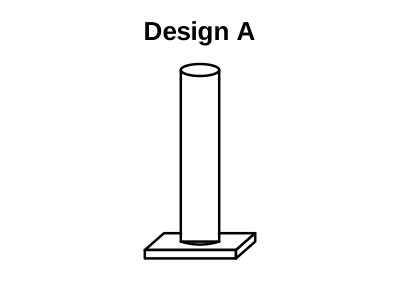
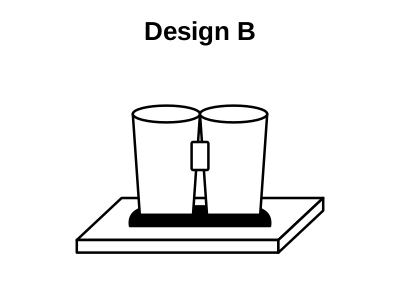
    Build design B (Day 3). One-minute check: ask "What is different about Design A and Design B?" (Answers vary. Look for: a shape difference.)

    New words

    • data: facts and numbers we collect in a test
    • trial: one try of a test
    • tally: a mark that counts one thing

    You need

    • Design A and Design B
    • 20 crayons (10 for each design)
    • A table
    • A tally chart in the Engineering Journal: 2 rows (Design A, Design B) and 3 columns (Trial 1, Trial 2, Trial 3), plus a column "Did it tip?"
    • Pencil
    • Week 33 science check page (given separately)
    1. Warm-Up / Wonder · 5 min

      Spaced review: ask: "What makes a test fair?" (Everything stays the same except the one thing you are testing.) Wonder question: "How can we test both designs in the very same way?"

    2. Review Game · 10 min

      Play "Fair or Not Fair?" Say each test plan; your child gives a thumbs-up (fair) or thumbs-down (not fair). "Put 10 crayons in A and 3 crayons in B." (not fair) "Bump the table 5 times for A and 2 times for B." (not fair) "Put 10 crayons in each and bump the table the same way 5 times for each." (fair) Say: "Let's use the fair plan." Note for grown-ups: if your child chose a different problem in Week 31, keep the same fair-test idea but match the test to the goal (for example, for a backpack hook, hang the same backpack on each design 5 times and count how many times it stays on). Run the test: your child puts 10 crayons in Design A in the middle of the table. A grown-up bumps the table with a flat hand the same gentle way 5 times. Your child counts the crayons still inside and writes the number for Trial 1, and writes yes or no for "Did it tip?" Put the crayons back and do Trials 2 and 3. Then do exactly the same for Design B. Ask: "Why do we do 3 trials?" (to be sure the result was not luck) If stuck recording, your child makes one tally mark for each crayon still inside, then counts the marks.

    3. Check · 10 min

      Give the Week 33 science check. The check items are on the Week 33 check page; do not show them ahead of time. Read each part aloud. Your child answers by talking, pointing, showing with the real materials or drawing. You write down their words exactly. It is not timed; stop and finish later if your child is tired. Make a check mark next to each part your child shows on their own. The printed check has 8 items. It covers these goals: (1) I can build my first design; (2) I can build my second design; (3) I can test two designs and record what happens. This week the check is a test-and-record task. Look for: your child runs the same test on both designs (same number of crayons, same bumps), records the number of crayons left after each trial and whether each design tipped, and tells which design kept more crayons in. If stuck on a part, do one trial together while you say each step out loud, then let your child do the next trial alone. Secure: 6 of 8 correct, including items 1 and 2 (the same test for both designs, recorded) and item 3 (tells which kept more). If the check is not yet secure, use the reteach step on the check page that matches the items missed.

    4. Exit Ticket · 3–5 min

      Ask the three questions aloud. Your child answers by talking or drawing.

    Exit ticket

    1. Why did each design get the same number of crayons?
    2. Design A kept 6 crayons in and Design B kept 9. Which kept more?
    3. What did you write down each time?
    Answers
    1. So the test was fair.
    2. Design B.
    3. Answers vary. Look for: how many crayons stayed in and whether it tipped.
    Watch for, and help or stretch
    Watch for
    Bumping harder for the design your child does not like.
    Try
    Say: "Engineers are fair even to the design they don't like." Let your child watch the grown-up's hand and count the 5 bumps out loud.
    Extra help
    Do 1 trial for each design and use tally marks only.
    Stretch
    Your child adds a fourth trial with a harder test (6 bumps) for both designs and compares.

    At home (optional): Your child shows the tally chart to a family member and tells which design kept more crayons in.

    Practice

    Read each direction aloud. Your child works on the page; answers are in the grown-up view.

    Warm-up

    Remember?

    Math

    1. Does size change whether a shape is a triangle? (yes or no)
    2. Which comes first in the day: 6:00 or 6:30?

    Reading & Writing

    1. dishes, bells, benches

    Math · Week 33 check

    Weekly check

    How to give it: Read every item aloud. It is untimed. Your child may fold paper to try a shape before drawing. For item 5, your child says the name and you write it. If your child is stuck, say only: "How many equal shares do you need?" Do not give the answer. 5 or 6 right: start Week 34. 4 right: redo Day 3 Guided Practice before Week 34. 3 or fewer right: redo Days 1 and 3 with paper folding before Week 34.

    Secure when: 5 or 6 of the 6 items right.

    • I can split shapes into halves and fourths.
    • I can name the shares.
    • I can tell that a half is bigger than a fourth of the same shape.
    1. 1.
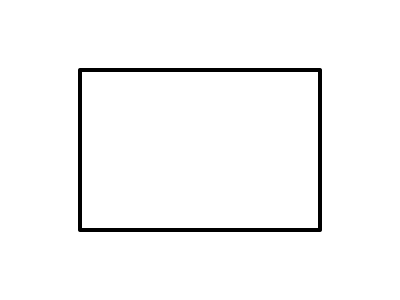
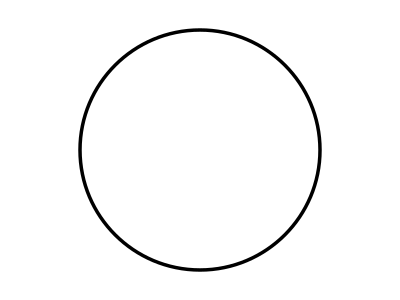
      A circle. Split it into halves.
    2. 2.
      A rectangle. Split it into halves.
    3. 3.
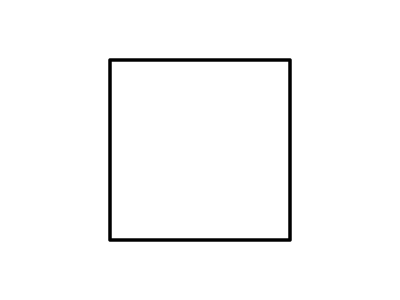
      A square. Split it into fourths.
    4. 4.
      A circle. Split it into fourths.
    5. 5.
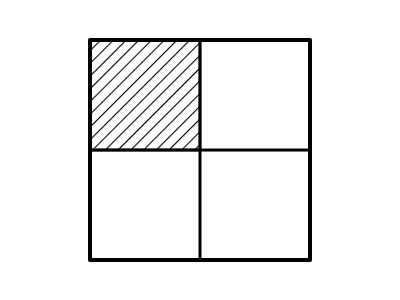
      A square split into 4 equal shares with 1 shaded. Say the name of the shaded share. A grown-up writes it.
    6. 6.
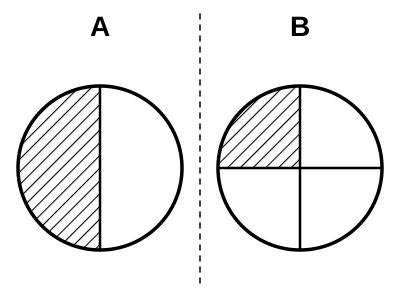
      Picture A: a circle split into halves with 1 half shaded; picture B: the same size circle split into fourths with 1 fourth shaded. Circle the bigger share.
      • A
      • B

    Reading & Writing · Week 33 check

    Weekly check

    How to give it: Give it in one sitting, untimed. Read each direction aloud and give no hints. For items 1-5, your child reads each word aloud and you tick the ones read right. Your child reads Rabbits before items 6-7. For item 6, say: Could a real rabbit do this? For item 8, say: Circle the number of the picture. For items 9-10, say: Write the line with capitals and an end mark.

    Secure when: 12 of 15 words in items 1-3, 4 of 5 consonant-le words in item 4, 4 of 5 sight words in item 5, and 4 of 5 on items 6-10. Note any team your child mixes up (such as ou and oi) for next week's warm-ups.

    • I can read r-controlled and ou/oi words.
    • I can read words that end in consonant-le.
    • I can compare a tale and a fact text, and their pictures.
    • I can use capitals and end marks to publish my writing.

    Rabbits

    A rabbit has soft fur and a white tail. It eats grass and weeds. It rests in the day. It can run fast and zigzag!

    1. 1.
      dart cord stern firm blurt
    2. 2.
      torch chart twirl surf herd
    3. 3.
      pout growl scout coil moist
    4. 4.
      riddle noodle grumble sizzle wobble
    5. 5.
      home us try kind hand
    6. 6.
      Can a rabbit put on a hat?
      • yes
      • no
    7. 7.
      What does a rabbit eat?
      • grass and weeds
      • cake
    8. 8.
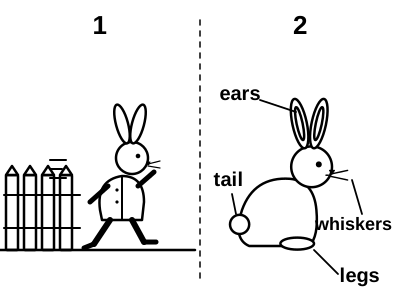
      1 a story picture of a rabbit in a coat, 2 a diagram of a real rabbit with labels. Which one shows the parts with names?
      • 1
      • 2
    9. 9.
      on sunday, bert and i went to the barn
    10. 10.
      is the rabbit in the yard

    Science · Week 33 check

    Weekly check

    How to give it: Read every direction, question and choice aloud. It is not timed; stop and finish later if your child is tired. Your child answers by talking, pointing, showing with the real materials or drawing, and you write their words exactly. Have Designs A and B, 20 crayons (10 for each), the table and the tally chart. The same grown-up gives the same gentle bumps each time. If your child chose a different problem, match the test to the goal and keep it fair.

    Secure when: 6 of 8 correct, including items 1 and 2 (the same test for both designs, recorded) and item 3 (tells which kept more).

    • I can build my first design.
    • I can build my second design.
    • I can test two designs and record what happens.
    1. 1.
      Test Design A: 10 crayons, 5 gentle bumps on the table, 3 trials. Record the crayons left and "Did it tip?" each time.
    2. 2.
      Test Design B the very same way and record.
    3. 3.
      Tell which design kept more crayons in. Your grown-up writes it.
    4. 4.
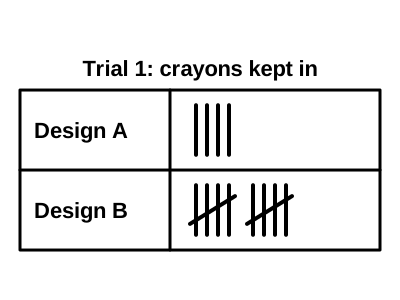
      A tally chart, Trial 1: Design A kept 4 crayons, Design B kept 10 crayons. Which design kept fewer crayons in?
      • Design A.
      • Design B.
    5. 5.
      Is it fair to put 10 crayons in each design?
      • yes
      • no
    6. 6.
      Show Design A. Point to its base.
    7. 7.
      Show Designs A and B side by side. Point to how their shapes are different.
    8. 8.
      Circle the design with a wide base.
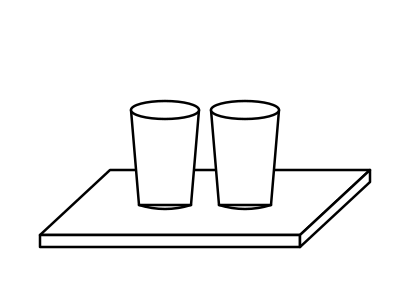
      • 2 cups on a big cardboard square.
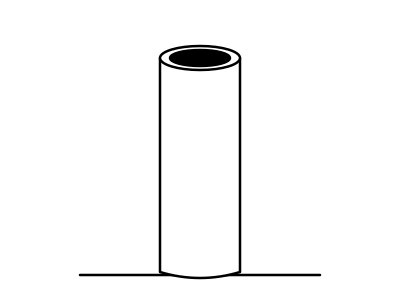
      • A tube standing alone.