1First Grade

    Count objects and write the number

    Two mice, two homes

    Practice pages

    0 of 180 days complete · Saved on this device

    View all 180 days

    Math

    Count objects and write the number

    I can count a collection to 120 and write the numeral.

    Standards: 1.NBT.A.1, 1.NBT.B.2

    Number practice (no timer)
    Make 10 and doubles (keep-up practice)
    Builds on
    Week 13 counting a collection with 10 in each cup, and Week 14 tens and ones. One-minute check: "6 cups of 10 and 3 more?" (63)

    New words

    • estimate: a smart guess about how many, made without counting

    You need

    • A clear jar or bowl with 87 small items, such as dried beans, pasta or buttons (count it before the lesson)
    • A small bowl with 32 of the same items (count it before the lesson)
    • 12 small cups
    • A sticky note or scrap of paper for the estimate
    • Notebook and pencil
    1. Warm-Up · 5 min

      Fluency: make 10 and doubles. "7 and what make 10?" (3) "6 + 6?" (12) "8 + 8?" (16) Spaced review from Week 15: "What number is 50 + 7?" (57)

    2. Mini-Lesson · 10 min

      Say: "Before we count a big collection, we make an estimate. An estimate is a smart guess." Show the small bowl of 32. Say: "I think there are about 30, because it looks like 3 handfuls of 10." Write "about 30." Count it together into cups of 10: "10, 20, 30, 31, 32." Write 32 = 3 tens and 2 ones. Ask: "Was my estimate close?" (Yes. 32 is close to 30.) Say: "An estimate does not have to be exact. Then we count to find out."

    3. Guided Practice · 10 min

      Show the jar of 87. Your child writes an estimate on the sticky note. Then your child counts the items into cups of 10, counts the cups by tens and the leftovers by ones: "10, 20, 30, 40, 50, 60, 70, 80, 81, 82, 83, 84, 85, 86, 87." Your child writes 87 and "8 tens and 7 ones." Ask: "Was your estimate more or less than 87? Was it close?" (Answers vary.) If stuck, say: "Fill one cup with exactly 10. Check it. Then fill the next cup."

    4. Play · 10 min

      Guess and Count. You secretly scoop a new collection into the jar (between 60 and 120 items). Each player writes an estimate. Your child counts the collection with cups and writes the numeral. The closer estimate wins the round. Play 2 rounds. Then ask: "Did your estimates get better the second time? Why?" (Answers vary. Look for: I remembered what 87 looked like.)

    5. Exit Ticket · 3-5 min

      Put the objects to one side but leave them on the table. Read each question aloud. Your child answers out loud, with objects or with a quick drawing. Check each answer together right away.

    Exit ticket

    1. 8 cups of 10 and 7 more. How many?
    2. Write one hundred three.
    3. Is it easier to count a big pile by ones or by tens? Why?
    Answers
    1. 87
    2. 103
    3. Answers vary. Look for: by tens, because it is faster and you lose track less.
    Watch for, and help or stretch
    Watch for
    Counting the cups by ones ("1, 2, 3 ...") instead of by tens.
    Try
    Tap each cup and say together: "10, 20, 30." Ask: "How many beans are in each cup?" (10)
    Extra help
    Use collections of 30 to 50, and count each cup together.
    Stretch
    Count a collection of 100 to 120 and write it, such as 112 (11 cups and 2 more).

    At home (optional): Estimate, then count, a collection at home such as coins, pasta or toy blocks. Write the numeral.
    Reading & Writing

    Two mice, two homes

    I can retell a fable and tell its lesson.

    Standards: RL.1.2, RF.1.3.c, RF.1.3.g

    Phonics
    Vowel team igh and y as long i (light, night, my, fly)
    Sight words
    for, or, but, not, all
    Reading
    The Town Mouse and the Country Mouse (Aesop, public domain)
    Writing
    Opinion: which place would you choose and why · Handwriting: neat copying of a short fable line
    Builds on
    Telling the lesson of a tale (Week 13). One-minute check: ask "What lesson did The Little Red Hen teach?" (People who help get to share; help with the work.)

    New words

    • fable: a short story, often with animals, that teaches a lesson
    • country: the land outside a town, with fields and farms
    • plain: simple, not fancy

    You need

    • "The Town Mouse and the Country Mouse" (in the lesson)
    • igh and y word cards
    • Sight word cards: for, or, but, not, all
    • Printed "Max and Skip" (in the lesson)
    • Lined handwriting paper
    1. Phonics & Word Work · 15 min

      I do: write light and underline igh. Say: "igh is a team of three letters. Together they say /ī/. The g and h are silent." Read /l/ /ī/ /t/, light. Then write my. Say: "When y comes at the end of a short word that has no other vowel, y says /ī/: my, by, fly." We do: read high, right, sky, cry. You do: your child reads night, bright, sight, might, try, dry, shy, why. Read: "The sky is bright at night." "Why did the cat cry?" Dictation: light, night, try, sky. If stuck on igh, cover the g and h with a finger: "You only hear the i, saying its name."

    2. Sight Words · 5 min

      Introduce this week's words with see-say-spell-write. For each card: Say: "This word is ___. Say it with me." Your child reads it, spells it aloud while tapping each letter, then writes it once while saying each letter, and reads it again. Draw a small heart over any tricky part, the part we must learn by heart: for (or says /or/, a sound we learn in two weeks); or (or says /or/, like the end of for); but (every sound is one you know: /b/ /u/ /t/); not (every sound is one you know: /n/ /o/ /t/); all (a says /aw/ and the two l's say /l/). Finish by reading all five cards in mixed order twice. If stuck, cover the tricky part, read the rest together, then uncover it and say the whole word.

    3. Read-Aloud & Shared Reading · 15 min

      Read the fable below. Your child retells it with first, next, then, last. (First, the town mouse visits the country mouse and does not like the plain food. Next, they go to town to a fancy feast. Then dogs burst in and the mice hide. Last, the country mouse goes home.) Ask: "Why did the country mouse go home?" (She was scared and liked her safe, quiet home better.) Ask: "What is the lesson? Say it in your own words." (Answers vary. Look for: a safe, simple life can be better than a fancy one full of fear; or be happy with what you have.) The Town Mouse and the Country Mouse (a fable by Aesop, retold; you read it aloud) A country mouse lived in a quiet field. One day her cousin, the town mouse, came to visit. The country mouse served what she had: beans, seeds and a bit of corn. The town mouse nibbled and wrinkled her nose. "How can you eat such plain food?" she said. "Come to town with me. I will show you how to live." So the two mice went to town. The town mouse lived in a big, fancy house. On the table were cake, cheese and jam. The country mouse had never seen such a feast! Just as they began to eat, the door banged open. In came two big dogs, barking. The mice ran and hid in a dark hole, shaking. When it was quiet, the country mouse said, "Thank you, cousin, but I am going home. I would rather eat plain food in peace than fancy food in fear." And back to the country she went. Lesson: A simple, safe life can be better than a fancy life full of fear. Then echo-read this week's decodable story: you read a line, your child reads it back. Max and Skip Max is a cat. Max has a home in a big shop. At night, the shop is bright with light. Skip is a cat. Skip has a home in a shed by a pond. At night, the shed is not bright. Skip can see the black sky. Max came to see Skip. "Why is it not bright?" said Max. "I like the light!" Then Skip came to see Max. A big truck went by. Honk! Honk! Skip got a fright. "I do not like this," said Skip. "Do not cry," said Max. "It is just a truck." "I like my shed," said Skip. "It is dim, but I can nap in it." "I like my shop," said Max. "I can sit in the light all night." Max and Skip are not the same, but they like to play. Is a shed or a shop the best home for a cat? What do you think?

    4. Writing & Handwriting · 15 min

      Your child folds a paper in half, draws the country home on one side and the town home on the other, and writes one good thing about each: "It is quiet." "It has cake." Handwriting (4 min): neat copying of a fable line. Your child copies "I like my home.", the country mouse's big idea, checking each word against the model, with finger spaces and letters on the line.

    5. Exit Ticket · 5 min

      Oral answers.

    Exit ticket

    1. Read these words: light, my.
    2. What sound does igh make?
    3. What lesson does the fable teach?
    Answers
    1. light, my
    2. long i, /ī/
    3. Answers vary. Look for: a safe, simple life can be better than a fancy, scary one; or be happy with what you have.
    Watch for, and help or stretch
    Watch for
    Reading light as /l/ /i/ /g/ /t/, sounding the silent g and h.
    Try
    Have your child circle igh as one chunk before reading.
    Extra help
    Practice only igh today with 4 words: light, night, high, right. Add y tomorrow.
    Stretch
    Your child rereads "Max and Skip" alone and finds 4 igh words and 3 words where y says /ī/. (igh: night, bright, light, fright. y: by, sky, Why, cry, my.)

    At home (optional): Your child retells the fable to a family member and says its lesson.

    Social Studies

    Weather and how we live

    I can tell how weather and climate change what people wear, eat and build.

    Standards: D2.Geo.4.K-2

    Builds on
    Landforms and water (Week 15). One-minute check: your child names 2 landforms and 2 bodies of water.

    New words

    • weather: what the air outside is like today, such as hot, rainy or snowy
    • climate: the usual weather in a place over a long time

    You need

    • Photos of modern homes and everyday clothes in 3 U.S. places (draw or print): a snowy place, such as Fairbanks, Alaska; a hot, dry desert place, such as Phoenix, Arizona; and a rainy place, such as a town near the rain forest in Olympic National Park, Washington
    • 3-column chart: Snowy, Hot and dry, Rainy
    • Crayons
    1. Warm-Up / Wonder · 5 min

      Spaced review: ask: "What is a valley?" (low land between hills or mountains) Wonder question: "What is the weather today? What did you wear because of it?"

    2. Explore · 10–15 min

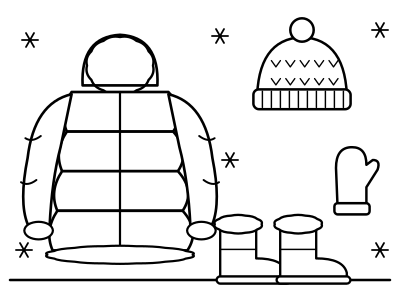
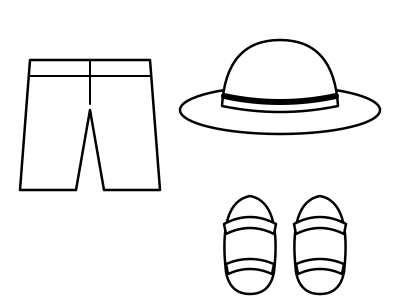
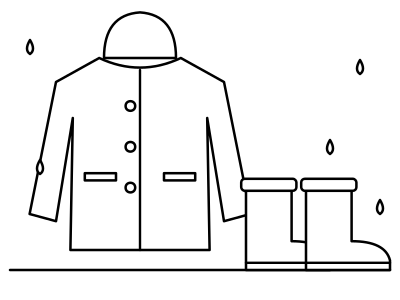
      Say: "Weather is what it is like outside today. Climate is the usual weather in a place over a long time, like 30 years." Ask: "Is a rainy day weather or climate?" (weather) Look at the 3 places. For each, ask: "What would you wear? How would your home keep you comfortable? What do people need to do here?" Snowy (Fairbanks, Alaska): winters are long and very cold. People wear warm coats, hats, gloves and boots; homes have strong heaters and thick walls; people shovel snow. Hot and dry (Phoenix, Arizona): summers are very hot and there is little rain. People wear hats, light clothes and sunscreen and carry water; homes have air conditioning and shade; farms there need water brought in from rivers or wells. Rainy (near the Olympic rain forest in Washington): the rain forest gets about 12 to 14 feet of rain a year. People wear raincoats and rain boots; roofs slope so rain runs off, and gutters carry it away. Say: "People everywhere live in modern homes, go to school and go to work. The climate changes what they wear and how they build." Your child fills in the chart with a drawing in each column. If stuck, ask: "What would happen if you wore shorts in Fairbanks in winter?"

    3. Talk & Record · 5–10 min

      Your child picks one place and draws a person dressed for it in front of their home. Sentence frame: "In ___, people wear ___ because the climate is ___."

    4. Exit Ticket · 3–5 min

      Ask the three questions aloud.

    Exit ticket

    1. What is the difference between weather and climate?
    2. What would people wear in a snowy place?
    3. How can a home help people in a very hot place?
    Answers
    1. Weather is what it is like today; climate is the usual weather over a long time.
    2. Answers vary. Look for: warm coats, hats, gloves or boots.
    3. Answers vary. Look for: air conditioning, shade, fans or thick walls that keep heat out.
    Watch for, and help or stretch
    Watch for
    Thinking people in cold or hot places live in old-fashioned ways, such as only in igloos or tents.
    Try
    Look at the photos of modern homes again. Say: "People in Alaska and Arizona live in houses and apartments, like many of us."
    Extra help
    Compare 2 places only: snowy and hot.
    Stretch
    Your child describes our own climate and one way it changes what our family wears or does.

    At home (optional): Your child checks the weather with you each morning for 3 days and picks clothes that fit it.

    Practice

    Read each direction aloud. Your child works on the page; answers are in the grown-up view.

    Warm-up

    Remember?

    Math

    1. How many tens are in 40?
    2. 9 + 2 = ? Start at the bigger number and count on.

    Reading & Writing

    1. foam, toast, blow

    Math · Week 16 Day 1

    I can count a collection to 120 and write the numeral.

    Look: counting 45 beans

    1. Make an estimate, a smart guess: about 40.
    2. Fill cups with 10 beans each: 4 cups and 5 left over.
    3. Count: 10, 20, 30, 40, 41, 42, 43, 44, 45. There are 45. The estimate was close.

    Count the cups by tens and the extras by ones. Write the number.

    1. 1.
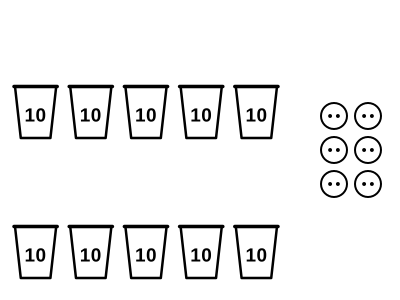
      10 cups, each labeled 10, and 6 loose buttons.
    2. 2.
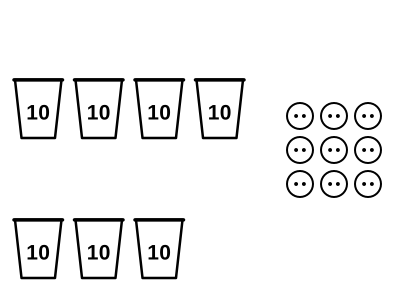
      7 cups, each labeled 10, and 9 loose buttons.
    3. 3.
      2 cups, each labeled 10, and 4 loose buttons.

    Write the number. Then write the tens and ones.

    1. 4.
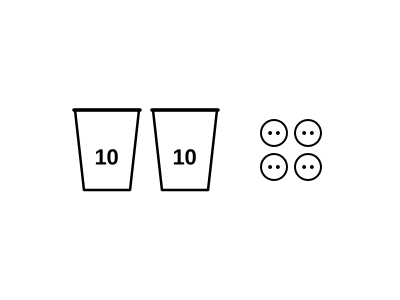
      6 cups of 10 and 3 more
    2. 5.
      9 cups of 10 and 8 more
    3. 6.
      12 cups of 10 and 0 more
    4. 7.
      Your grown-up says: one hundred fourteen. Write it.

    Challenge (optional)

    Grab a handful of beans. Write an estimate. Then count with cups of 10 and write the real number.

    You need: beans and small cups (for the challenge)

    Reading & Writing · Week 16 Day 1

    I can retell a fable and tell its lesson.

    Look: retell a fable and its lesson

    1. Read "The Fly and the Light" together. Retell it: First the fly sees the light. Next Moth says no. Then the fly gets hot and has to go back.
    2. Ask: "What is the lesson?" (Stop when a friend says it is not safe.)
    3. Say: "A fable is a short tale that teaches a lesson."

    The Fly and the Light

    A fly sat by a light at night. "I can fly up to the light," said the fly. "No! It is hot," said Moth. The fly did not stop. It got hot, and the fly had to go back.

    Write 1, 2 and 3 to retell the fable. Then circle the lesson.

    1. 1.
      The fly got hot.
    2. 2.
      A fly sat by a light at night.
    3. 3.
      Moth said, "No! It is hot."
    4. 4.
      The lesson:
      • Stop when a pal says it is not safe.
      • A light is bright.

    Read the word. Circle igh or y.

    1. 5.
      night
      • igh
      • y
    2. 6.
      sky
      • igh
      • y
    3. 7.
      fright
      • igh
      • y
    4. 8.
      dry
      • igh
      • y

    Challenge (optional)

    Did the fly stop?

    Social Studies · Week 16 Day 1

    I can tell how weather and climate change what people wear, eat and build.

    Look: weather or climate?

    1. Weather is what it is like outside today: hot, rainy or snowy.
    2. Climate is the usual weather in a place over a long time.
    3. Climate changes what people wear and how they build their homes.

    Listen. Circle what a person would wear there.

    1. 1.
      A town where it snows most of the winter.
      • A warm coat, hat and boots.
      • Shorts, a sun hat and sandals.
      • A raincoat and rain boots.
    2. 2.
      A desert town where summer is very hot and dry.
      • A warm coat, hat and boots.
      • Shorts, a sun hat and sandals.
      • A raincoat and rain boots.
    3. 3.
      A town where it rains almost every week.
      • A warm coat, hat and boots.
      • Shorts, a sun hat and sandals.
      • A raincoat and rain boots.

    Listen. Circle yes or no.

    1. 4.
      "It is snowing right now." Is that about the weather?
      • yes
      • no
    2. 5.
      "Our town is cold every winter." Is that about the climate?
      • yes
      • no
    3. 6.
      Does a steep roof help rain run off a home?
      • yes
      • no
    4. 7.
      Would thin walls and no heater help a family in a very cold place?
      • yes
      • no

    Challenge (optional)

    What is the climate like where you live? What do you wear because of it?