This week's lessons
Math and reading every day; science and social studies take turns
- Day 1 · Monday
- MathReview: counting and writing to 120I can count, read and write numbers to 120.
- Reading & WritingFables with a lessonI can retell a fable and explain its lesson.
- Social StudiesWhen big storms comeI can tell how a big storm or flood can change life in a place and how people help.
- Day 2 · Tuesday
- MathReview: tens and onesI can explain the tens and ones in any two-digit number.
- Reading & WritingCompare two fablesI can compare the characters in two fables.
- ScienceQuarter 2 review: light and living partsI can tell what I learned about light and plant and animal parts.
- Day 3 · Wednesday
- MathReview: comparing numbersI can compare two-digit numbers with >, < and =.
- Reading & WritingGrammar check-upI can use capitals, end marks, nouns and joining words correctly.
- Social StudiesPlaces change over time + Quarter 2 reviewI can tell how a place in the world has changed and review what I learned this quarter.
- Day 4 · Thursday
- MathQuarter review: numbers and factsI can show what I learned this quarter.
- Reading & WritingQuarter 2 reviewI can read vowel team words and sight words from this quarter.
- Science · Unit testUnit 3 test: parts at workI can match parts to jobs and explain a design that copies nature.
- Day 5 · Friday
- Math · Unit testUnit 3 test: count to 120, tens and ones, compareI can count to 120, explain tens and ones and compare numbers.
- Reading & Writing · Unit testUnit 3 testI can show what I know about tales, opinions and vowel teams.
- Social Studies · Unit testUnit 3 test: maps and placesI can read a simple map and tell how land and weather shape how people live.
This week's checks
Short checks on the last day each subject meets this week
Math · Unit 3 test
Open the unit testReading & Writing · Unit 3 test
Open the unit testScience · Unit 3 test
Open the unit testSocial Studies · Unit 3 test
Open the unit test
Reading About Our World: When a Big Storm Comes
Read it aloud. Your child reads the sentences marked with a star. Builds social studies knowledge.
Watching the Weather
Weather scientists watch the sky every day. When a big storm is coming, they tell people early. That gives families time to get ready.
Getting Ready
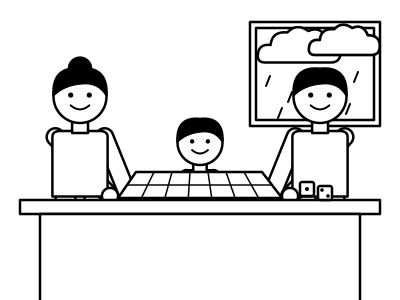
Families prepare by making a plan. They keep water, food, a flashlight and extra batteries in one spot. When the storm comes, they stay in a safe place and listen to what local leaders say. We can stay in and play.
Helpers After
After a big storm, helpers come. Workers fix power lines. Neighbors check on each other. Together, people clean up and help the place get back to normal.
Words to know
- storm: strong wind and rain
- prepare: get ready
- plan: an idea of what to do and when
Talk about it
- Who tells people a big storm is coming?
- Name two things a family can keep ready for a storm.
- Why does it help to know about a storm early?
Home Connection
Five-minute ideas for the whole family, with things you already have
Math
Tens and ones help us count, write and compare numbers to 120.
Do: Find numbers up to 120 around the house, like page numbers or a can label. Your child reads each one and tells the tens and ones.
Talk: Which number you found is the greatest? How do you know?
Reading & Writing
Fables teach lessons, and we can compare two fables.
Do: Tell two short fables and talk about each lesson. Write corn, fork, short, storm and horn for your child to read.
Talk: What lesson do both fables teach?
Science
Light helps us see, and the parts of plants and animals help them live.
Do: Play "What's my job?": one person names a part, like roots, ears or a shell, and the other tells its job.
Talk: Which part do you think is the most useful, and why?
Social Studies
Big storms can change a place, people help each other afterward, and places change over time.
Do: Talk calmly about where your family goes to stay safe in a storm. Keep it short and reassuring.
Talk: How can neighbors help each other after a storm?
This week's words: each, about, out, into, use
Celebrate the end of Unit 3: numbers to 120, two fables compared and plant and animal parts.
Math catch-up: Three Digits, Not Four
10 minutes, if this week's math check was not secure · 1.NBT.A.1
Numbers past 100 are often written the way they sound, such as 1012 for one hundred twelve. Finding them on a chart shows that these numbers have only 3 digits.
You need: a paper strip with the numbers 100 to 120 written in a row, paper and a pencil, 20 straws and 2 rubber bands
- Say "one hundred twelve." Your child finds 112 on the strip and counts its digits: 3.
- Cover the 1 at the front of 112. Ask: "What is left?" (12) Say: "One hundred, then twelve: 1 and then 12."
- Build 19 with 1 bundle and 9 loose straws. Then draw a quick picture of 90: 9 sticks and no dots. Ask: "Which is greater?" (90)
- Say 3 numbers from 100 to 120. Your child writes each and checks it on the strip.
Try again
- Write the number one hundred seventeen.
- 1 ten and 6 ones is ___
- Which is greater, 16 or 60?
Specials This Week
Weeks 13–18 unit • ~90 min/week per subject
Manipulative Skills (Throwing and Catching)
Developing underhand and overhand throwing, catching with two hands, aiming at targets.
Form and Space
Understanding 2D vs. 3D forms (cubes, spheres), exploring foreground, middle ground, background in drawings.
Tempo and Dynamics
Forte/piano (loud/soft), fortissimo/pianissimo, expressing musical ideas through tempo and dynamics.
For guiding principles and full standards reference, visit How to use this curriculum
As an Amazon Associate, we earn from qualifying purchases. Book and supply links on this page are affiliate links — using them supports this curriculum at no extra cost to you.