1First Grade

    Measure with paper clips

    Two texts, one topic

    Practice pages

    0 of 180 days complete · Saved on this device

    View all 180 days

    Math

    Measure with paper clips

    I can measure with paper clips in a line.

    Standards: 1.MD.A.2

    Number practice (no timer)
    Adding lengths: how many more clips?
    Builds on
    Week 25 (comparing lengths by lining up ends). One-minute check: "Order a spoon, a shoe and a crayon from shortest to longest." (Answers vary. Look for: lined-up ends.)

    New words

    • measure: find how long something is by counting units
    • unit: the same-size thing we lay down again and again to measure, like a paper clip
    • end to end: touching, with each one starting where the last one stops

    You need

    • 25 paper clips, all the same size
    • Objects to measure: a book, a pencil, a shoe, a crayon, a fork, a cup and a TV remote (or another small household item)
    • Notebook and pencil
    • Paper clips, beans and cubes are small parts: keep them away from children under 3.
    1. Warm-Up · 5 min

      Fluency: adding lengths. "A crayon is 4 clips long. A pencil is 2 clips longer. How long is the pencil?" (6 clips) Spaced review from Week 25: "Red is longer than blue. Blue is longer than green. Which is longest?" (Red)

    2. Mini-Lesson · 10 min

      Say: "Last week we said longer or shorter. Today we find out how long, with a number." Lay a pencil on the table. Put the first paper clip right at one end of the pencil. Lay more clips in a straight line, each one touching the last, until you reach the other end. Count the clips with your child. Say: "The pencil is ___ paper clips long." Write the sentence with the number. Ask: "Where did the first clip go?" (Right at the end of the pencil.) "Are there spaces between the clips?" (No. They touch.) Say: "If the last clip sticks out a little past the end, we say about, such as about 6 paper clips long."

    3. Guided Practice · 10 min

      Your child measures each object with paper clips, end to end in a straight line, starting at one end, and writes the sentence: "The ___ is ___ paper clips long." 1) the book 2) the shoe 3) the fork Answers vary. Look for: the first clip at the end, no spaces, a straight line, and a careful count. Check by counting again together. If stuck, say: "Put your finger on the end. Put the first clip right there. Each new clip touches the last one."

    4. Play · 10 min

      Guess and Check. Draw a table in the notebook with 3 columns: Thing, My guess, Paper clips. For each of the crayon, the cup (measure how tall it is) and the TV remote, your child guesses how many clips long it is, then measures. Fill in the table. If the guess is within 2 clips, your child gets a point. Then you guess and measure one thing your child chooses. Ask: "Did your guesses get better?" (Answers vary.)

    5. Exit Ticket · 3-5 min

      Before asking, lay exactly 5 paper clips end to end on a sheet of paper and trace a line from the start of the first clip to the end of the last. Take the clips off. Read each question aloud. Your child answers out loud, with the clips or with a quick drawing. Check each answer together right away.

    Exit ticket

    1. How many paper clips long is the line I drew? Measure it.
    2. A ribbon is 7 paper clips long. A string is 4 paper clips long. Which is longer?
    3. I laid paper clips along a fork, starting in the middle of the fork. What did I do wrong?
    Answers
    1. 5 paper clips
    2. The ribbon
    3. The first clip must go right at the end of the fork, not in the middle.
    Watch for, and help or stretch
    Watch for
    Starting the first clip partway along the object, or leaving spaces.
    Try
    Slide the clips together so they touch, and push the first clip to the very end. Count again.
    Extra help
    Measure shorter things (a crayon, a spoon) first so the count stays under 10.
    Stretch
    Measure the long side of the table with clips. (Answers vary.) Then ask: "Did you have enough clips? What could you do?" (Answers vary. Look for: get more clips, use a longer unit, or move the clips along, mark where the last one ended and keep counting.) This is optional; Grade 1 only needs many same-size copies laid end to end.

    At home (optional): Your child measures one thing at home with paper clips (or same-size crackers) and tells a family member: "It is ___ long."
    Reading & Writing

    Two texts, one topic

    I can tell how two texts about the same topic are alike and different.

    Standards: RI.1.9, RF.1.3.e, RF.1.3.g

    Phonics
    Two-syllable words with closed syllables (rabbit, napkin, picnic)
    Sight words
    name, good, man, say, great
    Reading
    Two original texts on the same topic: "The Moon" (a fact sheet) and "Moon Watch" (a child's journal)
    Writing
    Shared research: gathering facts from two sources to answer our question · Handwriting: fact cards
    Builds on
    Main topic and details (Week 25). One-minute check: your child tells two facts about the moon from "The Sun and the Moon".

    New words

    • compare: to tell how things are alike and different
    • journal: a book where someone writes about their own days
    • fact sheet: a page that lists facts about one topic

    You need

    • Printed "The Moon: A Fact Sheet" with your drawn diagram, and "Moon Watch" (in the lesson)
    • A two-column chart on paper: Fact Sheet and Moon Watch, with rows Same and Different
    • Two-syllable word cards (index cards): napkin, picnic, rabbit, basket, muffin, insect, sunset, magnet, dentist, kitten
    • Sight word cards: name, good, man, say, great (5 index cards)
    • Printed "The Night Picnic" (in the lesson)
    • Lined handwriting paper
    1. Phonics & Word Work · 15 min

      Two-syllable words with closed syllables. I do: write napkin. Underline the two vowels, a and i. Say: "When two consonants sit between the vowels, split between them: nap | kin. Each part ends with a consonant, so each vowel is short." Read nap, kin, napkin. We do: split and read picnic, rabbit, basket. You do: your child reads muffin, insect, sunset, magnet, dentist and kitten, first in parts and then whole. Read: "The rabbit hid in the basket." Dictation: say each word in parts; your child writes each part: napkin, picnic, insect. If stuck, draw a line between the two middle consonants with your finger and read each part alone.

    2. Sight Words · 5 min

      Introduce this week's words with see-say-spell-write. For each card: Say: "This word is ___. Say it with me." Your child reads it, spells it aloud while tapping each letter, writes it once while saying each letter, and reads it again. Draw a small heart over any part we must learn by heart: name (a_e, regular); good (oo says /oo/ as in book: heart over oo); man (regular); say (ay, regular); great (ea says /ā/ here, not /ē/: heart over ea). Finish by reading all five cards in mixed order twice. If stuck, cover the tricky part, read the rest together, then uncover it and say the whole word.

    3. Read-Aloud & Shared Reading · 15 min

      Say: "Two texts can be about the same topic but show it in different ways." Read both texts. The Moon: A Fact Sheet (an original text; you read it) Fact 1: The moon is a ball of rock that moves around Earth. Fact 2: The moon does not make its own light. Sunlight shines on it. Fact 3: The moon seems to change shape. It is always round like a ball, but we see only the part that is lit by the sun and turned toward us. Fact 4: It takes about a month for the moon to go through all its shapes and start again. Diagram (draw this for your child, left to right): four circles in a row. Circle 1 is all dark, labeled new moon (we can not see it). Circle 2 has a thin curve of light on one side, labeled crescent. Circle 3 is half light and half dark, labeled half moon. Circle 4 is all light, labeled full moon. Moon Watch (an original child's journal; you read it) Day 1: After sunset, I saw a thin moon low in the sky. It looked like a smile. I drew it. [Drawing: a thin crescent] Day 4: The moon was fatter. It was already up when the sun went down. [Drawing: a fatter crescent] Day 8: Half of the moon was bright! Grandpa said it is called a half moon. [Drawing: a half circle of light] Day 15: The moon was big and round. It came up just as the sun went down. Full moon! [Drawing: a full circle] Day 16: Clouds. I could not see the moon at all. My question: Why does the moon change? I am going to find out. Fill the chart together. Ask: "What fact do both texts tell?" (Answers vary. Look for: the moon looks like different shapes, such as a crescent, a half moon or a full moon.) Ask: "How are they different?" (Answers vary. Look for: the fact sheet lists facts with a labeled diagram; the journal tells what one child saw on different days, with drawings and the word I.) Ask: "Which text helps you most with our question, Why does the moon look different? Why?" (Answers vary. Look for: the fact sheet: it says sunlight lights only part of the moon that we see.) Then echo-read this week's decodable story: you read a line, your child reads it back. The Night Picnic Max and his mom had a picnic at night. Mom had a basket. In the basket was a napkin, two muffins and a jug of milk. They sat on a blanket on the grass. A rabbit hid in the grass. A cricket went chirp, chirp. "Look up!" said Mom. The sky had lots of stars. A man and his dog went past. "That is a good spot for a picnic," said the man. Max got a napkin and a pen. He made a dot for each star. "Mom, can we name a star?" said Max. "Yes," said Mom. "What name will you pick?" "Big Muffin!" said Max. Mom had a big grin. "Say, Mom," said Max. "This is a great picnic!"

    4. Writing & Handwriting · 15 min

      Plan fact cards. Say: "This week we gather facts from sources to answer our question." Your child labels two index cards Source: Fact Sheet and Source: Moon Watch (you write the source names) and draws a small moon on each. Handwriting (4 min): small, neat letters that fit on an index card. Your child copies Max had a picnic. on a card without running off the edge.

    5. Exit Ticket · 5 min

      Oral answers. Your child reads the words from a card you write.

    Exit ticket

    1. Read these words: cactus, goblin, plastic.
    2. Tell me one way the fact sheet and the journal are the same.
    3. Tell me one way they are different.
    Answers
    1. cactus, goblin, plastic
    2. Answers vary. Look for: both are about the moon, or both show its changing shapes.
    3. Answers vary. Look for: a difference in how they show information, such as a diagram with labels compared with a child's drawings by day.
    Watch for, and help or stretch
    Watch for
    Retelling both texts instead of comparing them.
    Try
    Point to the chart: "Just one thing that is the same. Now one thing that is different."
    Extra help
    Compare one thing only today: how each text shows the full moon.
    Stretch
    Your child finds the seven different two-syllable words in "The Night Picnic". (picnic, basket, napkin, muffins, blanket, rabbit, cricket)

    At home (optional): Look at the moon tonight (with an adult) and add a drawing to your own moon page with the day written next to it.

    Social Studies

    Every choice has a cost

    I can tell what I get and what I give up when I make a choice.

    Standards: D2.Eco.2.K-2

    Builds on
    Scarcity means we have to choose (Week 25). One-minute check: ask "If there is not enough for everyone, what do we have to do?" (make a choice)

    New words

    • cost: what you give up when you make a choice
    • benefit: what you get when you make a choice

    You need

    • 2 picture cards of Saturday choices: the park and the library
    • "I get / I give up" chart: a sheet of paper with 2 columns
    • Pencil and crayons
    1. Warm-Up / Wonder · 5 min

      Spaced review: ask: "What does scarce mean?" (not enough for everyone) Wonder question: "If we only have time to do one fun thing on Saturday, how do we choose?"

    2. Explore · 10–15 min

      Say: "We have time for only one trip on Saturday morning: the park or the library." Your child picks one. Fill in the chart. I get: ask "What will you get if you go there?" (Answers vary: if the park, swinging and running; if the library, new books and story time.) I give up: ask "What do you give up?" (the other place and the fun there) Say: "Every choice has a benefit, what we get, and a cost, what we give up." Then try two more choices out loud. "You can spend your time building with blocks or drawing. What do you get? What do you give up?" (Answers vary.) "You can have an apple or a banana for snack. What do you give up?" (the other fruit) Ask: "Is there a choice that costs nothing?" (No. Every choice means giving up something else.) If stuck naming the cost, ask: "If you pick this one, what don't you get to do?"

    3. Talk & Record · 5–10 min

      Your child draws the place they chose and, smaller in a corner, the one they gave up. Sentence frame: "I chose ___. I get ___. I give up ___."

    4. Exit Ticket · 3–5 min

      Ask the three questions aloud. Your child answers by talking or drawing.

    Exit ticket

    1. You can watch a show or play outside before dinner. If you watch the show, what do you give up?
    2. What is the cost of a choice?
    3. Name one benefit of choosing to read a book.
    Answers
    1. Playing outside.
    2. What you give up when you choose.
    3. Answers vary. Look for: learning, a good story or quiet time.
    Watch for, and help or stretch
    Watch for
    Saying the cost is money only.
    Try
    Say: "Sometimes the cost is money, but it can also be time or another fun thing." Ask: "What did you give up that was not money?"
    Extra help
    Do one choice only, and your child points to the picture for each column.
    Stretch
    Your child makes a choice chart for a family decision, such as what to cook for dinner.

    At home (optional): Your child tells a family member about one choice they made today, what they got and what they gave up.

    Practice

    Read each direction aloud. Your child works on the page; answers are in the grown-up view.

    Warm-up

    Remember?

    Math

    1. 40 - 20 = ? Think: 4 tens take away 2 tens.
    2. Which is greater, 35 or 53?

    Reading & Writing

    Math · Week 26 Day 1

    I can measure with paper clips in a line.

    Look: a crayon and paper clips

    1. Put the first paper clip right at one end of the crayon.
    2. Lay more clips in a straight line, each one touching the last, to the other end.
    3. Count the clips: 1, 2, 3. The crayon is 3 paper clips long.

    How many paper clips long is each thing? Write the number.

    1. 1.
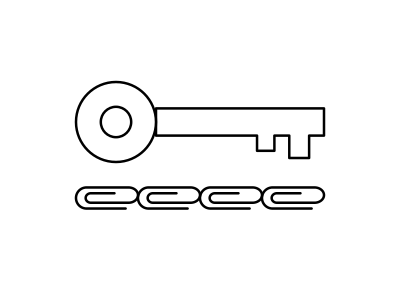
      A key with paper clips laid end to end under it, from its left end to its right end: 4 clips. The key is ____ paper clips long.
    2. 2.
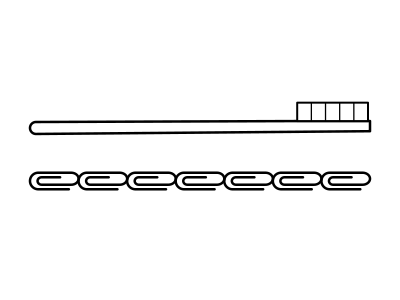
      A toothbrush with paper clips laid end to end under it, from end to end: 7 clips. The toothbrush is ____ paper clips long.
    3. 3.
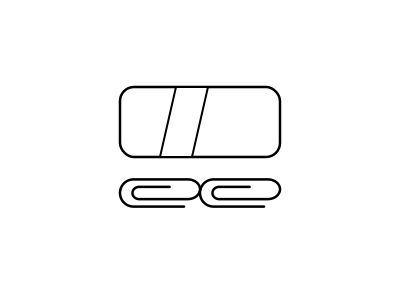
      An eraser with paper clips laid end to end under it, from end to end: 2 clips. The eraser is ____ paper clips long.
    4. 4.
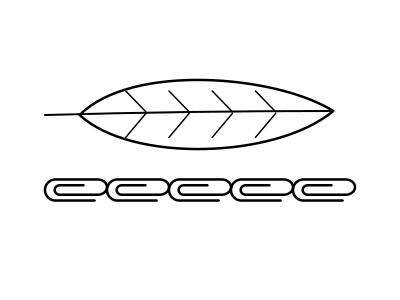
      A feather with 5 paper clips under it, starting at its left end; the fifth clip sticks out a little past the right end. The feather is about ____ paper clips long.
    Circle or draw.

    1. 5.
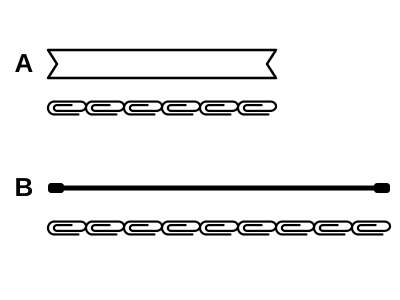
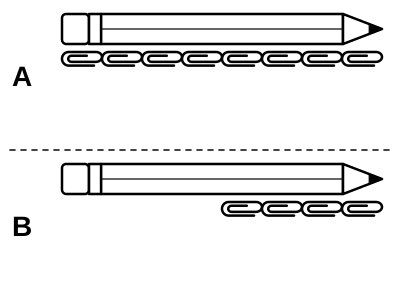
      Picture A: clips under a pencil starting right at its left end; picture B: clips under a pencil starting in the middle of it. Circle the right way to start.
      • A
      • B
    2. 6.
      A ribbon 6 paper clips long and a shoelace 9 paper clips long. Circle the longer one: A is the ribbon, B is the shoelace.
      • A
      • B
    3. 7.
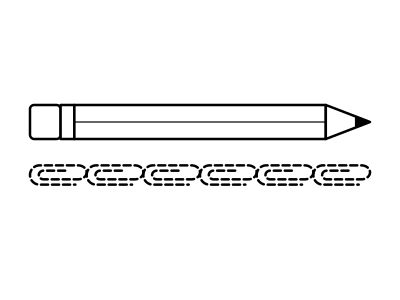
      A pencil with 6 dashed paper-clip outlines end to end under it, from its left end to its right end. Trace each paper clip. The pencil is ____ paper clips long.

    Challenge (optional)

    A ribbon is 8 paper clips long. Juan cuts off a piece 2 paper clips long. How long is the ribbon now?

    You need: Pencil, Paper clips (optional, to check), Paper clips and cubes are small parts: keep them away from children under 3.

    Reading & Writing · Week 26 Day 1

    I can tell how two texts about the same topic are alike and different.

    Look: two texts, one topic

    1. Read both texts. Ask: What are they both about? That is the topic.
    2. Ask: How are they the same? Both tell about ants.
    3. Ask: How are they not the same? One tells facts. One tells what a kid saw.

    Two Notes on Ants

    Card 1: Ants live in a nest. An ant can lift big things.

    Card 2, by Kim: I see six ants on a hill. The ants dig and dig!

    Read both cards. Circle the answer.

    1. 1.
      Card 1 and Card 2 tell about ____.
      • ants
      • bats
    2. 2.
      Which card has I in it?
      • Card 1
      • Card 2
    3. 3.
      Which card tells that ants live in a nest?
      • Card 1
      • Card 2

    Read the word in two parts. Write the parts.

    1. 4.
      tablet
    2. 5.
      hiccup
    3. 6.
      problem
    4. 7.
      velvet

    Challenge (optional)

    Card 1 tells what ants can do. Card 2 tells ____.

    Social Studies · Week 26 Day 1

    I can tell what I get and what I give up when I make a choice.

    Look: get and give up

    1. When you choose, you get something. That is the benefit.
    2. You also give up the other choice. That is the cost.
    3. I chose the beach. I get to dig in the sand. I give up the zoo.

    Listen. Circle yes or no.

    1. 1.
      You choose the beach instead of the zoo. Do you give up the zoo?
      • yes
      • no
    2. 2.
      You choose a pear for snack instead of grapes. Do you get the grapes too?
      • yes
      • no
    3. 3.
      You choose to paint instead of play a board game. Is painting your benefit?
      • yes
      • no

    Talk and draw. Write what your child says.

    1. 4.
      You can play at a friend's house or go to the pool. If you pick the friend's house, what do you give up?
    2. 5.
      What do you get if you pick the friend's house?
    3. 6.
      You can spend the afternoon reading or riding bikes. Pick one. Tell what you get and what you give up.
    4. 7.
      Draw a choice you made today and, small in the corner, what you gave up.

    Challenge (optional)

    Think of a choice a family makes on a weekend. What do they get and what do they give up?

    You need: crayons